
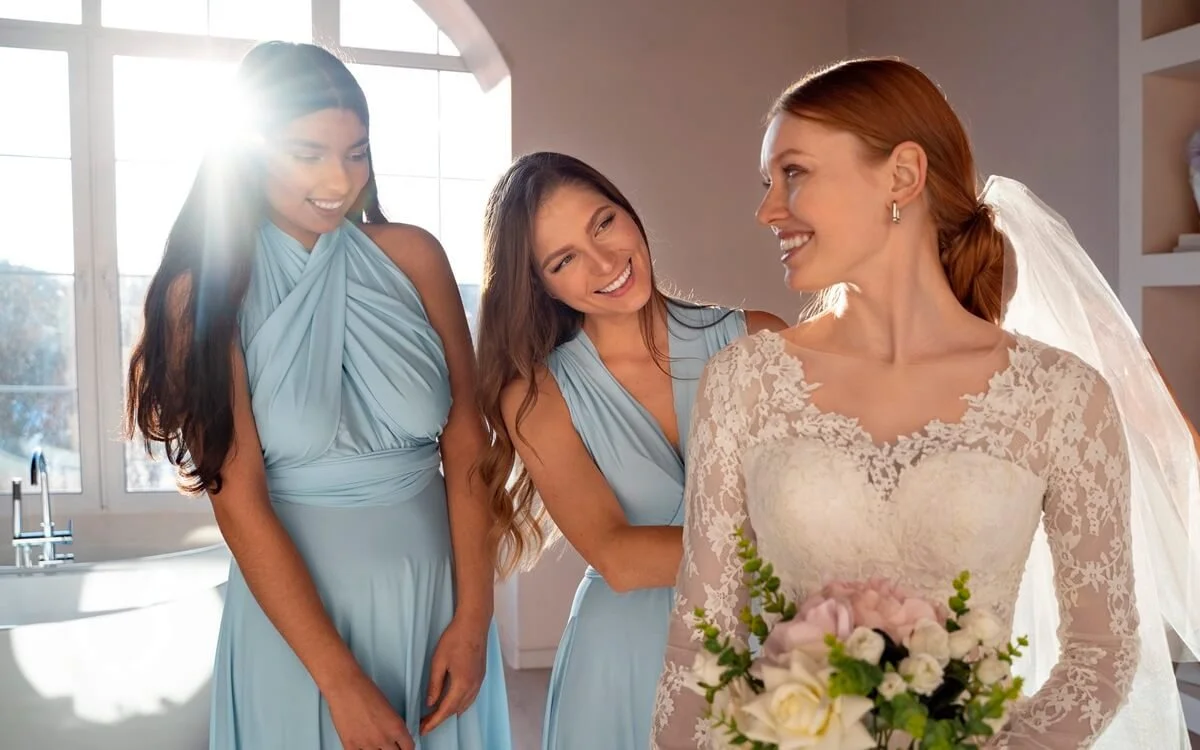
The best light and airy bridesmaid dresses use chiffon, tulle, organza, or lightweight lace in soft pastel or neutral shades that photograph beautifully in outdoor natural light. For Houston outdoor ceremonies from March through October, chiffon is the most practical and consistently flattering choice across body types. Color, length, and neckline should be chosen together rather than independently, and the final assessment of how each dress works should happen with the actual bridal party in mind, not on a single sample. At Estelle Bridal in Houston, custom bridesmaid dresses are designed from individual measurements so every bridesmaid looks as beautifully proportioned as the design intends.
If you are looking for light and airy custom bridesmaid dresses for a wedding, many beautiful styles and fabrics can give you the dreamy look you want. These dresses are not only elegant and stylish but also comfortable, which matters across a wedding day filled with joy, dancing, and celebration. A bridesmaid in a heavy, uncomfortably warm dress shows that discomfort in photographs by hour three of the reception. A bridesmaid in lightweight chiffon at an outdoor Houston garden ceremony looks polished, feels genuinely comfortable, and moves with confidence in every photograph from the processional through the final reception moment.
This guide covers the most popular light and airy bridesmaid dress styles, the key practical decisions for choosing each element, how different styles suit different Houston venues and seasons, and what custom design makes possible for bridal parties whose vision does not exist in standard ready-to-wear ranges. For the complete fabric guide by season and venue, see our wedding dress fabrics guide. For the complete bridesmaid style guide for Houston, see our bridesmaid dresses Houston guide.
Key Observations
- Choosing a light fabric is about a quarter of the job. How a dress is built decides how it actually moves, and construction is completely absent from every page we could find in this category, including our own until now.
- The same cloth rotated 45 degrees behaves like a different material. That is the bias cut, and it is the single biggest variable in how a light dress moves. Zero competitor pages mention it.
- A lining that is heavier than the outer fabric turns a light dress into a heavy one. The rule is simple: the lining should be equal to or lighter than the face fabric, and it should have a similar hand.
- Where the fullness sits is a design decision, not a fabric one. Gathered dumps it at the waist. A circle or gored cut engineers it into the hem and stays smooth over the hip.
- A hem can push out, pull down, or do neither. Horsehair braid pushes the hem away from the body, a weighted hem pulls it down and steadies it, a narrow rolled hem does neither. Three different dresses from the same skirt.
- Houston is windiest in February through May, peaking in April, and calmest in July through September. That means peak outdoor wedding season is also peak wind season, and the months people avoid for heat are the still ones.
- Nobody in the wedding industry connects wind to how a dress is built. The veil industry solved this years ago and sells veil weights. Dresses have the same physics and no equivalent.
- Airy in photographs and airy to wear are not the same goal, and on a windy day they pull against each other.
- Static in a light dress is usually two synthetic layers rubbing each other, which makes it a lining decision rather than a fabric one.
Popular Light and Airy Bridesmaid Dress Styles
Each of the following styles has specific qualities that make it suited to different venues, seasons, body types, and wedding aesthetics. Understanding what each fabric and silhouette actually does in real wedding conditions is more useful than selecting from a catalogue photograph.
Chiffon Dresses
Chiffon is a lightweight, sheer fabric perfect for creating a floaty, ethereal look that photographs beautifully in natural outdoor light. Bridesmaid dresses made from chiffon can be either long or short and come in a wide variety of colors that hold their shade well in outdoor afternoon lighting. about 15 grams per square meter in silk and about 95 in polyester, chiffon is one of the lightest formal dress fabrics available and one of the most genuinely breathable. For Houston outdoor ceremonies from March through October, it breathes in the heat, flows beautifully in outdoor breeze, and creates the soft romantic movement in ceremony photographs that heavier fabrics cannot replicate.
The practical consideration for chiffon bridesmaid dresses in Houston is wind management during the ceremony. Chiffon's lightness is its greatest quality outdoors and its primary logistical consideration: for open, breezy outdoor Houston venues, a slightly heavier chiffon or a double-layer construction behaves more predictably than the lightest single-layer styles. At Estelle Bridal, chiffon bridesmaid dresses can be custom-constructed in the weight most appropriate for the specific venue conditions. For the complete fabric comparison, see our fabrics guide.
Tulle Dresses
Tulle is another light and breathable fabric that gives off a romantic, whimsical quality. Tulle dresses can be layered and ruffled to create a full, flowing appearance that moves beautifully in the breeze and creates one of the most photographically distinctive bridesmaid looks available for outdoor garden ceremonies. Tulle provides visual volume without fabric weight, which makes it surprisingly practical for Houston summer use: a full tulle skirt circulates air rather than trapping heat against the body. In outdoor afternoon light at Houston garden venues in Katy or Sugar Land, tulle in a coordinated pastel shade creates ceremony photographs of genuine romantic beauty. The practical consideration for tulle is snagging on rough outdoor surfaces and the need for careful hemline management on grass terrain.
Lace Dresses
Lace is delicate and feminine, ideal for adding soft elegance to a bridesmaid look that reads as intentionally romantic rather than simply pretty. Lace bridesmaid dresses can be sleeveless, short-sleeved, or long-sleeved and suit every major wedding aesthetic from rustic garden to formal ballroom. For the most breathable construction in Houston summer conditions, Chantilly lace over a lightweight chiffon base creates visual richness in close-up portraits while maintaining the breathability the warm season requires. The lace provides the embellishment detail and the lightweight base fabric provides the comfort. For the complete lace type comparison including how different lace constructions perform in Houston's outdoor conditions, see our lace wedding dresses Houston guide.
Maxi Dresses
Maxi dresses are long, flowing gowns that are perfect for outdoor, beach, and destination weddings. Made from lightweight materials including chiffon and georgette, they offer comfort and elegance for a breezy wedding look that reads as both relaxed and intentional. For Houston outdoor garden ceremonies and Galveston or Gulf Coast destination weddings, a maxi bridesmaid dress in chiffon or lightweight crepe creates a cohesive, photographically beautiful bridal party look. The key practical consideration for floor-length maxi styles at outdoor Houston venues is hemline management on grass, gravel, and garden surfaces. A tea-length or midi maxi at outdoor venues reduces this management challenge significantly without sacrificing the flowing, airy visual that makes the maxi style appealing.
A-Line Dresses
A-line dresses are a classic and flattering option for bridesmaids and the most consistently recommended silhouette for mixed-body bridal parties. The A-line fits through the bodice and waist before flaring gradually to the floor, creating a balanced visual line that suits every body type including plus size and curvy figures. It never clinches uncomfortably at the midsection, never adds bulk where it is not wanted, and creates a flowing, elegant visual from bust to hem. In lightweight chiffon or georgette at an outdoor Houston garden ceremony, an A-line bridesmaid dress creates beautifully cohesive ceremony photographs that look equally elegant on every member of the bridal party. For the complete silhouette guide by body type, see our wedding dress silhouettes guide.
Organza Dresses
Organza is lightweight and structured, creating a beautifully crisp, airy appearance that suits more formal outdoor and indoor Houston venues. Unlike chiffon, which flows softly, organza holds its shape with a gentle crispness that creates clean, architectural silhouettes in outdoor photographs. An organza bridesmaid dress in a coordinated pale sage or champagne at a formal Houston outdoor evening ceremony creates a distinctly elevated bridal party visual. Organza can be used as an overlay over a chiffon base to add structure and formality while maintaining breathability, which makes it a versatile choice for Houston mixed indoor and outdoor events. For the full venue-specific bridesmaid guide, see our Houston venue dress guide.
Key Considerations for Light and Airy Bridesmaid Dresses
Each of the following decisions affects the final visual result, the comfort of the bridal party across the full wedding day, and the consistency of the look across different body types in the party.
1. Fabric
Choose lightweight and flowy fabrics like chiffon, tulle, or organza. These materials move beautifully and keep bridesmaids cool and comfortable throughout a full wedding day. For Houston outdoor ceremonies from March through October, chiffon and lightweight georgette are the most practical choices. They breathe in warm conditions, flow beautifully in outdoor air, and photograph consistently well across body types in natural afternoon light. For indoor climate-controlled Houston receptions, the fabric range opens to include lightweight crepe and organza which both photograph with greater formality under warm indoor venue lighting.
2. Color
Soft and light colors, including pastels, blush, sage, lavender, dusty blue, and warm neutrals, enhance the airy, romantic feel and photograph beautifully in natural outdoor afternoon light. Lighter colors also absorb less heat than dark shades, which has real practical benefits for bridesmaids spending extended time outdoors at Houston summer ceremonies. The color should always be chosen in coordination with the bride's gown shade and the overall wedding palette. Dusty rose and blush photograph with particular warmth in outdoor afternoon light. Sage and dusty blue create a distinctly fresh, garden-appropriate visual. Champagne and warm nude photograph beautifully under both outdoor and indoor lighting conditions.
3. Length
While floor-length gowns offer maximum elegance, shorter styles like tea-length or knee-length create a more playful and lighthearted visual that is ideal for spring or summer outdoor weddings. For outdoor Houston garden venues in Katy, Sugar Land, and west Houston, shorter lengths also have practical benefits: they reduce hemline management on grass and garden surfaces and make outdoor terrain navigation significantly easier for bridesmaids throughout the day. Tea-length is a particularly elegant compromise that photographs as intentionally fashion-forward and reads as completely appropriate at every Houston venue from casual garden to formal indoor reception.
4. Neckline
Pick a neckline that is flattering and comfortable for every member of the bridal party. V-neck and scoop necklines are excellent choices for a breezy, open look that complements a wide range of body types and draws attention upward to the face in close-up portrait photography. Off-the-shoulder necklines create a beautifully romantic visual and allow air circulation at the shoulders, which is particularly valuable for outdoor Houston summer ceremonies. Strapless necklines work well when the bodice is properly structured, but for mixed-size bridal parties, a neckline with at least minimal strap or coverage provides more consistent support across different bust sizes. For the full neckline guide by body type, see our necklines guide.
5. Details and Embellishments
Small embellishments like lace overlays or light beading add elegance without weighing the dress down or adding visual clutter. The key principle is restraint: simplicity keeps the look fresh and airy, while over-embellishment can create visual heaviness that contradicts the light and ethereal aesthetic the dress is designed to produce. For custom bridesmaid dresses at Estelle Bridal, embellishment decisions are made with the specific fabric and silhouette in mind rather than applied generically. A Chantilly lace trim on a chiffon hem creates a beautifully romantic finish. A beaded waistband on a simple A-line draws the eye to the waist with elegant precision. Both add visual interest in exactly the right places without weighing the overall look down.
Why Does a Lightweight Dress Sometimes Feel Heavy?
Because fabric is only one of the variables, and it is not usually the one that decides the answer.
Every guide to light and airy bridesmaid dresses, this one included until now, is a guide to choosing a fabric. Pick chiffon, pick georgette, avoid heavy satin. That advice is fine as far as it goes. It just does not explain why two chiffon dresses can feel and move completely differently, which is the thing brides actually notice and nobody accounts for.
The rest of the answer is construction. How many layers are under the outer fabric and what they weigh. Which direction the cloth was cut in. Where the fullness of the skirt was put. How the hem was finished. Whether the seams were enclosed. Each of those decisions changes how the finished dress moves, and none of them is visible in a fabric name.
So this section of the guide is about the build rather than the cloth. If you want the fabric science, with published weights and a swatch testing protocol, that lives in our fabric performance guide. What follows is what happens to that fabric once someone starts cutting it.
What Is Actually Between You and the Air?
A dress is rarely one layer. Here is what can be in the stack, what each layer is for, and what each one costs you in weight and movement.
| Layer | What it is for | What it costs | Worth asking |
|---|---|---|---|
| Outer or face fabric | The dress you can see | The thing you chose | What fiber, what weight |
| Lining | Covers the inside, hides seams, gives opacity. Hangs free, attached only at the waist, neck and sometimes the hem. | The biggest single variable after the fabric itself. A heavy lining under a light fabric produces a heavy dress. | "What is the lining, and is it lighter than the outer fabric?" |
| Underlining | Cut from the same pattern pieces and attached before construction, so the two behave as one layer. Adds body and reduces transparency. | Changes the hand of the fabric directly. As one long-standing sewing authority puts it, there is almost no way to prevent underlining from changing a fabric's drape and feel and adding body. That is the point of it. | "Is this underlined, and can it be lined instead?" |
| Interlining | A warmth layer, properly speaking | Almost never appropriate in a summer dress, and if you hear the word used about one, the person probably means underlining. | "Do you mean a warmth layer or a structural one?" |
| Underskirt or petticoat | Volume and opacity under a skirt | Real weight, real warmth, and a hard stop on how the skirt moves | "Does this need a petticoat to look right?" |
| Shapewear | Whatever you want it to do | Yours to decide, but it changes your measurements, so wear the same thing to every fitting | Nothing. This is entirely your call. |
The one lining rule worth memorizing
The lining should be equal to or lighter than the face fabric. A heavy satin lining under a lightweight chiffon adds bulk and works against the silhouette, and no amount of choosing the right chiffon will undo it.
There is a second half to that rule which matters just as much for movement: the lining should have a similar hand. A fluid outer fabric needs a fluid lining, something with a soft drape that does not fight the movement of the layer over it. A crisp lining under a fluid chiffon gives you a dress that looks like it should flow and does not.
And one honest note about underlining specifically. It is often the right answer for opacity, because it sits against the fabric rather than hanging separately. But it changes the hand by design. If a dress needs to be opaque and needs to float, those two things are in tension and somebody has to decide which matters more. That is a conversation worth having at the design stage rather than discovering at the first fitting.
A lining also becomes a visible design line on a sheer skirt, because you can see its hem through the outer layer. On a sheer dress the lining hem has to be parallel to the skirt hem or the whole thing reads as uneven. That is a construction detail nobody thinks about and everybody notices once it is wrong.
What Is a Bias Cut, and Why Does It Move Differently?
This is the biggest single variable in how a light dress moves, and we could not find one page in this whole category that mentions it.
Woven fabric has threads running two ways, along the length and across it. The true bias is at 45 degrees to both. Cut a dress on that diagonal and something genuinely changes. As one long-established sewing publication describes it, at 45 degrees the threads lose their inherent stability and the square spaces between them transform into diamonds.
The practical result is that the same cloth becomes stretchy, fluid and heavy-hanging where on the straight grain it was stable and crisp. A bias cut chiffon and a straight grain chiffon from the same bolt are, in how they behave, two different materials. That is why a bias cut skirt ripples and pours around the body and a straight cut one hangs.
What that costs
Bias is not free, and this is the part worth knowing before you commission one.
It has to hang before it can be hemmed. A bias garment stretches under its own weight, unevenly, and it keeps doing so until gravity has finished with it. Hem it too early and the hemline goes crooked on the hanger. How long it needs is genuinely disputed: one sewing authority says several days up to a week on a dress form, another says at least twenty four hours, and practitioners report everything from overnight to weeks. There is no agreed number. What everybody agrees on is that it has to happen, which means a bias cut dress needs more lead time than a straight cut one.
It wants a narrow hem. A deep turned hem on a bias skirt fights the drape and shows. Narrow is the standard answer.
It is harder to alter later. Bias seams stretch under the machine, so they need careful handling, and a bias garment that has been let out or taken in is more likely to show it.
None of that is a reason to avoid bias. It is a reason to raise it early, and to be suspicious of a quick turnaround on a bias cut dress.
Where the Fullness Sits: Circle, Gored and Gathered Skirts
Everyone in this category talks about silhouette as a shape. Almost nobody talks about it as movement engineering, which is what it actually is. Three skirts in identical fabric, with identical hem circumference, will move completely differently depending on how that fullness was put in.
| Construction | Where the fullness sits | How it moves | Fabric it suits |
|---|---|---|---|
| Gathered | All of it at the waist seam | Swings from the waist. Bulk sits where most people least want it, and a light fabric gathers more softly than a crisp one. | Very light, very fluid cloth. It is the cheapest construction and it shows on anything with body. |
| Gored or paneled | Built into the shape of each panel, narrow at the waist and wider at the hem | Smooth over the waist and hip, then flares. More panels give a smoother, fuller flare. A published guideline puts a gentle flare at roughly 1.5 to 2 times your hip measurement at the hem, and a dramatic one at 2.5 to 3 times. | Almost anything. The most versatile and the most flattering across a mixed party. |
| Godets | Inserted into slits in an otherwise smooth skirt | Smooth and long over the body, then opening into folds lower down. Lengthens the line before the fullness starts. | Light to medium fabrics where you want movement only at the hem. |
| Circle or half circle | Entirely in the cut of the cloth, no gathering at all | Maximum movement. A full circle falls in deep folds and moves dramatically. A half circle sits flatter at the hip and flares toward the hem. | Light, airy fabrics that need volume to show. Uses the most fabric of any construction, so it is also the most expensive. |
The practical distinction is the one that never gets said: gathered puts the fullness at the waist, and everything else engineers it into the hem. If a party has mixed body types and you want one construction that works across all of them, gored is usually the answer, and it is almost never what gets specified because it costs more to cut.
The Hem Is a Movement Decision, Not a Finishing Detail
Three hems, one skirt, three completely different dresses. This is possibly the most useful table on this page and we have not seen the comparison made anywhere in bridal writing.
| Hem treatment | What it does | Effect on movement | Right for |
|---|---|---|---|
| Narrow or baby hem | Folds the edge over twice, very small, and encloses the raw edge. On chiffon the allowance is tiny. | Neither pushes out nor pulls down. It adds a small amount of weight through the rows of stitching, which is enough to stop the edge fluttering randomly. | Bias cuts, fluid chiffons, anything where you want the fabric's own drape and nothing else. |
| Horsehair braid | A nylon or polyester tape sewn into the hem. It was made of horsehair once and has not been for a long time. | Pushes the hem out, away from the body. Width decides how much: narrow acts as a stabilizer, wide creates real flare. It is what gives a soft fabric shape at the bottom of a dress. | Soft fabric where you want a bell shape rather than a fall. It is also why the same chiffon can read floaty on one dress and structured on another. |
| Weighted hem | A fine chain or weights sewn into the hem allowance, a technique borrowed from tailoring and famously from one couture house's jackets. | Pulls the hem down and steadies it. It is a counterbalance, it helps the garment hang close, and on fabrics prone to it, it helps wrinkles hang out. | Anything that needs to stay put. Chain comes in different sizes and the weight has to suit the fabric, because a chain that is too heavy will stretch a light garment out of shape. |
Hold those three next to each other. One pushes out, one pulls down, one does neither. That is the whole answer to why a dress you loved on the hanger does not move the way you expected, and it is a specification you can ask for by name.
One caution from the couture side worth carrying: on a skirt built for movement, hem finishes tend to be kept deliberately lightweight so the finish does not hamper the drape of the fabric. A heavy hem on a floating skirt defeats the floating.
Why Seams Show Through a Sheer Dress
Because on translucent cloth, every seam finish is visible from the outside. A serged or pinked edge reads as a shadow through the fabric, and loosely woven light fabrics fray readily, so leaving the edge raw is not an option either.
The answer used on good sheer garments is a French seam, which folds the raw edges completely out of sight inside the seam itself. It is sewn twice, wrong sides first, trimmed, then folded and sewn again to enclose everything. On chiffon the allowances involved are tiny, around a quarter inch then three eighths.
Two things follow that are worth knowing as a buyer. French seams work best on straight or gently curved seams, because the enclosed fold does not like turning tight corners, so an armhole usually gets a bias bound or narrow rolled finish instead. And a French seam takes noticeably longer to sew than a plain one, which is part of why a well finished sheer dress costs what it costs.
Closures
A zip on a sheer or very light fabric is its own problem, because the zipper tape is heavier and stiffer than the cloth it is going into and it will show through and pull if it is not handled. Lightweight and mesh tape invisible zips exist specifically for this. Our own practice is to stabilize the zip area on lightweight fabric so the tape does not distort the seam, and to keep the zip as light as the fabric allows. We are describing our workroom here rather than citing a standard, because we could not find a good published source on closures for sheer fabric, which is itself telling.
What you can do as a buyer is simple: look at the back of a sample in daylight. If you can see the zipper tape through the fabric, or if the seam ripples along the zip, that is what the finished dress will do.
Wind, and the Month Nobody Plans For
Here is something we have not seen anywhere in wedding writing, and it changes what you should specify.
The National Centers for Environmental Information publish average wind speed by month for Houston Intercontinental, covering 1984 to 2023. Read the pattern rather than the absolute numbers, because the pattern is the finding.
| Month | Average wind speed (published value) | Where it sits |
|---|---|---|
| January | 3.5 | Above average |
| February | 3.8 | Windy |
| March | 3.9 | Windy |
| April | 4.0 | Windiest month of the year |
| May | 3.7 | Windy |
| June | 3.2 | Settling |
| July | 2.8 | Calm |
| August | 2.7 | Calmest month of the year |
| September | 2.8 | Calm |
| October | 3.1 | Building |
| November | 3.3 | Above average |
| December | 3.4 | Above average |
April is about 48 percent windier than August. And look at which months those are. February through May, the windiest stretch of the Houston year, is exactly when brides choose an outdoor ceremony to avoid the heat. July through September, the calmest stretch, is what everybody avoids for exactly that heat. The two considerations point in opposite directions and nobody tells you.
Three honest caveats, because we would rather be useful than impressive. These are measurements at an airport weather station, which is an exposed site at standard instrument height, so they are not the wind in a walled garden in Sugar Land. The published file does not state its units, so we are giving you the values as published and the relationship between them, which is the part that matters. And these are averages across forty years, not a forecast for your date.
What wind actually does to a light dress
The wedding industry has thought about this carefully for veils and not at all for dresses, which is strange, because the physics is identical. Veil weights are a product you can buy. There is no equivalent for a skirt, and there should be.
What we see happen: a very full skirt in a very light fabric is the combination that lifts. A single layer sheer skirt becomes transparent in a way it never was indoors, because wind presses it against the light. A strapless bodice that was borderline at the fitting is worse in wind, because you are moving more. And a floor length hem on grass picks up everything the wind is carrying.
What to specify for a windy month
| Specify | Why |
|---|---|
| A weighted or heavier hem | The only construction feature that directly resists lift. Ask for it by name and make sure the weight suits the fabric. |
| A slightly heavier chiffon, or a double layer | Behaves far more predictably outdoors than a single layer of the lightest cloth available, and solves the sun-through-it problem at the same time. |
| Gored rather than full circle | A gored skirt has the fullness built into the hem but less total sweep than a circle, so there is less sail area. |
| Straps rather than strapless | Not a coverage question. A movement one. |
| A lining that reaches the hem | Two layers moving together lift less than one layer moving alone, and it solves backlit transparency. |
| Hair that is actually pinned | Not a dress decision, but it is the thing brides most regret in outdoor photographs, and it belongs on the same checklist. |
If the ceremony is in August, you can relax most of that. If it is in April, plan for it.
Airy in Photographs and Airy to Wear Are Not the Same Goal
This one is our own observation rather than a sourced fact, and we want to label it as such.
The dress that photographs as most weightless is usually a full sweep of the very lightest fabric, single layer, minimal hem, because that is what catches air and moves in a picture. The dress that is most pleasant to actually wear outdoors for eight hours is usually a slightly heavier cloth, often with a lining, a hem with some weight in it, and less total sweep, because that is what stays where you put it.
Both are valid. They are just different briefs, and on a windy day they pull hard against each other. What we would ask a bride is which of the two she would rather have on the day, because a party specified for photographs and a party specified for comfort do not look the same on a lawn in April.
The compromise that usually works: build for wearing, then get the movement from the skirt cut rather than from the fabric weight. A gored skirt in a slightly heavier chiffon moves beautifully on camera and behaves itself in wind, which is more than a single layer of the lightest thing available will do.
Static Is Usually a Lining Problem
When a light dress clings, the instinct is to blame the outer fabric. Usually the real cause is two synthetic layers rubbing against each other, most often a polyester or acetate lining against a synthetic outer.
The mechanism is charge transfer between surfaces in contact, and humidity is what suppresses it: more moisture in the air means more moisture on the surfaces, which lets charge escape instead of building up. Worth being honest that the fine detail of how this works is not settled science, and that the popular tables ranking fabrics by static behavior are known to be unreliable.
What is actionable is the construction answer rather than the fabric one. Choosing a lining in a natural fiber, or an antistatic lining, solves it at the source. Changing the outer fabric usually does not, because the lining is half of the pair. And the practical Houston observation is that this is a dry air problem, so it is likelier to show up in an air conditioned reception room than outdoors in humid summer air.
The Construction Spec Sheet
Everything above, as things you can actually say to whoever is making or selling the dresses. Most of these get a straight answer. The ones that do not are informative in themselves.
| Ask | What you learn |
|---|---|
| What is the lining, and is it lighter than the outer fabric? | The single biggest predictor of whether a light dress feels light. The rule is equal or lighter, with a similar hand. |
| Is the skirt lined to the hem, or only to the knee? | Changes both the weight and how sheer it is when backlit outdoors. |
| Is it lined or underlined? | Underlining changes the hand of the fabric by design. If you want it to float, that matters. |
| Is any of it cut on the bias? | Bias moves completely differently and needs more lead time. Also worth knowing before a rush order. |
| How is the fullness in the skirt made? | Gathered, gored, godets or circle. This decides how it moves more than the fabric does. |
| What is the hem finish? | Narrow, horsehair or weighted. One pushes out, one pulls down, one does neither. |
| Are the seams French seamed or serged? | On sheer fabric a serged edge reads as a shadow from the outside. |
| Can I see the back of the sample in daylight? | Tells you whether the zipper tape shows through and whether the seam ripples. |
| Will it be windy where we are getting married, and what should change if it is? | If nobody has an answer, that is your answer. |
| Does this need a petticoat to look the way it looks on the hanger? | A petticoat adds real weight and warmth and stops the skirt moving. Better to know now. |
Light and Airy Decision Table
| What you want | Specify this | And accept this |
|---|---|---|
| Maximum movement on camera | Circle or gored skirt, light fabric, narrow hem, bias where it suits | More fabric and more cost, and it will misbehave in wind |
| Comfortable for eight hours outdoors | Slightly heavier cloth, gored skirt, lining to the hem, a hem with some weight | Less dramatic movement in photographs |
| Outdoor ceremony, February to May | Weighted hem, gored rather than circle, straps, lining to the hem | This is the windiest stretch of the Houston year, so plan for it rather than hoping |
| Outdoor ceremony, July to September | You can relax the wind specification and spend the attention on heat instead | These are the calmest months and the hottest ones |
| Beach or anywhere with a sea breeze | Weighted hem, shorter length, no petticoat, nothing that needs steaming on site | Sand and salt air are hard on delicate finishes |
| Worried about sheerness in sunlight | Lining to the hem, or a double layer of the outer fabric | Both add weight. A nude underlayer is the alternative but it has to match every skin tone in the party, which is harder than it sounds. |
| A structured bodice and a floating skirt | Two different treatments: underline the bodice, line the skirt | This is straightforward in custom work and rare off the rail |
| Mixed body types in the party | Gored skirt. Fullness in the hem, smooth over the hip, works across the widest range. | It costs more to cut than a gathered skirt, which is why it is rarely the default |
| A short lead time | Avoid bias, avoid heavy hand finishing | Bias needs days of hanging before it can be hemmed, and French seams take longer than plain ones |
| The dress not to cling | A natural fiber or antistatic lining | Changing the outer fabric alone usually will not fix it, because the lining is half the pair |
Light and Airy Bridesmaid Dresses by Houston Venue Type
The right light and airy bridesmaid dress style depends significantly on the specific venue type. Houston's range of wedding settings creates different requirements for fabric weight, silhouette, and length. For the complete venue guide, see our Houston venue dress guide.
Outdoor Garden Ceremonies: March Through October
For outdoor Houston garden ceremonies from March through October, chiffon in an A-line or flowing silhouette is the most practical and most photogenic bridesmaid choice. The fabric breathes genuinely in Houston's warm conditions, flows beautifully in outdoor air, and catches natural afternoon light with a soft romantic quality that creates distinctly beautiful bridal party photographs. Pastel colors, soft sage, dusty blue, and champagne all photograph with particular warmth in outdoor natural afternoon light. Floor-length styles require careful hem management on garden surfaces; tea-length or midi styles provide a more practical alternative without sacrificing the airy visual.
Indoor Ballroom and Formal Venues
For indoor climate-controlled Houston ballrooms and formal venue receptions, the fabric range opens to include organza, lightweight crepe, and structured lace in addition to chiffon. Under warm amber chandelier lighting at formal Houston venues, organza in pale jewel tones and lightweight crepe in coordinated pastels photograph with a visual richness and depth that outdoor chiffon does not replicate in the same way. The silhouette conversation for formal indoor venues also opens to A-line ball gown styles and structured floor-length silhouettes that would be impractical for outdoor warm-weather ceremonies.
Beach and Destination Weddings
For Houston area beach and Gulf Coast destination weddings, flowing chiffon maxi dresses in soft white, ivory, blush, or champagne create some of the most photographically beautiful bridesmaid looks available. The fabric moves naturally in coastal breeze and photographs with romantic softness in outdoor coastal light. Lengths should be practical for beach terrain: floor-length on sand requires significant management, while tea-length or midi lengths allow movement and create equally beautiful photographs. Strappy sandal heel heights and block wedges are significantly more practical on beach and lawn surfaces than stiletto heels.
Light and Airy Bridesmaid Dresses by Body Type
The most beautifully cohesive bridesmaid look in a mixed-body bridal party comes from selecting a fabric and silhouette that photograph well across all body types simultaneously rather than a specific dress that suits one figure best. The following guidance covers which light and airy styles work most consistently across different body types.
For All Body Types: Chiffon A-Line
A chiffon A-line is the most universally flattering light and airy bridesmaid dress choice for mixed-body bridal parties. The A-line fits through the bodice and waist before flaring gradually, creating a balanced visual line that suits every body type from petite to plus size. Chiffon flows away from the body in this silhouette rather than clinging against it, which creates a beautifully romantic visual that complements rather than reveals the body's specific contours. For Houston brides with bridal parties of varied sizes, a custom chiffon A-line in a coordinated pastel is the most reliably successful bridesmaid choice available.
For Plus Size Bridesmaids: Flowing Fabrics in Flattering Cuts
For plus size bridesmaids, fabrics that flow away from the body are the most consistently flattering. Chiffon and georgette in A-line or empire waist silhouettes flow softly away from the figure, creating a beautiful visual line that does not reveal specific contours. V-necklines and off-the-shoulder necklines draw attention upward to the face and create a beautifully proportioned upper body portrait. Custom construction from individual measurements at Estelle Bridal allows the silhouette to be optimized for each bridesmaid's specific proportions rather than adapted from a standard size chart.
For Petite Bridesmaids: Lightweight and Proportionate
For petite bridesmaids, lightweight fabrics in simpler constructions produce the most proportionally balanced result. Heavy fabrics and significant volume can overwhelm a petite frame visually, making the fabric appear to wear the bridesmaid rather than the other way around. Lightweight chiffon and georgette in knee-length or tea-length A-line silhouettes create proportionally balanced results that photograph beautifully on petite frames. Avoiding excess embellishment and maintaining clean, simple lines keeps the visual focus on the bridesmaid rather than the dress's construction.
Creating a Cohesive Bridal Party Look with Light Dresses
When choosing light and airy bridesmaid dresses, three principles consistently produce the most cohesive and photographically beautiful bridal party results: coordinate with the wedding gown style rather than matching it, match the dress choice to the season and venue conditions, and ensure every bridesmaid feels comfortable and confident throughout the full day.
The final color choice should always reflect the bride's wedding palette and the specific lighting conditions of the venue. Soft pastels photograph with particular warmth in natural outdoor afternoon light at Houston's outdoor garden venues. More saturated shades photograph better under warm indoor chandelier lighting at formal Houston ballrooms. Aim for harmony in fabrics, colors, and overall style across the bridal party rather than identical dresses, which frequently photograph as overly uniform and lose the natural variation that makes bridal party photographs genuinely beautiful.
For custom bridesmaid dress design including mixed silhouettes within a coordinated color, see our custom wedding dresses Houston guide. Browse the full collection at estellebridal.com/wedding-gowns or book your appointment.
Why Choose Estelle Bridal for Custom Bridesmaid Dresses in Houston
Custom bridesmaid design from individual measurements. For bridal parties with mixed body types, custom construction from each bridesmaid's measurements eliminates the standard size chart approximation that creates inconsistent fit across the party. Every bridesmaid looks proportionally perfect in her specific dress rather than wearing an adaptation of a single standard cut.
Houston venue and climate expertise in every recommendation. Chiffon for a May outdoor Sugar Land ceremony is a different conversation from organza for an August indoor ballroom reception. Every fabric and silhouette recommendation at Estelle Bridal reflects the specific conditions of the wedding rather than generic guidance. See our Houston venue dress guide.
Alterations included in every custom gown price. The complete fitting process from first appointment through final delivery is covered for every bridesmaid gown with no separate alteration bill. See our alterations guide for the full fitting timeline.
Black-owned, woman-owned Houston boutique since 2016. Founded by Flo A. Featured in Black Brides magazine. 4.8 stars, 300+ Google reviews. Private appointments. 2428 S Hwy 6, Houston TX 77077. (281) 208-7805. Tue/Thu/Fri/Sat 10am-5pm, Wed/Sun 1pm-7pm. Browse the wedding gowns collection or book your appointment.
Book Your Bridesmaid Dress Appointment at Estelle Bridal Houston
Custom light and airy bridesmaid dresses from individual measurements. Every style and fabric available. Alterations included with custom gowns. Private appointments. Houston's Black-owned boutique since 2016.
Book an AppointmentConclusion
Light and airy custom bridesmaid dresses are the perfect way to bring elegance, comfort, and a touch of magic to your wedding day. By choosing the right fabrics, colors, lengths, necklines, and subtle details for your specific Houston venue and season, you can create a cohesive and stylish bridal party look that complements your wedding beautifully. Let your bridesmaids feel confident and comfortable as they celebrate with you, dancing, smiling, and enjoying every moment in dresses that move with the breeze and glow in the sunlight.
At Estelle Bridal, the bridesmaid consultation is built around the bride's specific venue, wedding date, and bridal party's range of body types rather than generic style guidance. The result is a coordinated light and airy look that is genuinely beautiful on every member of the party and practically appropriate for the specific conditions of the celebration.
Whether you are planning an intimate outdoor garden ceremony in Sugar Land, a formal indoor ballroom reception in downtown Houston, or a relaxed destination wedding on the Gulf Coast, the right light and airy bridesmaid dress is one that serves both the aesthetic vision and the practical conditions of the specific day. Starting with the venue, the season, and the bridal party's body types, then working toward fabric and silhouette, consistently produces better results than starting with a style and hoping it works for the conditions. At Estelle Bridal, that sequenced conversation happens at every bridesmaid consultation, with the actual venue conditions and the specific bridal party guiding every recommendation from the first conversation through the final fitting.
Frequently Asked Questions
What fabrics are best for light and airy bridesmaid dresses?
Chiffon, tulle, and organza are the top choices for lightweight, breathable, and flowing bridesmaid dresses. For Houston outdoor ceremonies from March through October, chiffon is the most practical: it breathes in the heat, flows beautifully outdoors, and photographs consistently well across body types. Lightweight georgette is an excellent alternative when more wrinkle resistance is needed. For indoor formal Houston receptions, organza and lightweight crepe create more formal photographic results under warm venue lighting. See our fabrics guide.
Can short bridesmaid dresses work for a formal Houston wedding?
Yes. Tea-length and knee-length dresses can be both chic and appropriately formal when styled with the right accessories, fabric, and color. Tea-length chiffon in a coordinated pastel with elegant accessories reads as completely appropriate at semi-formal and formal Houston venues. The formality is established more by fabric quality, color, and accessory choices than by length alone. For outdoor Houston garden venues, shorter lengths are also more practical on garden terrain than floor-length styles.
How do I keep bridesmaid dresses light while still adding details?
Choose minimal embellishments like Chantilly lace trim, soft beading at the waistline, or a delicate lace overlay. Avoid heavy embroidery, thick materials, or multiple embellishment types combined. The key principle is restraint: one well-chosen detail in exactly the right location adds elegance without visual heaviness. At Estelle Bridal, embellishment decisions are made with the specific fabric and silhouette in mind rather than applied generically.
What colors work best for light and airy bridesmaid dresses?
Pastel shades, blush, dusty rose, soft sage, dusty blue, lavender, and warm neutrals including champagne all photograph beautifully in natural outdoor light and suit the airy aesthetic. Lighter colors also absorb less heat than dark shades, which has real practical benefits for bridesmaids at outdoor Houston summer ceremonies. The final color should always coordinate with the bride's gown shade and the specific lighting conditions of the venue.
What neckline is best for light and airy bridesmaid dresses?
V-neck, scoop, and off-the-shoulder necklines are consistently excellent choices for airy bridesmaid dresses. All three draw attention upward to the face in close-up portraits, suit a wide range of body types, and create a breezy, open visual appropriate for spring and summer outdoor ceremonies. Off-the-shoulder specifically allows air circulation at the shoulders, which is a genuine practical benefit for outdoor Houston summer events. For mixed-body bridal parties, a neckline with at least minimal strap provides more consistent support across different bust sizes than strapless. See our necklines guide.
Can bridesmaids wear different silhouettes in the same fabric and color?
Yes. Mixed silhouettes within a coordinated fabric and color is one of the most popular bridesmaid approaches in Houston's current bridal market. Each bridesmaid wears the silhouette that suits her body type best while the coordinated fabric and color create visual cohesion in bridal party photographs. At Estelle Bridal, custom bridesmaid design allows mixed silhouettes to be built from each bridesmaid's individual measurements in the same fabric and color so the full party photographs as a beautifully coordinated group. See our bridesmaid dresses Houston guide.
Where can I get custom light and airy bridesmaid dresses in Houston?
Estelle Bridal at 2428 S Hwy 6, Houston TX 77077 offers custom light and airy bridesmaid dress design from individual measurements in chiffon, tulle, lace, organza, and all major lightweight fabrics. Every silhouette is available in every size. Alterations included in every custom gown price. Open Tue/Thu/Fri/Sat 10am-5pm, Wed/Sun 1pm-7pm. Browse at estellebridal.com/wedding-gowns, book at estellebridal.com/book, or call (281) 208-7805.
Why does my lightweight bridesmaid dress feel heavy?
Almost always the lining. A dress is rarely one layer, and a lining heavier than the outer fabric turns a light dress into a heavy one regardless of what the outer fabric is. The rule is that the lining should be equal to or lighter than the face fabric and should have a similar hand, so a fluid outer layer gets a fluid lining rather than a crisp one fighting it.
What makes a bridesmaid dress flowy?
Four construction decisions, not just the fabric. Whether it is cut on the bias, how the fullness in the skirt was created, what the hem finish is, and what is underneath it. Two chiffon dresses built differently move completely differently, which is why choosing the right fabric only gets you part of the way.
What is a bias cut dress and why does it move differently?
Bias means cut at 45 degrees to the threads. At that angle the threads lose their inherent stability and the square spaces between them become diamonds, so the same cloth becomes stretchy, fluid and heavy hanging where on the straight grain it was stable. A bias chiffon and a straight grain chiffon from the same bolt behave like two different materials.
How long does a bias cut dress need to hang before hemming?
Sources genuinely disagree. One sewing authority says several days up to a week on a dress form, another says at least twenty four hours, and practitioners report anything from overnight to weeks. There is no agreed figure. What everyone agrees on is that it has to happen, because a bias garment stretches unevenly under its own weight and hemming it too early gives you a crooked hemline. Practically, it means a bias dress needs more lead time.
Does lining make a dress heavier?
Yes, and it is usually the largest single addition after the fabric itself. There is also a difference between lining and underlining. A lining hangs free and is attached only at the waist, neck and sometimes the hem. An underlining is cut from the same pattern pieces and attached before construction so the two behave as one layer, which changes the hand of the fabric by design. If you want a dress to float, that distinction matters.
What is the difference between lining and underlining?
Lining hangs separately inside the garment and covers the seams. Underlining is basted to the fashion fabric and handled as one layer with it, adding body and reducing transparency. A long-standing sewing authority notes there is almost no way to prevent underlining from changing a fabric’s drape and feel and adding body. The closer the hand of the two fabrics, the less it changes.
Which skirt shape moves the most?
A full circle skirt, because all the fullness is in the cut rather than gathered at a seam, so it falls in deep folds and moves dramatically. It also uses the most fabric of any construction. A gored or paneled skirt is the versatile middle: fullness engineered into the hem, smooth over the waist and hip, and one published guideline puts a gentle flare at roughly 1.5 to 2 times your hip measurement at the hem and a dramatic one at 2.5 to 3 times.
What does horsehair braid do to a hem?
It pushes the hem out, away from the body. It is a nylon or polyester tape sewn into the hemline, and the wider it is the more flare it creates, from a narrow version that mostly stabilizes to a wide one that gives real shape. It is what lets a soft fabric hold a bell shape at the bottom of a dress rather than simply falling.
What is a weighted hem?
A fine chain or small weights sewn into the hem allowance, borrowed from tailoring. It pulls the hem down and steadies it, acting as a counterbalance so the garment hangs close, and on fabrics prone to creasing it helps wrinkles hang out. The important caution is that the weight has to suit the fabric, because a chain too heavy for a light cloth will stretch the garment out of shape.
What is the best hem for a chiffon dress?
A narrow or baby hem in most cases, which folds the edge over twice very small and encloses the raw edge. It adds a small amount of weight through the rows of stitching, which is enough to stop the edge fluttering randomly without changing how the fabric falls. Horsehair or weight go in only when you specifically want the hem pushed out or pulled down.
Why do seams show through a sheer dress?
Because translucent cloth shows everything behind it, and a serged or pinked edge reads as a shadow from the outside. The answer is a French seam, which folds the raw edges completely out of sight inside the seam itself by sewing it twice. It works best on straight or gently curved seams, so an armhole usually gets a bias bound or narrow rolled finish instead.
What month is windiest in Houston?
April. Published long-run averages for Houston Intercontinental put April highest at 4.0 and August lowest at 2.7, which makes April roughly 48 percent windier. The pattern is the useful part: February through May is the windy stretch and July through September is the calm one. These are airport measurements over four decades, not a forecast for your date.
How do you stop a dress blowing up in the wind?
Construction, mostly. A weighted or heavier hem is the only feature that directly resists lift. A slightly heavier fabric or a double layer behaves far more predictably than a single layer of the lightest cloth. A gored skirt has less total sweep than a full circle, so less sail area. Straps rather than strapless. And a lining to the hem, because two layers moving together lift less than one layer alone.
Will a light bridesmaid dress be see-through outdoors?
It can be, and outdoors is where it shows, because sunlight behind a single layer of sheer fabric is a completely different test from shop lighting. The construction answers are lining to the hem, or a double layer of the outer fabric. Both add weight, which is the trade-off. A nude underlayer is the other option but it has to match every skin tone in the party, which is harder than it sounds.
Why does my dress cling with static?
Usually because two synthetic layers are rubbing each other, most often a polyester or acetate lining against a synthetic outer fabric. That makes it a lining decision rather than a fabric one, and choosing a natural fiber or antistatic lining solves it at the source. Humidity suppresses static, so it tends to show up in an air conditioned reception room rather than outdoors in Houston summer air.
Is a lighter fabric always better for an outdoor wedding?
No, and this is the trade-off nobody names. The dress that photographs as most weightless is usually a full sweep of the very lightest cloth in a single layer. The dress that is most pleasant to wear outdoors all day is usually slightly heavier, lined, with some weight in the hem and less total sweep. Both are valid, they are just different briefs, and on a windy day they pull against each other.
What should I ask about how a bridesmaid dress is made?
What the lining is and whether it is lighter than the outer fabric. Whether the skirt is lined to the hem. Whether it is lined or underlined. Whether anything is cut on the bias. How the fullness in the skirt is made. What the hem finish is. Whether the seams are French seamed or serged. And ask to see the back of a sample in daylight, because that shows you whether the zipper tape reads through.
Related Guides
| Guide | What it covers |
|---|---|
| Fabric performance, measured | Published weights, air permeability, the lining argument and a four-test swatch protocol. |
| Bridesmaids in summer heat | Houston climate data, sweat and skin comfort, terrain and the group problem. |
| Mismatched bridesmaid dresses | Letting dresses vary without losing the group. |
| How to get a custom bridesmaid dress | Measuring a whole party, timelines and how the money moves. |
| Customizing bridesmaid dresses | What can and cannot be changed on a bridesmaid gown. |
| Long bridesmaid dresses | Length as a formality and terrain decision. |
| Spring bridesmaid trends | Gulf Coast spring weather, palettes and layering. |
| Looking good in a bridesmaid dress | Fit and confidence for the individual bridesmaid. |
| Wedding dress fabrics | The same construction questions applied to the bridal gown. |
| Alterations guide | What can genuinely be changed on a finished dress, and what cannot. |
About the Author
Flo A. is the founder and lead designer of Estelle Bridal in Houston, TX. Since 2016, she has guided Houston brides and bridal parties through fabric selection, silhouette choice, and custom design for every season, venue, and body type, with particular expertise in light and airy bridesmaid dress construction for Houston's warm outdoor wedding conditions. Estelle Bridal is featured in Black Brides magazine and holds a 4.8-star rating across 300+ Google reviews.
Related guides: Bridesmaid Dresses Houston TX · Wedding Dress Fabrics Guide · Lace Wedding Dresses Houston · Wedding Dress Silhouettes Guide · Wedding Dress Necklines Guide · Houston Venue Dress Guide · Custom Gown Design Houston · Wedding Dress Alterations Guide · Browse Wedding Gowns