
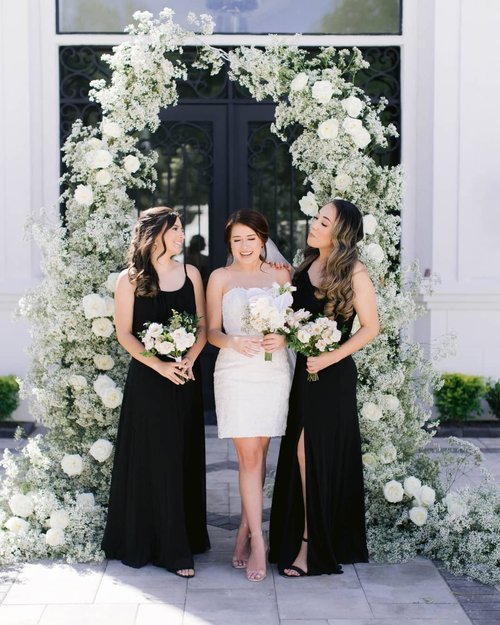
There is no definitive answer to this question as fashion is constantly evolving, and what is considered "in style" can vary depending on cultural, regional, and personal preferences. However, long bridesmaid dresses have been a popular choice for many brides in recent years and continue to be a classic and timeless option. Ultimately, the most important thing is to choose a dress that you and your bridesmaids feel comfortable and confident in.
Where should a long bridesmaid dress fall?
A long bridesmaid dress typically falls to the floor and covers the feet. The exact length of the dress can vary depending on factors such as the height of the bridesmaid, the style of the dress, and personal preference. It's common for the hem of the dress to graze the floor, creating a slight train, or to have a small break where the front hem is slightly shorter than the back. It's important to note that the length of the dress should also take into consideration the type of shoes the bridesmaids will be wearing and ensure that the dress is an appropriate length for the occasion and venue.
How do I measure for a bridesmaid dress?
Measuring for a Luxury Bridesmaid Dress typically involves taking four key measurements: bust, waist, hips, and height. Here's a step-by-step guide:
Bust: Measure around the fullest part of the bust, keeping the tape level and parallel to the floor.
Waist: Measure around the natural waistline, which is the narrowest part of the torso.
Hips: Measure around the fullest part of the hips, typically 7-9 inches below the waistline.
Height: Measure from the top of the head to the floor, without shoes. If you plan to wear heels, be sure to measure with the shoes on.
It's important to have accurate measurements to ensure the best fit possible. If you're unsure about your own measurements, you may consider getting measured by a professional tailor or seamstress. Additionally, you may need to provide additional measurements such as arm length or neck-to-waist distance to the dressmaker or retailer.
Read More: Creative Ways to Give New Life to Your Old Bridesmaid Dresses
What is the most flattering bridesmaid dress style?
The most flattering bridesmaid dress style will vary depending on the individual bridesmaid's body type, skin tone, and personal style. Some styles that tend to be universally flattering include:
A-line: This style has a fitted bodice that gradually flares out from the waist to the hem, creating a flattering silhouette for most body types.
Wrap: A wrap-style dress can be cinched at the waist to create a defined silhouette and allows for adjustability for different body shapes.
Empire waist: This style has a raised waistline, typically just under the bust, which elongates the torso and can be slimming for many body types.
V-neck: A V-neckline draws the eye downwards and can create the illusion of a longer neck and slimmer upper body.
It's important to choose a style that the bridesmaids feel comfortable and confident in and to consider their body types, skin tone, and personal style when selecting a dress. A bridesmaid may also consider trying on several different styles to see what flatters her figure best.
Can we customize bridesmaid dresses?
Yes, many bridesmaid dress retailers offer customization options such as adjusting the length of the dress, adding sleeves, or changing the neckline. Some retailers also offer a fully custom design service, where you can work with a dressmaker to create a dress tailored to your specific requirements. Customization options and availability can vary, so it's best to check with the retailer or dressmaker to see what options are available.
It's important to keep in mind that a Custom Wedding Dress can increase the cost and lead time, so be sure to factor in these considerations when planning your wedding. Additionally, it's a good idea to provide clear instructions and communication with the dressmaker to ensure that the final product meets your expectations.
Key Observations
- Yes. Floor length is still the default for bridal parties in 2026, and it is the only length that suits every dress code from black tie down. Shorter lengths are a deliberate choice for a specific venue or vibe, not a replacement.
- Length is a fit decision before it is a style decision. The same floor-length dress needs eight to ten inches removed for a 5ft bridesmaid and may be too short on a 6ft one, because most hems only have one to two inches of allowance to let down.
- Hem to clearance, not to a number. Every dress in the party should sit the same distance off the floor, about half an inch to an inch, measured in the shoes she will actually wear.
- In a Houston summer, length is not the problem. Fabric weight is. A floor-length silk chiffon wears cooler than a knee-length satin.
- Floor length costs more than short once alterations are counted. Hemming alone runs $45 to $90 per dress nationally, and short dresses often need no hem at all.
- Made-to-measure removes the mixed-height problem completely, because each dress is cut to its wearer rather than hemmed down from one standard length.
Are Long Bridesmaid Dresses Still in Style in 2026?
Yes. Floor length remains the default for bridal parties, and nothing in the 2026 trend cycle has displaced it. What has changed is that it is now a choice rather than an assumption, and brides are picking length deliberately alongside color, fabric and silhouette instead of defaulting to long because that is what bridesmaids wear.
Three practical reasons floor length keeps its place:
- It is the only length that works across every dress code. A floor-length dress is correct at a black tie evening wedding and still correct at a garden ceremony in a lighter fabric. No other length has that range.
- It photographs consistently across a mixed-height party. A knee-length dress lands at a different point on every leg in the line-up. A floor-length dress ends at the floor on everyone, which is why it reads as uniform even when the party is not.
- It flatters the widest range of bodies without anyone having to think about it. That matters when six people with six different comfort levels are wearing the same dress.
Shorter lengths are having a real moment, and they are the right answer for some weddings. Midi and tea length suit a cocktail dress code, a shorter daytime celebration, a very hot outdoor venue, or a bride who wants the party to read modern rather than formal. The mistake is treating short as automatically fresher and long as automatically dated. Length follows the venue, the dress code and the people wearing it, in that order.
What Length Should a Bridesmaid Dress Be for Each Dress Code?
The bridal party is held to a stricter standard than the guests. Guests at a black tie optional wedding can arrive in a well-cut midi and be perfectly correct. A bridal party standing at the front, in photographs, and in every wide shot, is expected to read one notch more formal than the room.
| Dress code on the invitation | What the bridal party should wear | Also works | Avoid |
|---|---|---|---|
| Black tie | Floor length, no exceptions | A full-length column, A-line or draped gown | Anything above the ankle, casual fabrics |
| Black tie optional | Floor length | A very polished midi in satin or crepe, if the bride sets it | Knee length, cotton or jersey |
| Creative or modern black tie | Floor length | A dramatic midi, or a tailored jumpsuit if the bride chooses it | Anything that reads daytime |
| Formal or black tie preferred | Floor length | Midi in a formal fabric | Short, and heavy daytime prints |
| Cocktail | Midi or knee length | A simple floor-length column | Ball-gown volume, long trains |
| Semi-formal or dressy casual | Midi or knee length | Tea length | Heavy structured skirts, anything with a train |
| Garden party | Midi or tea length | Floor length in chiffon or georgette | Heavy satin, sweeping hems on grass |
| Beach or casual | Midi, tea, or floor length in a light fabric | Knee length in a soft fabric | Heavy fabric at the hem, trains, stiletto heels |
One rule that saves a lot of debate: if the dress code on the invitation is formal or above, choose floor length and spend the decision energy on fabric and color instead. If the dress code is cocktail or below, length becomes a genuine open choice.
How Much Does a Floor-Length Dress Need Hemming for Each Height?
This is the question every bride with a mixed-height party actually needs answered, and almost nobody publishes it. Bridesmaid dresses are cut to one standard length. Designers vary, but that standard is commonly drafted around a height in the region of 5ft8 to 5ft9 in a mid heel, which gives an effective height of roughly six feet. Ask your designer or retailer for their exact figure, because it is the number everything else depends on.
From there the arithmetic is simple. Add her height to her heel height, and subtract that from the effective height the dress was cut for. The difference is what comes off the hem.
| Her height | Heel she will wear | Effective height | Roughly what comes off the hem | What that means in practice |
|---|---|---|---|---|
| 5ft 0in | Flat or 1in | 5ft 1in | About 11in | A major shorten. Proportions change, so check where the skirt seams now sit |
| 5ft 2in | 3in | 5ft 5in | About 7in | Significant. A tiered or lace hem may need rebuilding, not just cutting |
| 5ft 4in | 3in | 5ft 7in | About 5in | Standard alteration, straightforward on plain fabric |
| 5ft 6in | 2in | 5ft 8in | About 4in | Standard alteration |
| 5ft 8in | 3in | 5ft 11in | About 1in | Barely a hem. Often just a clean finish |
| 5ft 10in | 3in | 6ft 1in | Nothing to remove | Needs the hem let down, and allowance is usually only 1 to 2in |
| 6ft 0in | 2in | 6ft 2in | 2in short already | Order extra length, a tall size, or have the dress made to measure |
Treat those figures as a planning guide rather than a measurement. The only number that counts is taken with her standing in the actual shoes. But the table shows the thing brides are rarely told: the taller members of the party are the constraint, not the shorter ones. David's Bridal notes that a hem is finished leaving about one to two inches of hem allowance, which is all the fabric there is to let down. A bridesmaid whose effective height is above what the dress was cut for cannot be fixed by alterations at all.
If your party spans more than about six inches in height, raise it with your retailer before you order. Options are ordering extra length where the designer offers it, choosing a style with a deeper hem allowance, or having the dresses made to measure so each one is cut rather than corrected.
Should Every Bridesmaid's Hem Be the Same Distance Off the Floor?
Yes, and this is the single most useful rule in this whole article. Hem to a clearance, not to a number of inches from the waist.
Give your seamstress one instruction for the whole party: every dress should sit the same distance off the floor with the wearer standing straight in her wedding shoes. The Knot's alterations guidance describes the usual options as letting the dress hang about an inch off the floor, barely touching the floor, or puddling slightly. For a bridal party that will walk, stand and dance, half an inch to one inch of clearance is the practical choice, and two inches starts to read as too short.
Hemmed this way, a 5ft 1in bridesmaid and a 5ft 11in bridesmaid have hems that line up perfectly in a photograph, even though one dress lost eleven inches and the other lost one. Hemmed to a fixed measurement from the waist instead, the line-up will be visibly uneven and nobody will be able to say why.
Do All the Bridesmaids Need the Same Heel Height?
No, and this is where the clearance rule earns its keep. Because each hem is set against the floor in her own shoes, different heel heights are absorbed automatically. What matters is that nobody changes shoes after the fitting.
- Choose the shoes before the hem, not after. A two-inch change in heel height turns a correct hem into a dragging or a floating one.
- Bring the exact shoes to the fitting. Same height is not the same as the same shoe, because platform thickness changes the effective height.
- On grass or sand, a stiletto sinks and a block heel does not, which can cost an inch of effective height on the day. Hem in the shoe she will wear on the surface she will stand on.
- If a bridesmaid plans to change into flats for the reception, hem for the ceremony shoes and accept that the dress will sit slightly longer later, or ask for a discreet wrist loop or hem lift.
What Happens to a Long Hem on Grass, Sand, Stairs and a Dance Floor?
Most length guides mention outdoor weddings and stop there. The ground surface is what actually decides how much clearance a floor-length dress needs, and Houston venues cover most of them.
| Surface | What a sweeping hem does there | Clearance to hem to | The fix |
|---|---|---|---|
| Ballroom or indoor venue | Nothing much. This is what floor length is designed for | Half an inch to 1in | Standard hem, any fabric |
| Dry manicured lawn | Picks up clippings and dust along the hem edge | About 1in | Hem to a full inch, and steam rather than brush before photos |
| Damp, dewy or freshly watered grass | Wicks water several inches up the hem and holds it all evening | 1 to 1.5in | Lighter fabric that dries, and a slightly higher hem than indoors |
| Sand | Drags, fills with sand, and heels sink so effective height drops | 1.5in, hemmed to flats | Flat sandals for the whole party, hem set in the flats |
| Gravel or crushed shell path | Snags and pulls threads in chiffon, tulle and lace | 1 to 1.5in | Avoid open-weave fabric at the hem, use a bound or rolled edge |
| Brick or flagstone courtyard | Catches on uneven joints, real trip risk in a processional | About 1in | Block heel, and walk the aisle route in the shoes beforehand |
| Stairs | The front hem is the hazard, not the back. This is where falls happen | 1in minimum | Practice the lift, and consider a fractionally higher front hem |
| Dance floor | Other people step on a sweeping hem and pull the waist seam | 1in, or a hem lift | A discreet wrist loop or hem lift fitted at the final fitting |
If the ceremony and the reception are on different surfaces, which is common in Houston with an outdoor ceremony and an indoor reception, hem for the ceremony. A dress that is correct on grass will look fine indoors. A dress hemmed for a ballroom will be muddy by the time the photos start.
Will a Floor-Length Dress Be Too Hot for a Houston Summer Wedding?
Less than most brides fear, because length is not what makes a dress hot. Fabric weight and lining are. A floor-length chiffon gown wears cooler than a knee-length satin one, and that surprises people every time.
The measure that matters is fabric weight in GSM, grams per square meter. Fabrics below 80 GSM are lightweight and appropriate for an outdoor wedding. Anything above 150 GSM holds body heat and belongs in autumn or a climate-controlled room. Chiffon sits at roughly 15 to 95 GSM depending on the fiber, which is why it carries most Houston summer bridal parties.
What actually makes a long dress unbearable in a Gulf Coast August:
- A full lining under a heavy outer fabric. Two layers of anything above 150 GSM is the mistake, and it is far more common than a fabric that is simply too heavy on its own.
- Satin, taffeta and mikado in direct sun. They look beautiful in photographs and hold heat against the body. If the ceremony is outdoors between eleven and five, they are the wrong choice regardless of length.
- No airflow at the leg. A narrow column in a heavy fabric traps heat. A soft A-line or a skirt with a slit moves air, which is why a long flowing skirt can be cooler than a fitted short one.
- A heavy hem after rain or dew. Wet fabric is heavier, clings, and stays that way. This is the real argument for a lighter fabric at an outdoor Houston ceremony, not the length itself.
So the answer to the heat question is not to go short. It is to go long in the right fabric. Our summer bridesmaid dress fabric guide works through each fabric with its weight and where it belongs, including what to avoid.
Does a Long Bridesmaid Dress Cost More Than a Short One?
The dress itself, usually only slightly. The alterations, definitely. This is the comparison nobody publishes, and it is worth doing before you choose, because a bridal party of six multiplies every line.
| Cost line, per bridesmaid | Knee length | Midi or tea length | Floor length |
|---|---|---|---|
| The dress, national average | Around $128 | Around $128 | Around $128 |
| Does it need hemming | Often not at all | Sometimes | Almost always |
| Hemming alone | $0 to $45 | $45 to $90 | $45 to $90, more for lace, beading or multiple layers |
| Typical full alterations | $75 to $150 if other work is needed | $75 to $150 | $75 to $150 |
| Time in the workroom | Little or none | 1 to 3 hours for a hem | 1 to 3 hours, longer on lace or tiered hems |
| Realistic all-in | About $128 to $175 | About $175 to $220 | About $175 to $220, higher on embellished hems |
| Across a party of six | About $770 to $1,050 | About $1,050 to $1,320 | About $1,050 to $1,320 and up |
The dress figure comes from The Knot's 2025 Real Weddings Study, which surveyed nearly 17,000 couples married in 2024 and put the average bridesmaid dress at $128 per person, rising to around $140 in the Mid-Atlantic and Northeast. The alterations figures come from The Knot's bridesmaid alterations guidance, which puts full alterations at $75 to $150 and hemming alone at $45 to $90.
Two things worth deciding early, because they cause more friction than the length itself. First, who pays for alterations. Traditionally bridesmaids do, but if you have chosen a length that guarantees every dress needs hemming, say so when you ask. Second, whether the party uses one seamstress or six. One seamstress hemming the whole party to the same clearance produces a visibly better line-up than six independent alterations, and often costs less per dress. Our guide on how much bridesmaids should spend on their dresses covers the budget conversation in full.
Can Bridesmaids Wear Different Lengths in the Same Party?
Yes, and the difference between it looking deliberate and looking like a mistake comes down to one thing: whether the lengths sit next to each other on the scale, and whether everything else matches.
The usable rule is adjacency. Floor length beside midi reads as a considered choice. Floor length beside knee length reads as somebody could not find her size. The eye accepts one step, not two.
| Combination | How it reads | What makes it work |
|---|---|---|
| All one length | Always deliberate. The safe default | Nothing extra needed |
| Floor length plus midi | Deliberate if the fabric and color are identical | Same fabric, same color, same finish. Alternate them in the line-up rather than grouping |
| Midi plus tea length | Deliberate, and easy | Same fabric and color, similar skirt volume |
| Floor length plus knee length | Usually accidental | Hard to rescue. Only works with a strong unifying element such as one bold shared color |
| Three or more lengths | Almost always accidental | Not recommended for a party under eight |
| Maid of honor longer than the rest | Deliberate, a recognized way to distinguish her | Keep color and fabric identical so length is the only variable |
Two more things that decide it. Mixed lengths photograph very differently in a formal line-up than in candids: in a straight line, the hemline is a visible edge and two steps of difference will jump out; in a walking or seated shot nobody notices. And if one person is a different length for a practical reason rather than an aesthetic one, mirror it, so at least two people share that length. One person alone in a different length always reads as an exception. If mismatched is the direction you want, our guide to pulling off mismatched bridesmaid dresses covers the other variables.
How Many Lengths Is Too Many?
Two for a party of any size. Three only if the party is eight or more and every other variable is locked, meaning identical fabric, identical color and similar silhouette. Beyond that you are no longer mixing lengths, you are dressing individuals, which is a different and much harder look to land.
What Length Should a Pregnant or Postpartum Bridesmaid Wear?
This barely appears anywhere in bridesmaid dress guidance, including in guides written specifically about pregnant bridesmaids, and it causes real problems on the day. A bump changes where the hem falls, and length is the part people forget to plan for.
- A bump lifts the front hem. Fabric that has to travel over the bump is fabric that is no longer available at the hem, so a floor-length dress reads short at the front and still sweeps at the back. It looks unbalanced in photographs and it is a trip risk on stairs.
- Hem her last. Mark her hem as late as the schedule allows, ideally within two weeks of the wedding, because the front lift changes week by week in the third trimester.
- Choose an empire waist or a soft A-line. A waist seam that sits above the bump keeps the skirt hanging from a fixed point, which keeps the hem far more predictable than a natural-waist style.
- Go a fraction shorter at the front if needed. A quarter to half an inch of extra clearance at the front, blended around the sides, corrects the visual tilt without anyone being able to see what was done.
- Flats change everything, so decide early. Many pregnant bridesmaids switch to flats late. Hem in the shoes she will actually wear, not the ones she ordered in month four.
- Postpartum and nursing need a closure decision, not just a length one. A wrap front, a button or zip front, or a discreet side opening matters more than the hem. Say it out loud early so the style choice accounts for it rather than working around it afterwards.
If someone in the party is pregnant and the wedding is more than three months away, made to measure is worth pricing, because the final measurements are taken close to the date rather than months in advance.
What Do You Do If a Bridesmaid Does Not Want the Length You Chose?
It happens more than brides expect, and it is almost never really about the length. It is usually about a specific worry: legs, arms, a scar, a prosthetic, a body that has changed, or simply not wanting to be the one person who looks uncomfortable in the photos. A 2017 survey of over 1,000 UK women commissioned by Simply Be and reported by FashionNetwork found that 78 percent of bridesmaids had been unhappy with a dress they felt obliged to wear, while 86 percent felt they should go along with the bride's choice without complaint. That combination is the problem: people say yes and then quietly dread it.
Handle it in three steps.
- Ask what specifically is worrying her, privately. Not "is the length okay" but "is there anything about this dress you would change if you could". The real answer is almost always more solvable than the length.
- Offer the smallest change that fixes it. Very often the answer is not a different length at all. A slit, a longer sleeve, a higher neckline, a wrap over the shoulders, or a slightly different skirt volume resolves it while everything else stays the same.
- If the length really is the issue, move one step and mirror it. Go floor length to midi rather than floor length to knee, keep fabric and color identical, and if you can, put a second person in the same length so it reads as a design choice rather than an exception.
On cost, if the variation is something you asked for, it is reasonable for the couple to cover the difference. If she asked for it, the usual convention is that she does. Either way, agree it before the order goes in rather than at the fitting.
One useful reframe: a bridal party is a group portrait, not a uniform. What holds a group portrait together is color and fabric far more than hemline. You have more room to move on length than it feels like you do.
Which Bridesmaid Dress Length Will She Actually Wear Again?
Worth thinking about honestly, because re-wearability is the argument most often used for short dresses and it is only half true.
| Length | Where it gets worn again | Realistic wears in five years | Cost per wear on a $128 dress |
|---|---|---|---|
| Floor length | Black tie events, galas, formal work functions, another wedding | 1 to 3 for most people | $43 to $128 |
| Midi | Showers, rehearsal dinners, work events, christenings, other weddings | 4 to 8 | $16 to $32 |
| Tea length | Daytime events, church occasions, garden parties | 3 to 6 | $21 to $43 |
| Knee length | Almost anything, though it can read bridesmaid if the color is very specific | 4 to 10 | $13 to $32 |
Two honest caveats. Color matters more than length for re-wearability: a floor-length dress in black or deep green gets worn again far more often than a knee-length one in a very specific wedding shade. And a dress heavily altered to fit one person, particularly one shortened by eight inches or more, has effectively no resale value, which is worth factoring in. If a dress has already done its job, our guide to giving new life to an old bridesmaid dress has practical ways to get more out of it.
How Long Before the Wedding Should a Bridesmaid Dress Be Hemmed?
The Knot's guidance is to start alterations no sooner than six weeks before the wedding, with an average turnaround of about a month. That window exists for a reason: measurements taken too early stop being accurate, and measurements taken too late leave no room for a correction.
| When | What should be happening |
|---|---|
| 8 to 10 months out | Decide the length, the fabric and the dress code. Ask the designer what height their standard length is cut for |
| 6 to 9 months out | Order, including any extra length for taller members of the party |
| 3 to 4 months out | Everyone chooses and buys their actual shoes. This is the step that gets skipped |
| 6 weeks out | First alterations appointment, in the real shoes and underwear. Hem marked to clearance |
| 2 to 3 weeks out | Collection and a final check. Hem any pregnant bridesmaid at this point |
| The week of | Steam, not press. Hang everything long so hems do not crease |
A floor-length hem needs more lead time than a short one, particularly on lace, tiers or beading, where the trim has to be lifted and reset by hand rather than simply cut and finished. If your party is in floor length with an embellished hem, add two weeks to everything above.
What If a Bridesmaid Lives Out of Town?
Common, and manageable if you plan for it rather than hope.
- Send her the measuring instructions and the clearance rule in writing, and have her measured by a local seamstress rather than measuring herself.
- Have her buy her shoes first and photograph herself standing in them, side on, against a plain wall.
- She can have the hem done locally to the same clearance the rest of the party is using. Give her the exact instruction, not just "floor length".
- If she arrives the week of the wedding, book her fitting for the day she lands and keep a contingency slot. Our long-distance bridesmaid ordering guide covers the whole remote process.
Does a Custom Bridesmaid Dress Solve the Mixed-Height Problem?
It removes it rather than solving it. When each dress is cut to its wearer, there is no standard length to hem down from and no hem allowance to run out of. The 5ft bridesmaid is not losing eleven inches and having her skirt proportions redrawn by a seamstress, and the 6ft bridesmaid is not discovering her dress is two inches short with nothing left to let down.
Where made to measure earns its place in a bridal party:
- A party spanning more than six inches in height. This is the classic case, and it is the one alterations handle worst.
- A party spanning several sizes. The same style graded across a wide size range changes proportion. Cut to measure, it does not.
- Someone pregnant, postpartum or expecting their body to change. Measurements are taken close to the date.
- A specific color, fabric or neckline you cannot find in a collection. Or a length that does not exist as a stock option.
- When you want two lengths deliberately. Made to measure means both are cut properly rather than one being a hemmed compromise.
The honest counterweight is time and cost. Custom bridesmaid dresses need the conversation started six to eight months before the wedding, and the per-dress price sits above a stock dress even once alterations are added. For a party of three in similar heights, stock plus a good hem is usually the sensible answer. For a party of eight spanning 5ft to 6ft, it often is not. Our guide to custom bridesmaid dresses covers what the process involves.
Why Choose Estelle Bridal for Bridesmaid Dresses in Houston
A workroom, not just a rail. Hemming, fitting and construction happen in house, so the whole party can be hemmed to one clearance by one pair of hands rather than by six different seamstresses in six different suburbs.
Custom bridesmaid dresses cut to each wearer. For a party spanning several heights and sizes, each dress is cut rather than corrected, which removes the hem allowance problem entirely.
Fabric chosen for a Gulf Coast climate. Houston is not a neutral setting for a floor-length dress. Fabric weight, lining and airflow get decided with the venue, the month and the ceremony time in front of us.
Every size treated the same way. Plus-size, petite and tall members of the party get the same styling attention and the same construction quality, not a separate rail and a shrug.
Two lengths handled properly when you want them. If the party is mixing floor length and midi, both are cut correctly rather than one being a shortened compromise.
Out-of-town bridesmaids planned for. Measuring instructions, the clearance rule in writing, and fitting slots scheduled around arrival dates.
Founded and led by Flo A. A Black-owned Houston bridal boutique operating since 2016, rated 4.8 stars across 300+ Google reviews, at 2428 S Hwy 6, Houston TX 77077. Private appointments, Tuesday, Thursday, Friday and Saturday 10am to 5pm, Wednesday and Sunday 1pm to 7pm. Serving Houston, Katy, Sugar Land, Missouri City, Richmond and Pearland.
What Estelle Bridal Brides Say
★★★★★ Alice Ericks, Google Review, 1 month ago
"This bridal shop exceeded my expectations! The atmosphere was warm and welcoming, and the staff was so friendly and helpful throughout the entire process. They took the time to listen, offered thoughtful suggestions, and never made me feel rushed. It's clear they truly care about their customers and love what they do. I ordered my bridesmaid dresses from them and they turned out wonderful!"
★★★★★ TyEsha Jackson, Google Review, 4 years ago
"Great experience! Flo was very attentive when it came to my wedding. She custom made my dress along with my mom, grandmother, & mother in law & wedding party! She even came to my wedding to help me get it all together. LOVE LOVE LOVE HER!"
★★★★★ Chesaney Martin, Google Review, 6 months ago
"Such a great experience!! They were very helpful and made my cousin first stop her last! They didn't rush but was patient and beat her asking the things she was thinking! They covered every possible concern that was thought of and cleared any worries!"
★★★★★ Kierra (Keeks A), Google Review, 6 months ago
"I love, love, love Estelle Bridal! This place is truly amazing. My experience was 10/10 from the customer service to the gowns, it was perfection. Blessing was my stylist and she was absolutely amazing."
★★★★★ Erica Jenkins, Google Review, 1 year ago
"For the bride who knew what she wanted and came to Ms. Flo and her team with a photo and a dream, NO ONE ELSE could have brought my dream dress to life! I came alone but was never made to feel more at home."
★★★★★ Brisa Duarte, Google Review, 10 months ago
"Estelle Bridal has been amazing through out this whole journey! My dress is beautiful and I can't wait to wear it on our special day. Thank you Estelle for going above and beyond to make my dreams and vision come true."
Estelle Bridal holds a 4.8 star rating across 300+ Google reviews at the time of writing. These are quoted as the brides wrote them.
Frequently Asked Questions About Bridesmaid Dress Length
Are long bridesmaid dresses still in style in 2026?
Yes. Floor length remains the default for bridal parties and is the only length correct across every dress code from black tie downward. Midi and tea length are genuine alternatives for cocktail dress codes, daytime weddings and very hot outdoor venues, but they are a deliberate choice rather than a replacement for long.
How far off the floor should a bridesmaid dress be hemmed?
Half an inch to one inch off the floor, measured with the wearer standing straight in the exact shoes she will wear. Two inches starts to read as too short. Hem every dress in the party to the same clearance rather than to the same measurement from the waist, so the hemline lines up across different heights.
How much does a floor-length bridesmaid dress need hemming?
It depends entirely on height and heel. Most bridesmaid dresses are cut to one standard length, commonly drafted around roughly 5ft8 to 5ft9 in a mid heel. A bridesmaid at 5ft4 in a three-inch heel loses around five inches, while one at 5ft in flats loses around eleven. A bridesmaid taller than the standard cut may have nothing to let down, because hem allowance is usually only one to two inches.
Can bridesmaids wear different lengths?
Yes, if the lengths are adjacent. Floor length with midi reads deliberate. Floor length with knee length usually reads accidental. Keep fabric and color identical, alternate the lengths through the line-up rather than grouping them, and avoid three or more lengths unless the party is eight or more.
Will a long bridesmaid dress be too hot for a Houston summer wedding?
Not if the fabric is right. Fabric weight matters far more than length. Fabrics below 80 GSM suit an outdoor wedding, while anything above 150 GSM holds body heat. Chiffon sits around 15 to 95 GSM depending on the fiber, so a floor-length chiffon gown wears cooler than a knee-length satin one. The usual mistake is a full lining under a heavy outer fabric.
Do long bridesmaid dresses cost more than short ones?
The dress itself usually costs about the same. The difference is alterations. Nationally the average bridesmaid dress is around $128, and hemming alone runs $45 to $90 while full alterations run $75 to $150. A knee-length dress often needs no hem at all, so across a party of six the long option can add several hundred dollars.
When should bridesmaid dresses be hemmed?
Start alterations no sooner than about six weeks before the wedding, with roughly a month of turnaround, and collect two to three weeks out. Everyone needs their actual shoes bought by three to four months out. Add two weeks if the hem is lace, tiered or beaded, because the trim has to be lifted and reset by hand.
What length should a pregnant bridesmaid wear?
An empire waist or soft A-line in floor length works well, because the skirt hangs from a fixed point above the bump. A bump lifts the front hem, so allow a fraction more clearance at the front, blended around the sides, and mark her hem as late as the schedule allows. If she is nursing afterwards, choose a front or side opening at the same time as the length.
What length is best for an outdoor wedding on grass?
Floor length works outdoors, but hem it with one to one and a half inches of clearance rather than the half inch you would use in a ballroom, and choose a fabric that dries. Damp grass wicks water several inches up a hem and a heavy fabric holds it all evening. On sand, hem to flat sandals. On gravel or crushed shell, avoid open-weave fabric at the hem.
Do all the bridesmaids need to wear the same heel height?
No. If every hem is set to the same clearance off the floor in each person's own shoes, different heel heights are absorbed automatically. What matters is that nobody changes shoes after the fitting, since a two-inch change in heel height turns a correct hem into a dragging or floating one.
Related Bridesmaid Guides
| Read this next | What it covers |
|---|---|
| Best fabric for bridesmaid dresses in summer | Fabric by weight in GSM, what works outdoors and what to avoid |
| Bridesmaid dresses in Houston TX | The local guide to choosing and ordering for a Houston wedding |
| How much should bridesmaids spend on their dresses | Budget, who pays for what, and how to have the conversation |
| Four ways to pull off mismatched bridesmaid dresses | Mixing color, fabric and silhouette so it reads deliberate |
| Custom bridesmaid dresses | What made to measure involves, and when it is worth it |
| Plus-size bridesmaid dresses guide | Fit, construction and styling across a mixed-size party |
| Ordering bridesmaid dresses long distance | Measuring, fitting and hemming for out-of-town bridesmaids |
| Giving new life to an old bridesmaid dress | Practical ways to get more wears out of a dress |
| Destination wedding bridesmaid dresses | Travel, packing, climate and fabric for a wedding away |
| Book a bridesmaid appointment | Private appointments at 2428 S Hwy 6, Houston TX 77077 |
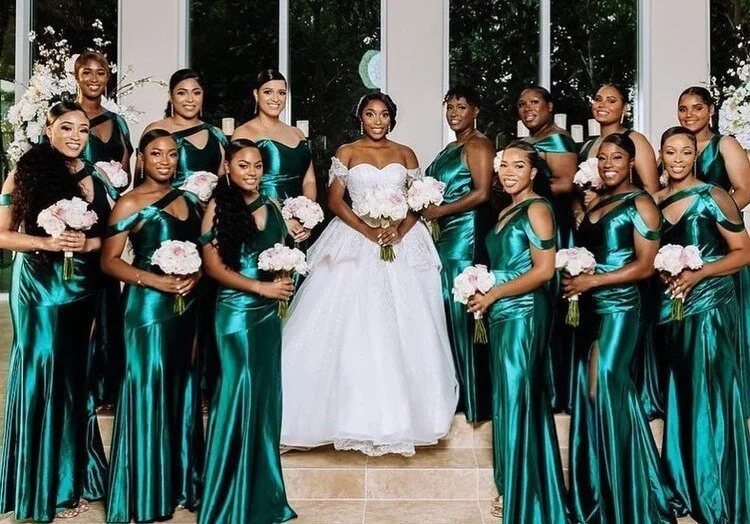
What is the most popular bridesmaid dress color?
There is no definitive answer to this question as the popularity of bridesmaid dress colors can vary from year to year and depend on cultural, regional, and personal preferences. However, some classic and timeless colors that have been popular for bridesmaid dresses in recent years include:
Navy blue, Blush pink, Dusty rose, Burgundy, Champagne, Lavender, Sage green and deep purple. It's important to note that the most popular bridesmaid dress color may not necessarily be the best choice for your wedding and should be selected based on the overall aesthetic and color palette of the wedding, as well as the skin tone and preferences of the bridesmaids.
What is the best bridesmaid dress style for big arms?
For bridesmaids with big arms, styles that are sleeveless or have short sleeves, such as spaghetti straps or cap sleeves, tend to be more flattering. A-line or empire waist dresses can also be a good option as they provide more room for the arms and divert attention from them. Additionally, choose dresses made from lighter and flowy fabrics, as they will not cling to the arms. Overall, it's important to choose a style that the bridesmaid is comfortable in, as confidence is key to looking good.
Read More: How Much Should Bridesmaids Spend on Their Dresses?
What is the trend for bridesmaid dresses?
The latest trend in bridesmaid dresses includes: Mix and Match: Bridesmaids wearing different styles, colors or fabrics in the same color palette.
Bold Colors: Bridesmaids wearing dresses in bold, statement-making colors such as emerald green, burgundy, and navy blue.
Mismatched Prints: Bridesmaids wearing dresses in the same color but with different prints, like florals, polka dots, and stripes.
Convertible Dresses: Dresses that can be worn in different styles, providing versatility and allowing bridesmaids to personalize their look.
Casual Chic: Bridesmaids wearing more relaxed, comfortable and effortless styles, like jumpsuits, midi dresses, and two-piece sets.
Sustainability: Bridesmaids wearing dresses made from eco-friendly, sustainable and organic materials.
Remember, the trend is to ultimately choose a dress that makes the bridesmaid feel beautiful, confident, and comfortable on the special day.
What bridesmaid dresses look good on plus size?
For plus-size bridesmaids, it's important to choose a dress that flatters their figures and makes them feel comfortable. Here are some styles that tend to look good on plus-size bridesmaids:
A-line dresses: These dresses have a flare from the waist and are more forgiving, creating a flattering silhouette.
Empire waist dresses: These dresses have a raised waistline and flow away from the body, creating a more relaxed fit.
Wrap dresses: Wrap dresses cinch at the waist and drape over the body, providing a flattering fit and the ability to adjust to different body types.
Maxi dresses: Maxi dresses elongate the body and provide a flattering and comfortable fit for all body types.
Dresses with sleeves: Dresses with sleeves, such as cap sleeves or three-quarter length sleeves, provide more coverage for the arms and can be more flattering for plus-size bridesmaids.
Remember, the most important factor is for the bridesmaid to feel confident and comfortable in their dress, regardless of the style.