
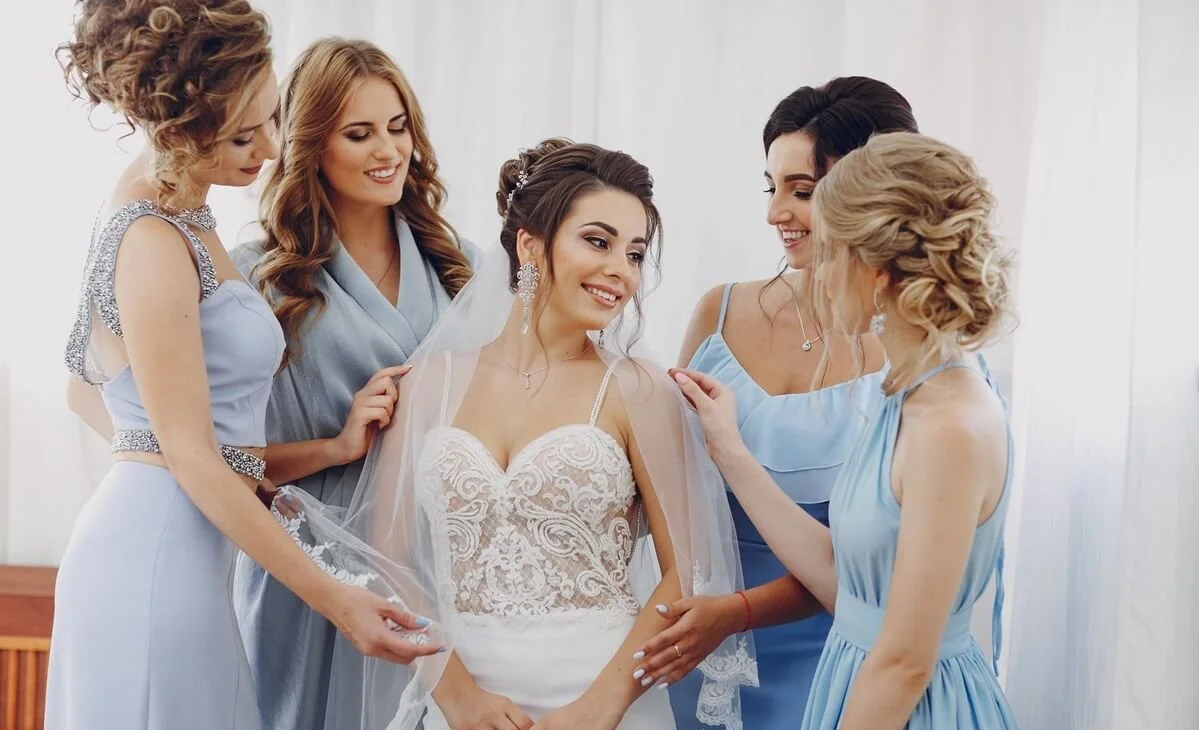
The best fabrics for summer bridesmaid dresses are chiffon and georgette for outdoor Houston ceremonies, lightweight crepe for indoor and outdoor versatility, lace over a chiffon base for romantic visual richness, and organza for formal structured elegance without weight. Cotton, linen, rayon, and jersey suit casual and beach settings. The fabrics to avoid in Houston summer heat are heavy satin, thick polyester lining, and stiff structured fabrics that trap body heat and show discomfort in photographs. At Estelle Bridal, fabric selection for every bridesmaid gown is made with the specific venue, wedding date, and bridesmaids' body types in mind.
Summer is a beautiful season for weddings, and choosing the right fabric for your bridesmaid dresses is essential to ensure your bridal party stays cool, stylish, and comfortable throughout a full Houston wedding day. The difference between the right fabric and the wrong one is visible in photographs: bridesmaids in breathable fabrics look polished and comfortable at the end of the reception, while those in heavy or poorly ventilated fabrics show visible discomfort by hour three. This guide covers the 15 best fabrics for summer bridesmaid dresses with Houston-specific advice on when each works best, which body types each suits, and what to avoid for outdoor warm-weather ceremonies.
For the complete fabric guide covering bridal gowns by season and venue, see our wedding dress fabrics guide. For Houston-specific bridesmaid dress guidance including silhouettes and colors, see our bridesmaid dresses Houston guide.
Key Observations
- Almost nothing written about summer bridesmaid fabric contains a number. We went and found the numbers, and several of them contradict the advice everybody repeats.
- Fabric names do not describe weight. One technical wholesaler lists crepe from 20 to 215 grams per square meter. Crepe is a finish, not a weight class.
- Silk charmeuse at 37 grams per square meter is lighter than polyester chiffon at 95. The rule that satin is heavy and chiffon is light is false at the level of an actual bolt of cloth.
- Weight is a weak predictor of breathability. In a published study of thirteen fabrics that were all the same fiber and all plain weave, air permeability varied eightfold while weight varied barely twofold. The gaps between the yarns predicted it far better than the weight did.
- A lined dress breathes like its tightest layer. Beautiful chiffon over a dense polyester lining performs as the lining. This is the most consequential thing on this page and the least discussed.
- Nobody has published any measurement of how bridal fabrics hide sweat. The standard test methods exist. They have not been run on these fabrics. We would rather tell you that than star-rate a guess.
- The standard wrinkle recovery test gives a fabric 24 hours to recover before anyone rates it. A bridesmaid stands up and is photographed in about ninety seconds. Wrinkle resistance is a timing question, not a property.
- The five biggest bridal retailers openly contradict each other on silk, charmeuse, organza, satin and tulle. We have put their quotes side by side so you can see it.
- There is a four-test protocol at the end you can run on a swatch in ten minutes. It is derived from the published methods and it is the most useful thing here.
Lightweight and Breathable Fabrics for Summer Weddings
These fabrics are the foundation of any successful Houston outdoor summer bridesmaid look. All allow meaningful air circulation against the skin, photograph well in natural outdoor light, and hold their appearance across a full wedding day in warm and humid conditions.
1. Chiffon
Chiffon is the most consistently recommended fabric for summer bridesmaid dresses and the top choice at Estelle Bridal for outdoor Houston ceremonies from March through October. Published supplier weights for chiffon run from about 15 grams per square meter in silk up to about 95 in polyester, so in its silk form it is one of the lightest fabrics used in formal dress construction. It breathes genuinely, allows real airflow against the skin, flows away from the body rather than clinging, and creates the soft romantic movement in outdoor photographs that heavier fabrics cannot replicate. Chiffon in a coordinated pastel or sage at an outdoor garden ceremony in Katy or Sugar Land creates beautifully cohesive bridesmaid photographs in natural afternoon light. Its limitation is structure: chiffon has minimal body on its own, so the dress construction must provide all silhouette support through internal lining and boning rather than the fabric itself. For the full comparison of how chiffon performs versus alternatives, see our wedding dress fabrics guide.
2. Cotton
Cotton is a natural fabric that is lightweight and breathable, making it a practical choice for casual and semi-formal summer bridesmaid dresses. Its natural hollow fibers absorb and release moisture effectively, which creates real cooling in Houston's humid conditions. Cotton in a well-cut midi or A-line silhouette suits garden parties, backyard ceremonies, and relaxed outdoor weddings beautifully. The limitation for more formal Houston weddings is that cotton has a casual visual weight that reads as less formal than chiffon, organza, or crepe in photographs under warm indoor lighting. Cotton is at its best for daytime outdoor events and casual or rustic wedding aesthetics.
3. Linen
Linen is consistently underestimated in the summer bridesmaid fabric conversation. Its natural hollow fibers breathe better than most synthetic alternatives in genuine heat and humidity, creating real cooling that polyester blends marketed as breathable cannot match. Linen's relaxed, slightly textured appearance suits rustic, bohemian, and coastal wedding aesthetics particularly well. For Houston outdoor garden ceremonies in spring and early autumn, linen in warm earthy tones or soft white creates a beautifully natural, photographically distinctive bridesmaid look. Its natural wrinkle tendency requires managing: linen that is not properly steamed before the ceremony will show creasing in photographs, which is worth accounting for in the day-of logistics.
4. Silk
Silk is luxurious and elegant, making it ideal for formal summer weddings in climate-controlled indoor settings. It is naturally breathable and temperature-regulating, with the added quality of feeling cool against the skin rather than warm. Silk in a well-cut A-line or sheath silhouette photographs with a luminous, elevated quality that no synthetic alternative produces. The practical limitation for Houston outdoor summer ceremonies is moisture sensitivity: silk water-spots immediately and visibly, and perspiration can permanently stain it. For outdoor or very warm Houston ceremonies, silk is better reserved for indoor climate-controlled receptions or autumn and winter events where thermal comfort and moisture risk are lower. For formal indoor Houston receptions from October through February, silk bridesmaid dresses create a genuinely luxurious visual result.
5. Rayon
Rayon is soft, breathable, and has a feel similar to cotton with a slightly silkier drape. It is a practical and accessible choice for casual summer bridesmaid dresses, offering genuine comfort and ease across a warm wedding day. Rayon drapes more fluidly than cotton, which gives it a more polished appearance in photographs than a cotton equivalent at the same price point. It suits casual outdoor ceremonies, beach settings, and bohemian aesthetics well. For more formal Houston weddings, rayon lacks the visual weight and photographic richness of chiffon, georgette, or crepe, but for relaxed and intimate outdoor events it is a comfortable and practical choice.
6. Jersey
Jersey is stretchy, soft, and comfortable, with a relaxed, casual look ideal for beach, outdoor, and informal summer weddings. Its stretch quality allows freedom of movement that structured fabrics cannot provide, which makes it particularly practical for outdoor events where bridesmaids are navigating garden terrain, grass, or beach surfaces. Jersey in a coordinated color at a Houston Gulf Coast or beach ceremony creates an effortlessly relaxed bridal party look that suits the setting perfectly. For formal or semi-formal Houston weddings, jersey reads as too casual and lacks the photographic quality that chiffon, georgette, or crepe deliver under indoor venue lighting.
Elegant and Structured Summer Fabrics
These fabrics provide more visual weight and photographic richness than the purely lightweight options above, while remaining appropriate for summer use in the right venue and construction conditions. They are the strongest choices for formal and semi-formal Houston summer weddings. For the full venue-specific guide, see our Houston venue dress guide.
7. Organza
Organza is sheer, structured, and lightweight, making it perfect for formal summer bridesmaid styles. It gives a touch of elegance without adding weight, and its crisp quality creates a beautifully architectural volume in outdoor photography that softer fabrics like chiffon cannot achieve. An organza overlay over a chiffon base is one of the most elegant summer bridesmaid fabric combinations: the breathability of the chiffon base with the visual formality and structured volume of the organza overlay. For formal Houston summer weddings at indoor venues or for evening outdoor ceremonies, organza in a coordinated pale or jewel tone creates a bridal party look that reads as genuinely elevated.
8. Georgette
Georgette is one of the strongest summer bridesmaid fabrics and an excellent alternative to chiffon for brides who want more wrinkle resistance and slightly more opacity. Its slightly crinkled surface texture means it holds up better across a long Houston wedding day than chiffon: a bridesmaid who has been sitting through a ceremony and cocktail hour in georgette looks considerably more polished than one in flat chiffon when she stands for reception photographs. Georgette breathes well, drapes beautifully in bias-cut and flowy silhouettes, and catches light with a soft luminosity that photographs well under both natural outdoor and warm indoor lighting. For formal outdoor events, vineyard receptions, or weddings where the bridal party moves between an outdoor ceremony and an indoor reception, georgette is consistently one of the best choices available.
9. Crepe
Lightweight crepe is the Estelle Bridal team's most consistent all-season recommendation for bridesmaid dresses, including summer. What crepe offers that no other summer fabric provides is wrinkle resistance without visual bulk. A bridesmaid in stretch crepe looks the same at the end of a six-hour reception as she did walking down the aisle, because the fabric has a natural memory that returns it to shape after hours of sitting and movement. Crepe has genuine stretch, a matte finish that photographs cleanly under both indoor and outdoor light, and enough structure to hold a tailored silhouette without additional support underneath. It runs slightly warmer than chiffon and lacks its romantic flow, but for modern structured silhouettes and indoor climate-controlled venues, crepe is one of the most reliable and photographically consistent summer bridesmaid fabrics available. For silhouettes that work best in crepe, see our wedding dress silhouettes guide.
10. Tulle
Tulle is soft, airy, and whimsical, making it a favorite for romantic or fairytale-themed summer weddings where volume and movement are the priority. It provides visual volume without fabric weight, which makes it surprisingly practical for summer use: a full tulle skirt circulates air rather than trapping it against the legs. Tulle over a fitted lining creates a beautifully full silhouette that moves dramatically in outdoor breeze and photographs with a luminous, dreamlike quality in natural afternoon light. For Houston garden ceremony and outdoor reception bridesmaids in romantic or bohemian-inspired wedding aesthetics, tulle in a coordinated pastel creates beautifully photographed bridal party images. The limitation is practical: tulle snags on surfaces and requires more careful cleaning than flat fabrics.
Casual and Relaxed Fabric Options
These fabrics suit informal, rustic, casual, and coastal summer wedding aesthetics where practicality and comfort take priority over formal visual weight. They are excellent choices for the right setting and wedding aesthetic, but generally not appropriate for formal indoor Houston receptions.
11. Voile
Voile is a sheer, breathable fabric that creates a breezy, laid-back bridesmaid look perfect for informal outdoor summer ceremonies. It is lighter than chiffon and has a slightly crisper hand, which gives it a clean, polished appearance despite its casual weight. Voile works beautifully for daytime garden ceremonies, outdoor brunch weddings, and relaxed afternoon celebrations where the aesthetic is natural and informal. It is not appropriate for formal or semi-formal indoor Houston venues where it will read as too lightweight for the setting.
12. Batiste
Batiste is lightweight and soft, making it practical for casual summer bridesmaid dresses. It delivers both comfort and simplicity, with a fine, smooth hand that is comfortable against the skin in warm conditions. Batiste suits simple, informal summer weddings and relaxed outdoor settings where the visual priority is understated elegance rather than formal sophistication. Like voile, it is best suited to daytime outdoor events rather than formal indoor receptions.
13. Muslin
Muslin is breathable, light, and genuinely comfortable in warm conditions. It suits simple, informal summer weddings where an understated, natural aesthetic is the priority. Muslin has a relaxed, organic texture that works well for rustic or farm-to-table wedding aesthetics where the visual language is warm and natural rather than formal and polished. For Houston brides planning intimate outdoor ceremonies with a deliberately informal aesthetic, muslin in soft white or warm natural tones creates a beautifully organic bridal party look.
14. Chambray
Chambray resembles denim but is lighter and softer, making it ideal for rustic, country, or western-style Houston summer weddings. It offers a relaxed, easy-going look that suits ranch venues, barn settings, and country-themed celebrations with a distinctly Texan visual identity. Chambray in coordinated blue or warm neutral tones creates a cohesive and photogenically distinctive bridal party look for rustic outdoor settings. Like all casual fabrics, chambray is not appropriate for formal or semi-formal indoor Houston venues where its visual weight reads as too casual for the setting.
15. Lace
Lace is timeless, delicate, and feminine, adding a romantic or bohemian touch to summer bridesmaid dresses whether styled formally or casually. For summer use, lace over a lightweight chiffon or voile base creates the most breathable construction: the lace provides the visual richness and romantic detail while the lightweight base fabric maintains the breathability the warm season requires. A lace overlay bridesmaid dress in blush or sage at an outdoor Houston garden ceremony photographs with particular richness in close-up portraits where the lace thread pattern is visible in detail. For the full lace type comparison, see our lace wedding dresses Houston guide.
What Fabrics to Avoid for Houston Summer Bridesmaids
Understanding what not to choose is as important as knowing the best options. Several fabrics that appear in bridesmaid collections will create real comfort problems for Houston outdoor summer ceremonies where the heat and humidity are significant variables.
Heavy Satin and Structured Taffeta
Heavy duchess satin and structured taffeta are autumn and winter fabrics regardless of the color they come in. Both reflect and retain heat, do not breathe, and cling visibly when body heat warms them. A bridesmaid in floor-length heavy satin at an outdoor Houston ceremony in May will show visible discomfort in photographs within the first ninety minutes. For indoor climate-controlled formal Houston receptions from October through February, these fabrics become entirely appropriate and create beautifully rich photographic results. The temperature must justify them.
Thick Polyester Lining
The most overlooked comfort problem in summer bridesmaid dresses is a heavy polyester lining beneath an otherwise lightweight outer fabric. Many styles marketed as summer-appropriate use a thick polyester lining shell that traps moisture between the lining and the outer fabric, creating the same thermal discomfort as a heavy satin. When evaluating bridesmaid fabrics, always ask specifically about the lining construction. Cotton or silk-blend linings, or single-layer constructions without a full structured shell, are the correct choices for Houston outdoor summer use.
Velvet and Jacquard
Velvet and jacquard are autumn and winter fabrics that have no practical role in summer outdoor bridesmaid dressing. Both trap heat aggressively and will create real discomfort within the first hour of outdoor summer wear. They photograph beautifully at formal indoor winter events and are excellent choices for November through February indoor Houston receptions. They should not appear in any outdoor summer bridesmaid dress selection regardless of how they are marketed.
How to Choose the Right Fabric for Your Houston Summer Wedding
The right fabric for summer bridesmaid dresses depends on four specific variables: the ceremony venue (outdoor or indoor), the wedding date and seasonal conditions, the formality level of the event, and the range of body types in the bridal party. All four interact to define the right choice.
Outdoor Houston Ceremonies: March Through October
For outdoor Houston ceremonies from March through October, chiffon and georgette are the most reliable choices across all formality levels. For casual and rustic aesthetics, cotton, linen, and rayon provide practical comfort. For formal outdoor events, an organza-over-chiffon combination or a georgette in a structured silhouette provides the visual formality without compromising breathability.
Indoor Houston Receptions: Year-Round
For indoor climate-controlled Houston receptions, the fabric range opens significantly. Lightweight crepe, charmeuse, silk, and organza all become practical choices because air conditioning removes the thermal constraint. Under warm indoor chandelier lighting, crepe and silk in coordinated colors photograph with a richness and depth that outdoor chiffon cannot replicate. For the full venue-by-venue guide, see our Houston venue dress guide.
Mixed Indoor and Outdoor Events
For Houston weddings that involve an outdoor ceremony followed by an indoor climate-controlled reception, chiffon and lightweight crepe produce the best results across both settings. Both breathe outdoors and photograph well indoors. For bridesmaid dress consultations covering both ceremony and reception conditions, see our first bridal appointment guide.
Fabric and Body Type: What Works for Every Bridesmaid
One practical consideration that most fabric guides skip is how fabric choice interacts with the range of body types within a single bridal party. Houston bridal parties frequently include bridesmaids across a wide range of sizes and proportions, and the fabric that photographs most beautifully on one bridesmaid may not serve another equally well.
Chiffon and georgette in A-line or empire waist silhouettes are the most universally flattering combination for mixed-size bridal parties. The fabric flows away from the body in these silhouettes rather than resting against it, which creates a consistently elegant visual across a wider range of proportions than structured or fitted fabrics. Lightweight crepe in an A-line is the strongest structured alternative: its matte finish, clean drape, and natural stretch accommodate different body proportions without the visual tension that heavier structured fabrics create when the fit is not precise. For the full silhouette breakdown by body type, see our wedding dress silhouettes guide.
Why "Lightweight and Breathable" Is Not Useful Advice
We read eleven of the pages that rank for this question, including The Knot, Azazie, Dessy, Bella Bridesmaids, Revelry and Bari Jay. Between them they run to well over twenty thousand words. Between them they contain exactly one number with a unit, and that one is unusable because it gives ounces per yard without stating the width.
That is not laziness on their part. It is a supply chain problem. Bridal fabric retailers do not publish fabric weights. One well known bridal fabric supplier lists sixty eight different mikados and publishes a weight for none of them. Taffeta, the same. General technical wholesalers, the ones who sell to industry rather than to brides, publish weight per square meter for every single product they stock. So the information exists. It just does not exist where the wedding industry shops, which is why the wedding industry writes in adjectives.
This page is our attempt to fix that for the fabrics that matter to a summer bridesmaid dress. Everything below is either a published figure with the source named, a published test method, or an honest statement that nobody has measured it. Where sources disagree we say so rather than picking the one we like.
What Fabric Weight Actually Is, and What the Published Numbers Say
Fabric weight is quoted in grams per square meter, written as GSM or g per square meter. It is the weight of a piece of the cloth one meter by one meter. Silk is also sold by momme, a silk specific unit, where one momme equals 4.34 grams per square meter.
Here is the part that changes how you shop. The figures below are published per product by Whaleys Bradford, a technical fabric wholesaler that lists weight for every item it stocks. These are measured specifications for real bolts of cloth, not category averages.
| Fabric | Published weight range | What this tells you |
|---|---|---|
| Chiffon | 15 g/m2 (silk) to 95 g/m2 (polyester) | Polyester chiffon is more than six times the weight of silk chiffon. Same name, different cloth. |
| Georgette | 34 to 68 g/m2 | Double georgette at 68 is twice the weight of standard silk georgette at 34. |
| Crepe | 20 to 215 g/m2 | The widest spread of any fabric here. Crepe is a twist and finish, not a weight class. |
| Organza | 21 to 60 g/m2 | Consistently light. The lightest formal fabric group on this list. |
| Satin and charmeuse | 37 g/m2 (silk charmeuse) to 250 g/m2 (cotton duchesse) | Silk charmeuse at 37 is lighter than polyester chiffon at 95. Polyester satin sits around 156. |
| Cotton lawn | 70 to 80 g/m2 | Narrow and predictable. |
| Muslin | 50 to 66 g/m2 | Lighter than most people assume. |
| Linen, dress weight | 110 to 160 g/m2 | Heavier than every fabric above it here. Linen is not a light fabric, it is a cool feeling one. |
| Jersey | 125 to 300 g/m2 | The heaviest thing usually described as a summer fabric. |
Read that table once and the standard advice falls apart. "Choose chiffon because it is light" is only true if it is silk chiffon. A polyester chiffon at 95 is heavier than a silk charmeuse at 37, and charmeuse is in the satin family that every guide tells you to avoid. "Crepe is lightweight" can mean a 20 gram silk crepeline or a 215 gram wool crepe, and a bride told only the word crepe has no way to tell which she is being sold.
The right question to ask
Not "is this chiffon?" but "what does this weigh, and what fiber is it?" Any workroom can answer that. Most retail sales floors cannot, which is itself a useful signal.
Where the published figures disagree, and one correction
We want to be straight about the limits. Silk momme values conflict between sources: one silk specialist puts chiffon at 6 to 8 momme and another puts it at 8 to 12, and crepe de chine at 12 to 16 against 16 to 19. We could find no technical wholesaler publishing weight ranges for mikado, taffeta, bridal tulle or lace at all, so if you see a confident single figure for any of those, ask where it came from.
We also corrected a figure on this page. An earlier version of this guide gave chiffon as 50 to 75 GSM. No source we could find supports that number for any chiffon. Silk chiffon measures around 15, a silk cotton blend around 36, polyester around 95. The table above is the corrected, sourced version.
Weight Does Not Tell You How a Fabric Breathes
This is the finding that reorganizes everything else, and it comes from a published study rather than from a fitting room.
Breathability has a standard test. ASTM D737, Standard Test Method for Air Permeability of Textile Fabrics, clamps a fabric over a circular opening, creates a pressure difference across it and measures how much air passes through. The equivalent international standard is ISO 9237. Every time a bridal page says a fabric is breathable, this is the property it is gesturing at without measuring.
In 2020 Marie Havlova published air permeability measurements for thirteen woven fabrics in Fibres and Textiles. Every sample was 100 percent polyester staple yarn. Every sample was plain weave. The only things that varied were yarn fineness and how tightly the yarns sat together. Here is what came out.
| Property measured | Range across the thirteen fabrics |
|---|---|
| Weight | 90 to 199 g/m2, about a twofold spread |
| Thickness | 0.260 to 0.451 mm |
| Air permeability | 200.4 to 1680 mm/s, about an eightfold spread |
| Water vapor permeability | 69.7 to 83.0 percent |
Same fiber. Same weave. Weight roughly doubles. Airflow varies by a factor of eight. And when the study correlated air permeability against the possible predictors, porosity based on the area the yarns leave open came out at R equals 0.95, while weight came out at minus 0.82. The paper's own conclusion is that air permeability "is very closely associated with inter-yarn porosity of textile materials."
In plain language: how a fabric breathes is decided by the size of the gaps between the threads, not by how much the cloth weighs. Weight is a proxy, and a fairly poor one.
What that means when you are holding a swatch
Hold it up to a window. What you are looking at is the open area between the yarns, which is the thing that actually predicts airflow. A tightly woven light fabric can breathe worse than a loosely woven heavier one, which is exactly why a fine dense polyester lining is a problem and a loose open silk chiffon is not.
It also means the word breathable, used about a fiber, is close to meaningless. Polyester is not inherently unbreathable. A loosely woven polyester can pass a great deal of air. What makes most polyester bridesmaid dresses warm is that they are densely woven and fully lined, which is a construction decision rather than a fiber one.
Loose beats light
A 2023 review of clothing thermophysiological comfort in the journal Textiles notes that once the air gap between skin and fabric exceeds about 12 mm, natural convection begins to carry heat and sweat vapor away through the microclimate between the two. That is a measurable design target, and it is the real reason a floating skirt feels cooler than a fitted one in the same cloth. The fabric is not doing the work. The gap is.
Which is a useful thing to know when you are choosing between a fluid A line in a mid weight fabric and a fitted column in something feather light. On the numbers, the A line is very often the cooler dress.
The Lining Decides the Dress
If you read one section here, read this one. It is the highest value thing on the page and almost nobody in the industry says it plainly.
A bridesmaid dress is rarely one layer. It is a face fabric over a lining, sometimes with an interlining as well. Air has to pass through all of them. So the assembly breathes like its tightest layer, not like its prettiest one. A 15 gram silk chiffon over a dense polyester lining is, in airflow terms, a dense polyester lining with something lovely on top.
This is why two dresses in the same fabric, from two different makers, can feel completely different across a Houston August afternoon. The face fabric on the hanger is identical. What is underneath is not, and what is underneath is almost never on the label.
| Lining choice | What it does to the assembly | Ask the maker |
|---|---|---|
| Dense polyester lining, full length | Becomes the limiting layer. The face fabric's breathability stops mattering. | "What is the lining, and can it be changed?" |
| Cotton or cotton blend lining | Absorbs moisture rather than sitting against damp skin, and is usually more open than a polyester taffeta lining. | "Can I have a cotton or silk blend lining instead?" |
| Silk or viscose lining | Lighter hand, higher moisture regain, the most comfortable option and the most expensive. | "What would a silk blend lining add to the price?" |
| Partial lining, bodice only | Keeps structure where it is needed and leaves the skirt open, which is where the air gap matters most. | "Can the skirt be unlined or half lined?" |
| Unlined, self supporting fabric | Best airflow. Only works where the fabric is opaque enough on its own. | "Is this opaque without a lining?" |
For a custom dress this is a live decision, which is the argument for having it. For a dress bought off a rail it usually is not, which makes it a question to ask before you order five of them rather than after.
Does Any Fabric Actually Hide Sweat? An Honest Answer
This is one of the most searched questions in this whole area and it is answered everywhere with total confidence. One competitor page runs to roughly 4,500 words on it, complete with a star rating for each fabric's sweat visibility, and cites nothing at all. Not a standard, not a study, not a lab, not a supplier.
We went looking for the evidence. Here is what is actually true.
The measurements exist
The properties that would determine whether a wet patch shows are standardized and testable. AATCC Test Method 195 measures liquid moisture management, including how fast a fabric wets, how large a radius the liquid spreads to and how quickly it spreads. AATCC TM200 and TM201 measure drying rate, by air flow and by heated plate. AATCC TM204 measures water vapor transmission. These are real methods with real instruments behind them.
Nobody has run them on bridal fabrics
We could find no published dataset applying any of these to chiffon, georgette, crepe, charmeuse, mikado, organza or bridal tulle. The one peer reviewed study we found on sweat patch visibility specifically, from 2024, is about engineered reverse plated weft knits for activewear, using water repellent yarns on one face to speed drying. It is real work and it has nothing to do with a woven bridesmaid dress.
So when a page ranks fabrics by how well they hide sweat, that ranking is not measured. It is an opinion presented in a table.
What we can say, and how we know it
Mechanically, a fabric that spreads liquid over a wide radius makes a larger, fainter mark, and one that holds liquid locally makes a smaller, darker one. Both are visible. They are visible differently, and which reads worse depends on the dress and the light. Surface finish plausibly matters too, because a wet area on a shiny cloth reflects light differently from a dry area next to it, which is the most likely reason matte reads better than satin. We could find no measurement of that either.
From our own fitting rooms, and stated as observation rather than evidence: lined, mid weight, matte fabrics show less than thin, shiny, unlined ones, and the underarm and the small of the back are where it shows first regardless of fabric. We are not going to dress that up as science.
The things that do have evidence behind them are not fabric choices at all. Use an actual antiperspirant rather than a deodorant, apply it before bed on dry skin, and wear dress shields. All three are supported by dermatology guidance. Our guide to dressing bridesmaids elegantly in summer covers that properly.
The Wrinkle Question Is Really a Timing Question
Every fabric guide calls something wrinkle resistant. None of them say what that means, and the standard test reveals why the word is misleading.
AATCC Test Method 128, Wrinkle Recovery of Fabrics, puts a specimen under a set load for 20 minutes in controlled conditions. Then it conditions the specimen for 24 hours. Only then is it rated, against three dimensional reference replicas, on a scale of one to five. A second method, AATCC 66, folds a woven fabric under controlled force and measures the angle it recovers to.
Now put that next to a wedding. A bridesmaid sits through a forty minute ceremony and a sixty minute cocktail hour, stands up, and is photographed roughly ninety seconds later. The published test gives the cloth a full day to recover before anyone judges it. The wedding gives it a minute and a half.
So wrinkle resistance is not really a property of a fabric. It is a question of how fast it recovers, and the standard tests were not designed to answer the ninety second version. That is worth knowing because it means the honest advice is different from the usual advice.
| The usual advice | What the standards actually support | What to do instead |
|---|---|---|
| "Georgette is more wrinkle resistant than chiffon" | We found no published fiber by fiber or fabric by fabric recovery angle data for bridal fabrics. This is trade lore, repeated widely. | Crush a swatch in your fist for twenty seconds, let go, and time how long it takes to look acceptable. That is the test that matches your day. |
| "Crepe has natural memory" | Plausible from the yarn twist, but unmeasured in anything we could find. | Same test. Do it on the actual swatch, not the category. |
| "Linen wrinkles" | Widely observed and consistent with flax's low elastic recovery, but again we found no published recovery angle figures. | Linen does crease. Decide whether you mind, because it will not stop. |
| "Satin shows creases more" | The visibility of a crease on a shiny surface is an optical effect, not a recovery property. Two different things get blended here. | Judge creasing and crease visibility separately. The fist test covers the first, a look under strong light covers the second. |
The practical version for a wedding day: what matters is not whether a fabric creases in the car, because everything creases in the car. It is whether it looks acceptable within a minute or two of standing up, and whether it can be steamed on site.
"Flowy" and "Structured" Both Have Numbers
Two more adjectives that turn out to be measurable.
Drape has a number. The drape coefficient, measured on a Cusick drapemeter to BS 5058, drops a circular fabric specimen over a smaller support disc and measures the shadow area of how it falls. A lower coefficient means a more fluid drape. This is the number behind the word flowy.
Stiffness has a number too. ASTM D1388 measures bending length by letting a strip of fabric bend under its own weight off the edge of a platform, then calculates flexural rigidity from the bending length and the fabric weight. A higher bending length means a stiffer cloth. This is the number behind the word structured.
We could find no published drape coefficients or bending lengths for chiffon, georgette, crepe, mikado or organza. So we cannot give you a table of them, and nobody else can either. What is useful is knowing that drape and stiffness are two separate measurable things rather than one vague quality, and that they pull in opposite directions. The fabrics that hold an architectural shape are the ones that do not flow, and no fabric does both.
Which matters for a summer bridesmaid dress more than it sounds, because structure and airflow are in tension. A structured bodice needs a stiffer cloth or an interlining. A cool skirt needs a fluid one. The best summer bridesmaid dresses tend to be the ones that use two different fabrics for those two jobs rather than one compromise fabric for both.
See-Through, and How to Test It Before You Order Five
Opacity is decided by cover factor, which is how much of the cloth's area is actually covered by yarn rather than left open. It is the inverse of porosity, and it is the same property that governs airflow, which is why the most breathable fabrics are also the ones most likely to be sheer. That trade off is real and unavoidable.
There is a published optical method for assessing it. Researchers photograph a transparent woven fabric against a light source and analyze the image, treating the pores as particles and measuring their number, size and distribution. That is a laboratory procedure, but the principle behind it is something you can do in a fitting room with a window.
The thing worth knowing is that opacity changes with the light, not just with the cloth. A fabric that looks perfectly opaque under interior lighting can be transparent with the sun behind it. A pale unlined skirt photographed against a bright sky is the classic version of this going wrong, and it is a Houston outdoor ceremony problem specifically because the light is stronger here than the swatch was ever looked at in.
Static and Cling, and Why It Is a Winter Problem in Houston
Static is a moisture problem. Fibers that hold moisture conduct charge away and do not build up static. Fibers that do not hold moisture accumulate it. That is why polyester, nylon and acetate cling and why cotton, viscose and linen generally do not.
Published moisture regain figures disagree with each other enough that we will not give you a precise table. Cotton is quoted at both 7 and 8.5 percent and silk at both 11 and 22 percent across reputable looking sources. There is also a technical trap: the standard tables of commercial moisture regain, published as ASTM D1909, are explicitly a trade convention used to determine the commercial weight of fiber when it is bought and sold, not a physiological comfort measurement. Several health and comfort blogs quote those numbers as though they measured how a fabric feels. They do not.
The useful Houston conclusion, stated as mechanism rather than as a number: static cling is a low humidity failure. It is a bigger risk in a dry air conditioned ballroom in January than outdoors in July, when the air is carrying 90 percent humidity and no charge accumulates. If a polyester bridesmaid dress clings at the January fitting, that is not necessarily what it will do in August.
The Big Bridal Retailers Do Not Agree With Each Other
We read what the major bridal and bridesmaid retailers publish about summer fabrics, and they contradict each other directly on five of them. We are putting this side by side because no one else has, and because it explains why reading three articles leaves you more confused than reading one.
| Fabric | One side says | The other side says | Our read |
|---|---|---|---|
| Silk | One fabric retailer calls it "naturally temperature-regulating" and says it "feels cool against skin." | A bridesmaid retailer lists silk among the worst for heat, citing uneven moisture absorption and visible marks. | Both are describing real behavior. Silk feels cool and it water spots. Which matters more depends on whether the ceremony is outdoors. |
| Charmeuse | One major retailer rates its breathability "very good" and recommends it for summer. | Another says stretch charmeuse "clings" and "can feel uncomfortable in direct sun for long periods." | Silk charmeuse at 37 g/m2 and a stretch polyester charmeuse are different cloths. Both statements can be true of different products with the same name. |
| Organza | Widely recommended for summer, including by us, because it is consistently light at 21 to 60 g/m2. | One retailer lists organza jacquard among poor summer choices, as "structured and non-breathable." | Plain organza and organza jacquard are not the same thing. The jacquard is denser. The disagreement is about the qualifier, not the fabric. |
| Satin | The Knot quotes a brand founder recommending matte satin for spring and summer as "lightweight" and moving "beautifully." | Three other retailers say avoid satin in summer, citing heat retention and sweat visibility. | Silk charmeuse is a satin weave at 37 g/m2. A cotton duchesse satin is 250. Telling people to avoid satin is advice about a weave structure, which does not determine weight at all. |
| Tulle | Rated well for heat, on the reasoning that layers trap air and allow ventilation. | One retailer warns it "has more structure and can scratch bare skin after hours of wear." | Comfort and airflow are different questions. Tulle can be airy and still be uncomfortable against skin for eight hours. |
Look at what is causing four of those five disagreements. It is the fabric name doing too much work. Satin is a weave. Crepe is a finish. Chiffon comes in silk at 15 grams and polyester at 95. Once you ask for the fiber and the weight instead of the name, most of the contradictions resolve themselves.
The Four-Test Swatch Protocol
Several bridesmaid retailers will send you free swatches. Not one of them tells you what to do with them. These four tests take about ten minutes, need nothing you do not already own, and each one is a crude version of a published laboratory method. Run them on every swatch before you order five dresses.
| Test | How to do it | What you are looking at | The lab version |
|---|---|---|---|
| 1. The window test | Hold the swatch flat against a window in daylight. Then hold it against a lamp in a dim room. | How much open area sits between the yarns. More light through means more airflow and also more sheerness. Note the difference between the two lighting conditions, because that is the gap between the fitting room and an outdoor ceremony. | Optical porosity analysis, and air permeability testing to ASTM D737 |
| 2. The water drop test | Put one drop of water in the middle of the swatch. Watch it for thirty seconds, then leave it and check every few minutes until it is dry. | Whether it beads or sinks in, how wide the mark spreads, how dark it goes and how long it takes to disappear. Compare swatches against each other rather than judging one alone. | AATCC 195 moisture management, AATCC TM200 and TM201 drying rate |
| 3. The fist test | Crush the swatch tightly in your fist for twenty seconds. Open your hand, lay it flat and start timing. | How long until it looks acceptable. Ninety seconds is the number that matters, because that is roughly how long between standing up and being photographed. | AATCC 128 wrinkle recovery, AATCC 66 recovery angle |
| 4. The hand drape test | Lay the swatch over the back of your hand and turn your hand slowly. | Whether it falls in soft folds or holds a shape. This tells you whether it will read as fluid or as structured, and whether it will cling. | Cusick drape coefficient to BS 5058, bending length to ASTM D1388 |
Two notes. Do all four on every swatch in one sitting, because these tests only mean anything comparatively. And if a swatch is the face fabric only, ask for a piece of the lining too, then run test one on both and on the two of them together. That last comparison is the one that actually predicts how the finished dress will feel.
What We Can and Cannot Tell You
We would rather be useful than confident, so here is the honest ledger.
| Claim | Status |
|---|---|
| Published weight ranges for chiffon, georgette, crepe, organza, satin, linen, cotton lawn, muslin and jersey | Sourced. Per product specifications from a technical fabric wholesaler. |
| That airflow is governed by the gaps between yarns more than by weight | Sourced. Published measurements across thirteen fabrics, 2020. |
| That an air gap over about 12 mm starts moving heat and vapor away from the skin | Sourced. Published review of clothing thermophysiological comfort, 2023. |
| That the standard wrinkle recovery test allows 24 hours of recovery | Sourced. AATCC 128 method description. |
| Weight figures for mikado, taffeta, bridal tulle or lace | Not available. No technical wholesaler we found publishes them. |
| Air permeability values for any bridal fabric | Not available. The measured data we found is for polyester apparel fabrics, and does not transfer. |
| Any thermal comfort measurement on a bridal fabric in hot humid conditions | Does not exist as far as we can find. The science exists. The bridal application of it has not been done. |
| That a specific fabric hides sweat better than another | No published evidence. Standard methods exist, nobody has run them on these fabrics. |
| That a specific color hides sweat better than another | No published evidence. Asserted constantly, sourced never. |
| Fiber by fiber wrinkle recovery rankings | No published data found. The standards exist but no bridal fabric table does. |
| Drape coefficients or bending lengths for bridal fabrics | No published data found. |
| Silk momme values | Sources disagree. Chiffon at 6 to 8 against 8 to 12, crepe de chine at 12 to 16 against 16 to 19. |
| Moisture regain percentages | Sources disagree, and the standard tables are a trade weight convention rather than a comfort measurement. |
Anyone who gives you a confident star rating for how well a bridesmaid fabric hides sweat is making it up. We would rather hand you a swatch and a protocol.
A Note on Five of the Fifteen
Being straight about our own list. Voile, batiste, muslin, chambray and plain cotton are all genuinely good warm weather cloths, and they are all essentially absent from the bridesmaid dress market. If you are shopping a rail at a bridesmaid retailer, you will not find them. They appear here because they are relevant if you are having dresses made, or working with a dressmaker, or dressing a deliberately casual ranch or beach wedding where a cotton or linen bridesmaid dress is the right call.
The fabrics you will actually be choosing between at a bridesmaid retailer are chiffon, georgette, crepe, charmeuse, matte satin, tulle and lace. If you are pressed for time, those are the seven to run the swatch tests on.
Fabric Performance Decision Table
The practical summary, based on the sourced properties above rather than on adjectives.
| Your situation | What to prioritize | What to ask for specifically |
|---|---|---|
| Outdoor Houston ceremony, June to September | Open weave, minimal lining, a skirt with volume rather than the lightest possible cloth | "What is the lining, and can the skirt be half lined or unlined?" Silk or polyester chiffon, georgette, or a light crepe. |
| Indoor, air conditioned, all day | Almost nothing here constrains you. Choose on look and on wrinkle recovery. | Run the fist test. Crepe, charmeuse and matte satin are all fine indoors. |
| Ceremony outdoors, reception indoors | Airflow for the ceremony, and something that recovers fast after the car journey | Ask whether the venue has a steamer on site. It changes what you can risk. |
| Worried about sweat marks | Lining, weight and matte finish, in that order. Not color. | A mid weight matte fabric with a breathable lining. Then handle it with antiperspirant and dress shields, which is where the evidence actually is. |
| Worried the dress will be see-through outdoors | Run the window test in daylight, not under shop lighting | "Is this opaque with the sun behind it?" Ask to take the swatch outside. |
| Want a structured bodice and a cool skirt | Two fabrics, not one | "Can the bodice be a firmer cloth with a lighter skirt?" This is standard in custom work and rare off the rail. |
| Told to avoid satin | Ask which satin | Silk charmeuse at 37 g/m2 is a satin weave and is lighter than most chiffon sold. A cotton duchesse at 250 is not. |
| Told chiffon is the safe choice | Ask which chiffon | Silk chiffon is about 15 g/m2, polyester about 95. The word alone tells you nothing about the weight. |
| Beach or sand | Light, fluid, and forgiving of wind and salt air | Chiffon or georgette. Avoid anything you will be steaming on the day. |
| Deliberately casual, ranch or garden | Cotton, linen or voile become genuinely viable | Accept that linen creases and decide in advance that you do not mind. |
| Mixed sizes in the party | A fabric with enough body to hold a shape without needing heavy structure | Crepe or georgette usually flatter a wider range than a very fluid chiffon, which shows everything under it. |
Find Your Perfect Custom Bridesmaid Dress at Estelle Bridal Houston
At Estelle Bridal, bridesmaid dress fabric selection is part of a complete wedding party consultation rather than a standalone decision. The Estelle Bridal team advises on fabric based on the specific wedding date, venue, and the full range of body types in the bridal party, ensuring every bridesmaid is as comfortable as she is beautiful across the full wedding day. Custom bridesmaid dress design is available for brides whose vision requires a specific fabric and silhouette combination not available in the standard ready-to-wear range. For the full custom design process, see our custom wedding dress design guide. Browse the wedding gowns collection or book your appointment.
What Estelle Bridal Brides Say
★★★★★ TyEsha Jackson, Google Review, 4 years ago
"Great experience! Flo was very attentive when it came to my wedding. She custom made my dress along with my mom, grandmother, & mother in law & wedding party! She even came to my wedding to help me get it all together. LOVE LOVE LOVE HER!"
Why Choose Estelle Bridal for Summer Bridesmaid Dresses in Houston
Houston venue and climate expertise in every fabric recommendation. Fabric advice at Estelle Bridal reflects the specific wedding date, venue, and outdoor conditions. A chiffon recommendation for a May outdoor Sugar Land ceremony is a different conversation from a crepe recommendation for an August indoor downtown Houston reception, and the consultation reflects that distinction precisely.
Full bridal party coordination. Bridesmaid fabric selection is made with the bridal gown shade and fabric confirmed in the room. The result is a cohesive wedding party visual where every element works together photographically rather than being assembled separately.
Custom bridesmaid design from measurements. For brides whose vision requires a specific fabric and silhouette combination not available in the ready-to-wear range, custom bridesmaid design from individual measurements is available. Every member of the party can look proportionally perfect rather than approximated from a standard size chart.
Alterations included in every custom gown price. The complete fitting process from first appointment through final delivery is covered for every gown with no separate alteration bill. See our alterations guide for the full fitting timeline.
Black-owned, woman-owned Houston boutique since 2016. Founded by Flo A. Featured in Black Brides magazine. 4.8 stars, 300+ Google reviews. Private appointments. 2428 S Hwy 6, Houston TX 77077. (281) 208-7805. Tue/Thu/Fri/Sat 10am-5pm, Wed/Sun 1pm-7pm. Browse the wedding gowns collection or book your appointment.
Book Your Summer Bridesmaid Dress Appointment at Estelle Bridal Houston
Expert fabric guidance for your venue and date. Full bridal party coordination. Alterations included with custom gowns. Private appointments. Houston's Black-owned boutique since 2016.
Book an AppointmentFrequently Asked Questions
What is the best fabric for summer bridesmaid dresses in Houston?
Chiffon is the most practical and most consistently recommended fabric for outdoor Houston summer ceremonies. It breathes genuinely, flows beautifully in outdoor air, and photographs with soft romantic quality in natural afternoon light. Georgette is the best alternative when more wrinkle resistance is needed. Lightweight crepe is the most reliable choice for indoor and outdoor versatility. See our fabrics guide for the complete comparison.
Can bridesmaids wear lace dresses in summer?
Yes. Lace over a lightweight chiffon or voile base creates the most breathable summer lace construction: the lace provides visual richness while the lightweight base fabric maintains breathability in warm outdoor conditions. Lace photographs beautifully in close-up portraits where the thread pattern is visible in detail. For the full lace type comparison, see our lace wedding dresses Houston guide.
Is silk too hot for summer bridesmaid dresses in Houston?
For outdoor Houston ceremonies from March through October, silk is not the best choice due to its moisture sensitivity: it water-spots immediately and perspiration can stain it permanently. For indoor climate-controlled Houston receptions or autumn and winter events, silk is an excellent choice that photographs with genuine luminosity. For outdoor summer ceremonies, chiffon and georgette are more practical alternatives that photograph similarly well without the moisture risk.
What fabrics should I avoid for summer bridesmaid dresses?
Avoid heavy duchess satin, structured taffeta, velvet, jacquard, and any dress with a thick polyester lining for outdoor Houston summer ceremonies. All trap heat and moisture, creating visible discomfort within the first hour of outdoor wear in warm conditions. These fabrics are appropriate for indoor formal Houston events from October through February when the temperature supports them.
Is jersey fabric too casual for a wedding?
Jersey suits casual, beach, and outdoor informal weddings where comfort and ease of movement are priorities. For formal or semi-formal Houston indoor venues, jersey reads as too casual and lacks the photographic quality of chiffon, georgette, or crepe under indoor venue lighting. The right fabric always depends on the venue, wedding date, and formality level of the event. See our Houston venue dress guide for venue-specific guidance.
What is the difference between chiffon and georgette for summer bridesmaid dresses?
Chiffon is lighter, sheerer, and more flowy. Georgette has a slightly crinkled surface texture, more opacity, and better wrinkle resistance across a long wedding day. Both breathe well and photograph beautifully in outdoor natural light. Chiffon is the top choice for the most romantic, flowing outdoor look. Georgette is the stronger choice for events where the bridal party moves between settings or where wrinkle resistance matters more. See our bridesmaid dresses Houston guide for the full comparison.
How do I choose the right fabric for my wedding theme and venue?
Start with the venue and date. For outdoor Houston ceremonies from March through October, chiffon and georgette are the most reliable choices across formality levels. For indoor climate-controlled receptions, crepe, silk, and organza all become practical options. Casual and rustic settings suit cotton, linen, rayon, and jersey. Formal indoor settings suit crepe, silk, and organza. At Estelle Bridal, every fabric recommendation starts with the specific venue and wedding date. Book your consultation at estellebridal.com/book or read our first appointment guide to prepare.
What is the lightest fabric for a summer bridesmaid dress?
By published supplier weights, silk chiffon at around 15 grams per square meter and silk organza at around 21 are the lightest formal options. But lightness is not the same as breathability. A published study of thirteen fabrics found airflow varying eightfold while weight varied only twofold, with the gaps between the yarns predicting airflow far better than weight did. Hold the swatch to a window and look at the open area.
Is chiffon actually lightweight?
It depends entirely on the fiber. A technical wholesaler lists silk chiffon at 15 grams per square meter and polyester chiffon at 95, which is more than six times heavier. Both are sold as chiffon. Ask what fiber and what weight, not what the fabric is called.
Is satin or chiffon better for a summer wedding?
The question assumes satin is one thing, and it is not. Satin is a weave, not a weight. Silk charmeuse is a satin weave at around 37 grams per square meter, which is lighter than polyester chiffon at 95. A cotton duchesse satin is around 250. So a silk charmeuse can be a better summer choice than a polyester chiffon, despite everything you have read.
How much does bridesmaid dress fabric weigh?
Published per product weights from a technical wholesaler: chiffon 15 to 95, georgette 34 to 68, organza 21 to 60, crepe 20 to 215, satin and charmeuse 37 to 250, cotton lawn 70 to 80, muslin 50 to 66, dress weight linen 110 to 160, jersey 125 to 300, all in grams per square meter. Bridal fabric retailers generally do not publish weights, which is why so much advice in this area is written in adjectives.
What makes a fabric breathable?
The size of the gaps between the yarns, more than the fiber or the weight. There is a standard test for it, ASTM D737, which measures how much air passes through a clamped fabric under a pressure difference. Published measurements across thirteen fabrics of identical fiber and weave showed air permeability correlating strongly with the open area between yarns and only weakly, and negatively, with weight.
Does the lining matter more than the fabric?
For how the dress feels in heat, usually yes. Air has to pass through every layer, so the assembly breathes like its tightest layer. A 15 gram silk chiffon over a dense polyester lining performs as the lining. Ask what the lining is and whether it can be changed, and if the skirt can be half lined or unlined.
What fabric does not show sweat?
We could not find any published evidence that one fabric hides sweat marks better than another. The measurements that would answer it exist, including AATCC 195 for moisture spreading and TM200 and TM201 for drying rate, and nobody has run them on bridal fabrics and published the numbers. Anyone giving you a star rating is guessing. What does have evidence behind it is using an actual antiperspirant, applying it before bed, and wearing dress shields.
Which bridesmaid fabric wrinkles least?
We found no published recovery angle data for bridal fabrics, so the usual rankings are trade lore. More useful is the timing. The standard test, AATCC 128, gives a fabric 24 hours to recover before it is rated. A bridesmaid stands up and is photographed in about ninety seconds. Crush a swatch in your fist for twenty seconds and time how long it takes to look acceptable. That test matches your day.
Is linen a good summer bridesmaid fabric?
It is cool to the touch and genuinely comfortable, but it is not light. Dress weight linen runs 110 to 160 grams per square meter, which is heavier than chiffon, georgette, organza, cotton lawn and muslin. It also creases and will keep creasing. For a deliberately relaxed ranch, garden or coastal wedding it works well. For a formal one it usually does not.
Is silk too hot for a summer wedding?
Silk feels cool against the skin and the retailers disagree about everything else. One calls it naturally temperature regulating, another lists it among the worst for heat because of uneven moisture absorption and visible marks. Both are describing real behavior. Silk also water spots readily, which is a practical risk outdoors, though every source we found for that is a silk retailer or a preservation company rather than an independent one.
Will a polyester bridesmaid dress cling?
Static cling is a low humidity problem, because fibers that hold moisture conduct charge away and polyester does not. That means it is a bigger risk in a dry air conditioned ballroom in winter than outdoors in a Houston August, when the air is carrying over 90 percent humidity. If the dress clings at a January fitting, that is not necessarily what it will do in summer.
How do I know if a bridesmaid dress will be see-through outdoors?
Take the swatch outside, or at minimum hold it against a window in daylight rather than judging it under shop lighting. Opacity is governed by how much of the cloth area is covered by yarn, and the same openness that makes a fabric breathe makes it sheer. A fabric that reads opaque indoors can be transparent with the sun behind it, which is exactly the outdoor ceremony failure.
What should I do with free fabric swatches?
Four tests, about ten minutes, all on the same day so you can compare. Hold each to a window and look at the open area. Put one drop of water on each and watch how wide it spreads and how long it takes to dry. Crush each in your fist for twenty seconds and time the recovery. Drape each over the back of your hand to see whether it falls or holds a shape. Then ask for a lining swatch and repeat the first test with both layers together.
Why does every fabric guide say something different?
Because the fabric name is doing too much work. Satin is a weave, crepe is a finish, and chiffon comes in silk at 15 grams and polyester at 95. Two writers describing different products under the same name reach opposite conclusions in good faith. Ask for the fiber and the weight and most of the contradictions disappear.
Related Guides
This page covers how fabrics perform. These cover the rest of the decision.
| Guide | What it covers |
|---|---|
| Dressing bridesmaids elegantly in summer | Houston heat data, sweat management with real sources, the group coherence problem and a hot day hour by hour. |
| Summer bridesmaid fabric, shorter version | A quicker read on which fabrics work and which do not. |
| Custom wedding dress fabrics | The same questions applied to the bridal gown rather than the bridesmaids. |
| Mismatched bridesmaid dresses | Letting dresses vary without losing the group. |
| How to get a custom bridesmaid dress | Measuring a party, timelines, and how the money moves. |
| Customizing bridesmaid dresses | What can and cannot be changed, including linings. |
| Long bridesmaid dresses | Length as a formality decision. |
| Spring bridesmaid trends | Gulf Coast spring weather, palettes and layering. |
| Looking good in a bridesmaid dress | Fit and confidence for the individual bridesmaid. |
| Alterations guide | What alterations cost and what is genuinely possible. |
About the Author
Flo A. is the founder and lead designer of Estelle Bridal in Houston, TX. Since 2016, she has guided Houston brides and bridal parties through fabric selection for every season, venue, and body type, with particular expertise in how different fabrics perform in Houston's warm and humid outdoor wedding conditions. Estelle Bridal is featured in Black Brides magazine and holds a 4.8-star rating across 300+ Google reviews.
Related guides: Wedding Dress Fabrics Guide · Bridesmaid Dresses Houston Guide · Lace Wedding Dresses Houston · Wedding Dress Silhouettes Guide · Houston Venue Dress Guide · Custom Gown Design Houston · Wedding Dress Alterations Guide · Your First Bridal Appointment · Browse Wedding Gowns