
A hijab wedding dress is not a separate category of gown. It is a gown chosen so that the neckline, sleeves, fabric opacity and headcovering work together instead of fighting each other, and most of the work happens in the fitting room rather than on a mood board.
This guide covers which necklines and sleeves sit well under a hijab, how to match scarf fabric to gown fabric, keeping a hijab secure through a twelve hour day, wearing a veil over a hijab, dressing for a nikah and a walima, and what to ask before a bridal appointment.
Quick Summary
A hijab wedding dress pairs full coverage with a gown whose neckline and sleeves are designed to sit under a headcovering. The strongest combinations use a high or jewel neckline, long sleeves in a light fabric, a fully opaque or properly lined bodice, and a hijab fabric that moves the same way the gown does.
- Neckline first. Jewel, bateau and stand collars sit cleanly under a hijab. Deep V and sweetheart need a modesty panel.
- Test sleeves with your arms raised, not down by your sides.
- Match fabric movement, not just colour. A stiff scarf over a soft gown reads as two separate outfits.
- Check opacity under flash, because unlined fabric behaves very differently in photographs.
- Rehearse the full hijab with the exact scarf, undercap and pins before the day.
- Plan the nikah and walima separately, or build one gown with detachable pieces.
| Feature | Works well | Needs adjustment |
|---|---|---|
| Neckline | Jewel, bateau, high stand collar, illusion with lining | Sweetheart, deep V, strapless |
| Sleeve | Long fitted, bishop, sheer long with lining at the bodice | Cap, short, off shoulder |
| Back | Closed, buttoned, high illusion with lining | Open or low back |
| Fabric | Crepe, mikado, lined lace, heavy satin | Unlined chiffon, fine tulle, thin georgette |
| Hijab fabric | Silk, matte satin, heavy chiffon, modal | Slippery polyester, stiff organza |
| Headpiece | Crystal band, tiara over the hijab, pinned brooch | Combs that need hair, loose circlets |
Want to try gowns with your own scarf and undercap in a private room? Book a private appointment and tell us what you need when you book.
What is a hijab wedding dress?
A hijab wedding dress is a bridal gown chosen or made so that it works as a complete look with a headcovering. In practice that means full coverage at the neck, arms and back, fabric you cannot see through, and a silhouette that still reads as bridal rather than merely covered.
The word hijab describes the headcovering, so the gown itself is not technically a different garment. What changes is how every decision is made, because each one has to account for a scarf that frames the whole look from above.
Does it have to be a special gown?
Not necessarily. Many standard gowns work with small changes: adding sleeves, lining a sheer panel, raising a neckline or closing a back. Our guide to defining your coverage in a modest wedding dress covers how to set those requirements before you shop.
What makes a gown hard to adapt?
A strapless gown with an open back and allover beading is the hardest case, because adding coverage touches structure, beading and support at once. A closed back gown with plain seams is the easiest, even if it starts sleeveless.
Which necklines and sleeves work with a hijab?
The necklines that work best under a hijab are the ones that sit high and clean: jewel, bateau and high stand collars. They meet the scarf without a gap and without bunching. Sweetheart, deep V and strapless necklines all need a modesty panel or a lined illusion layer to work.
Sleeves are where most brides get caught out. A sleeve that covers perfectly with your arms down can ride up and expose the forearm the moment you raise them, which happens constantly through a wedding day.
How should you test sleeve length?
- Raise both arms above your head and hold, then check the cuff.
- Reach forward as if hugging someone, which is the most common movement of the day.
- Sit down and place your hands in your lap, which pulls the sleeve differently again.
- Check the underarm seam for gaping when your arms are raised.
- Repeat with the hijab on, because the shoulder sits differently with fabric over it.
What if a gown you love is sleeveless?
Sleeves can usually be added, and it is one of the more common bridal alterations. Sheer long sleeves in chiffon or fine mesh set into a sleeveless bodice give full coverage without weight. Raise it at the first fitting rather than the last, because it needs planning time.
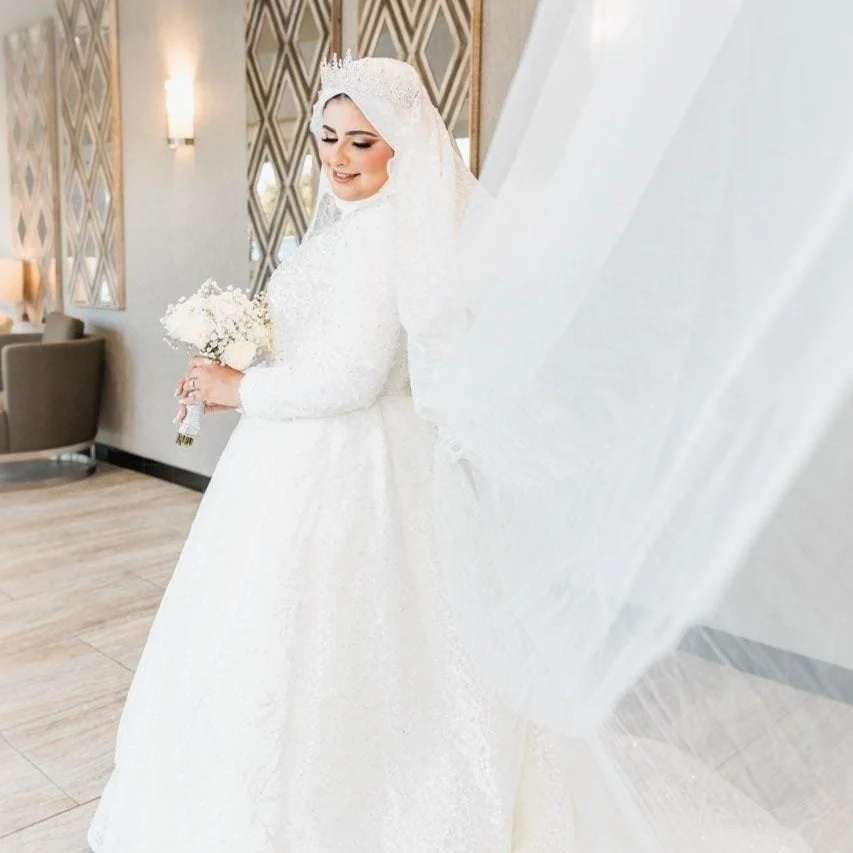
How do you match hijab fabric to gown fabric?
Match the way the fabrics move before you match the colour. A heavy structured gown pairs with a scarf that holds its shape, and a soft flowing gown pairs with a soft draping scarf. A stiff organza hijab over a fluid crepe gown reads as two separate outfits however well the shades line up.
Texture matters as much as weight. A matte gown with a high shine hijab creates a visual break at the shoulders that photographs badly, even when nobody can say why.
| Gown fabric | Hijab fabric that suits | Why |
|---|---|---|
| Crepe | Modal, heavy chiffon, matte satin | Matte on matte, both drape softly |
| Mikado or heavy satin | Silk or matte satin | Structure matches structure |
| Lined lace | Silk chiffon or georgette | Light scarf keeps the lace as the focus |
| Tulle ball gown | Silk or soft georgette | Soft scarf balances skirt volume |
| Beaded or sequinned | Plain matte scarf | Lets the beading lead without competing |
| Any gown | Avoid slippery polyester | It will not hold a pin through a long day |
Which hijab fabrics stay put longest?
Modal, heavy chiffon and silk with a slight texture all grip an undercap well. Smooth polyester satin looks beautiful for an hour and then slides. If you love a slippery fabric, a textured undercap underneath makes it workable.
White, ivory or champagne: which shade works?
Match the hijab to the gown's exact shade, not to the idea of white. A bright white scarf over an ivory gown makes the gown look yellow in daylight, and the mismatch is far more visible in photographs than in a fitting room mirror.
Take the scarf and the gown to a window together before deciding. Shop lighting hides undertone differences that daylight exposes immediately.
Can a Muslim bride wear white?
Yes, and many do. White bridal wear is widely worn across Muslim communities, particularly for the walima. There is no single rule, and colour conventions vary by community and family rather than by faith alone.
What colours do brides wear in different communities?
South Asian brides often wear red, maroon or gold with heavy zardozi work for the nikah. Arab and Arab American brides commonly wear white or ivory. Somali brides often wear dirac in bright colours, and West and East African Muslim brides frequently choose saturated jewel tones. Many brides wear more than one across the events.
What are the main bridal hijab styles?
Bridal hijab styles differ in how much structure they add around the face and how they interact with the gown's neckline. The right one depends on your gown's shoulders and collar as much as on personal preference.
| Style | What it looks like | Suits |
|---|---|---|
| Classic wrap | Smooth drape, ends tucked at the shoulder | Almost any gown, the safest choice |
| Draped with a long tail | One end falls down the back like a soft veil | Fitted and column gowns |
| Turban style | Wrapped close to the head, neck covered separately | High necklines and architectural gowns |
| Layered two tone | Two scarves, one as an accent edge | Simple gowns needing a focal point |
| Crystal band or tiara over the hijab | Jewelled band set over a smooth wrap | Beaded and embellished gowns |
| Hijab with a sheer veil layered over | Veil sits above the scarf, not instead of it | Traditional looks, ceremony photographs |
How do you check the style from every angle?
Photograph the front, both sides and the back before you commit. Brides check the mirror from the front and are then surprised by side profile photographs, where the shape around the jaw and the back of the head is most visible.
How do you keep a bridal hijab secure all day?
Security comes from the undercap and the pinning, not from the scarf. A textured undercap that grips, pins placed where they take the load rather than where they are easy to reach, and a full rehearsal in advance will carry a hijab through twelve hours.
The most useful thing you can do is a wear test. Put on the exact scarf, undercap and pins you plan to use, and keep them on for thirty minutes while moving normally. Every weak point shows up in that half hour.
- Use a textured undercap rather than a smooth one, especially under a silky scarf.
- Pin at the load points, usually just behind the ear and at the back of the crown.
- Use flat head pins, which sit comfortably under layers, and avoid pressure points at the temple.
- Count your pins and write the number down, so the look is repeatable.
- Do hijab after makeup and before the gown, which avoids both smudging and disturbing the scarf.
- Carry a small kit, with spare pins and a spare undercap, handed to someone else to hold.
What about Houston heat and humidity?
Choose a breathable undercap in cotton or bamboo rather than a synthetic one, and pick a scarf fabric that moves air. For an outdoor ceremony in summer, a lighter scarf in a matte finish will be far more comfortable than a heavy satin, and it photographs just as well.
How do you plan prayer into the day?
Build it into the timeline rather than fitting it around the schedule. Knowing when and where you will pray, and whether wudu will disturb the hijab, lets you choose a style you can restore quickly. Telling your photographer and planner in advance avoids the question arising at the wrong moment.
Can you wear a veil over a hijab?
Yes, and it is a common choice. The veil sits over the hijab rather than replacing it, usually pinned to the crown or secured to a band set over the scarf. The result reads as fully bridal while keeping coverage intact.
The mechanical problem is attachment. Most veils are made with a comb that grips hair, and there is no hair to grip. A veil can be stitched to a band, pinned directly into the undercap, or attached to a brooch set over the wrap instead.
Should the veil match the hijab exactly?
It should sit in the same shade family, but a slight difference in finish is fine and often looks better. A matte hijab under a sheer tulle veil gives depth. Two identical finishes stacked can read flat. Our wedding veil guide covers lengths and styles.
What if you remove the veil mid event?
Plan the hijab so it looks complete without the veil, because it will be seen both ways. Test the look with the veil off before the day, and make sure whatever held the veil does not leave the wrap loose when it comes away.

What do you wear for the nikah and the walima?
The nikah is the marriage contract ceremony and tends to be the more traditional and often more modest of the two. The walima is the celebration that follows, and is usually where a bride wears her most elaborate look. Many brides wear different outfits for each.
If one outfit has to cover both, build it with detachable pieces. A gown with a removable overskirt, detachable sleeves or a changeable hijab can read as two distinct looks across the day.
| Element | Nikah version | Walima version |
|---|---|---|
| Skirt | Base gown alone | Add a detachable overskirt or train |
| Sleeves | Full long sleeve | Swap to a sheer or embellished sleeve |
| Hijab | Simple matte wrap | Layered or embellished with a crystal band |
| Veil | Usually none | Layered over the hijab |
| Jewellery | Restrained | Statement pieces |
Should you tell the seamstress about both events?
Yes, at the very first fitting. Detachable pieces have to be planned into the construction rather than added later, and a seamstress who knows the full plan will build the gown differently. Our alterations guide covers how that conversation should run.
Why does fabric opacity matter more than brides expect?
Fabric that looks opaque in a fitting room can turn sheer under a photographer's flash. This is the single most common surprise for brides choosing a modest gown, and it is entirely avoidable with a two minute test before you buy.
The culprits are usually unlined skirts, illusion panels and fine tulle. All three photograph very differently from how they look to the eye.
How do you test opacity properly?
- Stand in front of a bright window and have someone photograph you.
- Take a flash photograph in a dim room, which is the real test.
- Check the skirt from behind with light coming through it.
- Look at illusion panels and sleeves specifically, since they are designed to be semi sheer.
- Ask about adding a lining if anything fails, because it is usually a straightforward fix.
What if a gown fails the test?
Lining is the normal answer and rarely changes the look of the gown. A light crepe or mesh lining behind a sheer panel keeps the design intact while solving the coverage problem. Raise it early so it is costed into the alteration scope.
What should you ask before a bridal appointment?
Ask about the practical conditions before you arrive, not when you are already in the fitting room. A good boutique will answer all of these easily, and the answers tell you a great deal about how the appointment will go.
- Is there a private fitting room away from the main floor?
- Can I ask for female staff only for the appointment?
- May I bring my own scarf and undercap to try with the gowns?
- Do you carry gowns with sleeves and closed backs, or would those be alterations?
- Can sleeves and linings be added in house, and what does that do to the timeline?
- Can I photograph the gowns to review the side and back profile later?
Should you bring your hijab to the appointment?
Always, along with the undercap you actually use. Trying gowns without the headcovering gives you a misleading picture of the neckline and shoulders, and it is the main reason a gown that looked right in store looks wrong later.
Why Houston Brides Choose Estelle Bridal
Estelle Bridal builds gowns rather than only selling them, which matters when coverage requirements are not optional. Sleeves, linings and closed backs are construction decisions here rather than afterthoughts.
- Custom construction so coverage is designed in from the first sketch.
- Private appointments with the room to yourself.
- Sleeve, lining and neckline work on gowns from our collection, plus custom gowns designed with full coverage.
- Experience across cultural bridal traditions in Houston since 2016.
See our wedding gowns and accessories, or contact the studio to discuss what you need.
Frequently asked questions
What is a hijab wedding dress?
A hijab wedding dress is a bridal gown chosen or built so that its neckline, sleeves, back and fabric opacity work as a complete look with a headcovering. It is not a separate garment type, but every design decision accounts for the scarf.
Which wedding dress necklines work best with a hijab?
Jewel, bateau and high stand collars sit cleanly under a hijab with no gap at the neck. Sweetheart, deep V and strapless necklines need a modesty panel or a properly lined illusion layer to work.
Can a Muslim bride wear a veil over her hijab?
Yes. The veil sits over the hijab rather than replacing it, pinned to the crown or attached to a band set over the scarf. Standard veil combs grip hair, so the attachment method usually needs changing.
Should your hijab match your wedding dress exactly?
Match the exact shade, since a bright white scarf over an ivory gown makes the gown look yellow. Finish can differ slightly and often looks better, but check them together in daylight rather than under shop lighting.
How do you stop a bridal hijab slipping during the day?
Use a textured undercap rather than a smooth one, pin at the load points behind the ear and at the crown with flat head pins, and do a thirty minute wear test with the exact scarf and pins before the day.
More questions from Houston brides
Can a Muslim bride wear white?
Yes, and many do, particularly for the walima. Colour conventions vary by community and family rather than by faith, and brides across different communities wear red, gold, jewel tones or white depending on tradition and preference.
Can sleeves be added to a sleeveless wedding dress?
Usually yes, and it is a common alteration. Sheer long sleeves in chiffon or fine mesh can be set into a sleeveless bodice for full coverage without weight. Raise it at the first fitting because it needs planning time.
Which hijab fabric is best for a wedding day?
Modal, heavy chiffon and textured silk all grip an undercap well and hold a pin through a long day. Smooth polyester satin looks good initially but tends to slide, and needs a textured undercap underneath to work.
Do you need two outfits for the nikah and the walima?
Not necessarily. Many brides wear different outfits, but one gown built with detachable sleeves, a removable overskirt and a changeable hijab can read as two distinct looks. Tell your seamstress at the first fitting if that is the plan.
How far in advance should you order a modest wedding dress?
Eight to twelve months if the gown is being made or significantly adapted, since sleeves, linings and neckline changes all add to the timeline. A gown needing only standard alterations can be ordered later, but coverage work is rarely standard.
For related reading, our guides to Muslim wedding dresses, long sleeve wedding dresses and gowns with sleeves all cover the coverage side in more detail.
About the Author
Flo A. is the founder and lead designer of Estelle Bridal in Houston, Texas. Since 2016 she has designed and fitted gowns for hundreds of Houston brides, with particular experience in custom construction, lace and embellished work, and gowns built around fabric that brides bring to her themselves.
To talk through your garment, your cloth and your ceremony plan, book a private appointment at 2428 S Hwy 6, Houston, TX 77077, or call (281) 208-7805.