
Modest Wedding Dresses: How to Define Your Coverage and Find the Gown
Most guides to modest wedding dresses describe a mood. They talk about elegance and timeless style, then stop before the part you actually need. You need to know what counts as covered, how to tell if a lace panel is see through, and what to do when the shop near you has two gowns with sleeves.
This guide handles that. It gives you a way to write your coverage down, a test for opacity you can run in a fitting room, and an honest comparison of the three ways to end up in a gown that fits your rule.
Quick Summary
A modest wedding dress is a gown that covers the parts of your body you have decided to keep covered. Most brides mean some mix of sleeves, a higher neckline, a closed back and opaque fabric. There is no industry standard for the word, so the useful first step is writing your own coverage spec before you shop.
- Write a five line coverage spec before your first appointment: neckline, shoulders, arms, back and opacity.
- Sheer is not the same as covered. Illusion lace and tulle photograph as covered and often are not in daylight.
- There are three routes: buy a gown that is already covered, add coverage to a standard gown, or have one made to your spec.
- Adding sleeves later is a bodice rebuild, not a small alteration, so decide before you order rather than after.
- Call the shop before you book. Ask how many sleeved gowns they stock in your sample size.
- Covered does not mean hot. Lining choice affects temperature far more than sleeve length does.
| Coverage zone | Light | Moderate | Full |
|---|---|---|---|
| Neckline | V neck or sweetheart | At or just above the collarbone | High neck to the base of the throat |
| Shoulders | Straps only | Cap or short sleeve | Shoulder fully covered |
| Arms | Bare | Elbow length | Wrist length |
| Back | Open to the waist | Open to the shoulder blades | Closed to the neck |
| Fabric | Sheer panels are fine | Sheer with partial lining | Fully lined and opaque |
Already know your coverage line? Book a private appointment at Estelle Bridal and bring the spec with you.
What Makes a Wedding Dress Modest?
A wedding dress is modest when it covers the zones you have decided to keep covered. That is the whole definition. The bridal industry uses the word as a style label, which is why two gowns tagged modest can look nothing alike and why one of them may fail your rule outright.
Coverage is not one setting. It is five separate decisions, and brides mix them in ways the word modest never captures. One bride needs wrist length sleeves and is relaxed about the back. Another is fine with bare arms but will not wear anything that shows her back or chest.
Which parts of the body does coverage actually cover?
Five zones decide whether a gown works for you. Treat each one on its own rather than looking for a single gown labelled modest.
- Neckline. How high the front sits, measured against your collarbone rather than against a style name.
- Shoulders. Whether the shoulder cap is covered, and by what.
- Arms. Where the sleeve ends: cap, elbow, three quarter or wrist.
- Back. How far down the opening goes, and whether it closes at the neck.
- Opacity. Whether every covered zone is actually solid, or sheer with lace on top.
Hemline matters for some brides too, usually those working to a tea length or ankle length rule. If that applies to you, add it as a sixth line. Most bridal gowns are floor length anyway, so it rarely becomes the deciding factor.
Does a sleeve automatically make a gown modest?
No. A sleeve that is cut from sheer illusion mesh covers nothing. The arm is visible through it, which is the point of the fabric. It softens the outline of the arm and keeps the gown from reading as strapless, and for plenty of brides that is exactly what they want.
If your rule is opaque coverage, a sheer sleeve fails it no matter how long the sleeve is. This single point causes more wasted appointments than anything else in the search.

How Do You Turn Modest Into a Spec Your Boutique Can Work With?
Write five lines before you walk into a showroom. A stylist cannot read your rule from the word modest, but she can match a gown to five concrete statements in under a minute. This is the single highest value thing you can do before shopping.
How do you write your five line coverage spec?
Use the coverage table above and pick one box per row. Then turn each one into a sentence a stranger could act on. A finished spec looks like this.
- Neckline: at or above the collarbone, no plunge.
- Shoulders: fully covered, no bare shoulder cap.
- Arms: elbow length or longer.
- Back: closed, no lower than the shoulder blades.
- Opacity: every covered zone lined, no sheer panels over skin.
Mark which lines are firm and which are flexible. Most brides have two or three hard rules and two they will bend for the right gown. Saying so out loud saves your stylist from pulling gowns you will never say yes to.
Take the spec to your appointment on your phone. If you are also working to a venue or officiant requirement, confirm that first, because it sets the floor for everything else. Our guide to the church wedding dress covers how houses of worship tend to handle coverage.
How Can You Tell if a Lace or Illusion Panel Is Really Opaque?
Hold the fabric up to a window or a lamp and look at the shadow on your hand behind it. If you can see the outline of your fingers, that panel is sheer. Photographs will not tell you this, because studio lighting and a pale background flatten the difference between lined lace and unlined lace.
Opacity is the one coverage question that almost no bridal guide answers, and it is the one that decides whether a gown passes or fails for a lot of brides. Here is how to settle it in person and online.
What should you check in the showroom?
- Backlight the panel. Stand with a window behind you and have someone look at the gown from the front.
- Look at the seam allowance. A lined panel has a second layer you can see and feel at the edge. An unlined one does not.
- Check in daylight, not showroom light. Step to the door or a window. Warm indoor lighting hides sheerness.
- Photograph it with flash. Flash is harsh and unflattering, which is exactly what you want for this test.
- Ask what is underneath. The answer should be a fabric name, not a reassurance.
What should you check in a photo before you order online?
Look for a detail shot at the shoulder or the upper arm, where the fabric sits against skin rather than against the body of the gown. If every image is a full length shot on a light background, assume the panel is sheer until someone confirms otherwise in writing.
Ask the shop for a close up taken in daylight. A boutique that makes its own gowns can answer the lining question directly, because the lining was a decision someone made rather than a detail nobody recorded.
What Are Your Three Routes to a Modest Wedding Dress?
There are only three. You buy a gown that already meets your spec, you add coverage to a gown that does not, or you have one made. Each route solves a different problem, and the second one is the one brides underestimate.
| Route | Best when | What it cannot fix | Main risk |
|---|---|---|---|
| Buy a covered gown | Your spec is moderate and you have time to search widely | A neckline or back that is wrong for your shape | Very few covered gowns in most showrooms, so the search is slow |
| Add coverage later | You love a gown that misses on one zone only | A plunging front, because raising it rebuilds the torso | Matching fabric is hard, and the addition can look stuck on |
| Have one made | Your spec is strict, or two or more zones are wrong on everything you try | Nothing on coverage, but it needs the longest lead time | Requires a maker who drafts patterns, not a shop that only orders in |
Why is adding sleeves harder than it sounds?
A sleeve needs more fabric than people expect, and it has to match the gown. On lace that is sometimes possible, because extra appliqué can be ordered with the gown. On plain satin or crepe it is far harder, since any join shows on an unbroken surface.
The armhole also has to be recut. A strapless bodice has no armhole to work from, so the seamstress is building one. That is construction, not alteration, and it belongs in the plan before you order rather than six weeks before the wedding. For how fittings and timing work in practice, see our wedding dress alterations guide.
Why is raising a neckline the hardest change of all?
Raising a neckline means redoing the front of the bodice. The cup placement, the boning and the seams were all drafted around the original line, so moving it up changes every one of them. Some designers decline this request at the order stage rather than attempt it.
If a high neckline is a hard line in your spec, do not plan to buy a plunging gown and fix it. Start from a gown that is already close, or go custom.

Why Do So Few Boutiques Have Modest Wedding Dresses to Try On?
Showrooms stock what sells fastest in that market, and strapless has dominated sample ordering for years. Sleeves are increasingly offered as an add on option rather than as finished gowns on the rail. That is a stocking decision, not a statement about what is available to order.
The practical effect is that a bride with a coverage rule can visit three shops and try on four relevant gowns. The fix is to qualify the shop on the phone instead of discovering the problem after you arrive.
What should you ask a boutique before you book?
- How many gowns with sleeves do you have in the showroom right now? A number, not a yes.
- What sample sizes are those in? Two sleeved gowns in one size is not a selection.
- Are the sleeves and necklines lined or sheer? This is the question that saves the trip.
- Can you add coverage in house, and is it quoted before I order? In house work is faster and easier to hold to account.
Four questions, two minutes. If the answers are vague, book somewhere else. A shop that designs its own gowns can usually answer all four without checking.
Can a Modest Wedding Dress Still Look Modern?
Yes, and the thing that dates a gown is almost never the coverage. It is the shape and the surface. A clean high neckline in crepe with a narrow skirt reads as current. The same coverage delivered with shoulder padding, a stiff stand up collar and all over appliqué reads as twenty years old.
Three choices do most of the work here.
- Keep the sleeve close to the arm. Gathering at the shoulder is the fastest way to date a gown.
- Let one zone be the feature. A covered front with a beautiful closed back reads as designed, not as careful.
- Pick fabric with weight. Crepe, mikado and heavy satin hold a clean line. Thin fabrics need volume to look intentional, and volume is what reads as dated.
Silhouette matters as much as surface. If you are not sure which shapes suit you, our wedding dress silhouettes guide walks through them, and the guide to neckline types covers how each one sits on different frames.
How Do You Plan Two Coverage Levels for One Wedding Day?
Build the gown at your ceremony coverage and make the extra layer removable. That is the rule. Brides who need to be covered for the ceremony and want to dance later get into trouble when they try it the other way round.
Three removable options work well when they are planned at the design stage.
- Detachable sleeves. Attached at the shoulder seam or a hidden hook, removed in under a minute.
- A removable modesty panel. Sits inside the neckline and lifts out, leaving the original line.
- An overskirt or cape. Adds coverage and drama for the ceremony, comes off for the reception.
Retrofitting any of these to a finished gown rarely sits well, because the attachment points were not built in. Decide early and the join disappears into a seam. Decide late and the join is visible in every photograph. Our guide on whether a sleeveless wedding dress is appropriate goes further into the coverage options and what each one involves.
What Should Plus Size and Tall Brides Know About Modest Gowns?
Two things change for brides outside standard sample measurements. The covered gowns a showroom does carry are usually in one or two sample sizes, so the already small selection shrinks again. And coverage can fail on fit rather than on cut.
A cap sleeve drafted for a B cup sits differently on a fuller bust, and a neckline that is modest on the hanger can drop once it is filled out. The gown has not changed. The draft has met a different body.
Two practical moves help.
- Judge coverage on your body, not on the rail. Ask to be clipped into the closest sample and look at where the neckline actually lands.
- Ask whether the gown can be ordered with the bodice redrafted rather than ordered and then altered. Redrafting at the order stage is cleaner than taking in a finished bodice.
Height has its own version of this. A gown drafted for five foot six will sit higher on a taller bride, which can move a modest neckline lower than intended, and the sleeve can finish above the wrist. Hollow to floor is the measurement to confirm first, and the how to measure page lists exactly what to record. For more on sizing and fit range, see the plus size wedding dresses guide and how many sizes a wedding dress can be taken in.
Will You Overheat in a Covered Gown?
Lining traps more heat than sleeves do. A single layer of light lining under a lace sleeve wears cooler than a heavy double lined bodice with bare arms. Brides who regret a covered gown in warm weather usually regret the layers, not the coverage.
Ask what every layer in the gown is doing. Some are there for opacity, some for structure and some because that is how the sample was built. Layers that serve no purpose for your gown can often come out.
- Choose breathable lining. A light, smooth lining moves air better than a stiff structured one.
- Count the skirt layers. Each extra layer of tulle adds warmth you will feel after the first hour.
- Pick sleeve fabric for weight. A fine lace sleeve is far cooler than a lined satin one at the same length.
This matters in Houston, where an outdoor ceremony can run warm well into October. Build the gown for the hours you will actually wear it, not for the twenty minutes of the ceremony.

When Should You Start Shopping for a Modest Wedding Dress?
Start ten to twelve months before the wedding. Covered gowns are a smaller share of most showrooms, so the search itself takes longer than it does for a bride with no coverage rule. Production and fittings then run on the same clock as any other gown.
| Stage | How long it takes | When to start it |
|---|---|---|
| Shopping and appointments | Varies with how strict your spec is | 10 to 12 months out |
| Designer gown production | 4 to 6 months | At the point of order |
| Custom gown at Estelle Bridal | 6 to 8 months, depending on complexity | At the design consultation |
| Fittings | 8 to 12 weeks | 2 to 3 months before the wedding |
If your date is closer than that, say so at the first appointment rather than at the end of it. The honest answer may be a gown that is already covered rather than one that needs work. Our guide on how long it takes to get a wedding dress breaks the full schedule down.
How Much Does a Modest Wedding Dress Cost?
Coverage itself adds very little. A sleeve uses a modest amount of extra fabric, and a lined bodice uses one more layer. What raises the price is adding coverage after the gown is finished, because that is skilled hand work on something already built.
That is the part to plan around. A gown bought below budget and then altered into your spec can end up costing more than a gown that was covered to begin with, and it carries the risk that the addition does not match.
At Estelle Bridal a custom wedding dress in Houston is priced on fabric, hand work and complexity rather than on how much coverage you ask for. Alterations are included in every gown price, custom and ready to wear, so the fitting process from the first appointment through to final delivery is part of the price rather than a bill that arrives later.
Want your coverage built in rather than added on? See how the custom process works or talk to our stylists.
Why Houston Brides Choose Estelle Bridal for Modest Wedding Dresses
Coverage designed in, not repaired later. Because the gowns are designed in house, neckline height, sleeve length, back closure and lining are all set before the gown is cut. That removes the fabric matching problem entirely. See the custom gown guide.
Alterations included in every gown price. The fitting process from the first appointment through to final delivery is part of the gown price, custom and ready to wear, rather than a separate bill that arrives later. See the alterations guide.
Private appointments and measurements taken in person. Appointments run Tuesday through Sunday, so you are not shopping alongside another party, and measurements are taken at the appointment rather than from a form. See the how to measure page.
Familiar ground for faith and cultural coverage rules. Guides to Muslim wedding dresses, the wedding dress with sleeves, the long sleeve wedding dresses guide and the wedding veil guide go deeper on styles, sleeves and veils.
Black owned, woman owned Houston boutique since 2016. Founded by Florence Adeboye and featured in Black Brides magazine, with 4.8 stars across 310 Google reviews.
Virtual consultations and nationwide shipping for brides outside Houston. 2428 S Hwy 6, Houston TX 77077, (281) 208-7805. Browse the wedding gowns collection or bridal accessories.
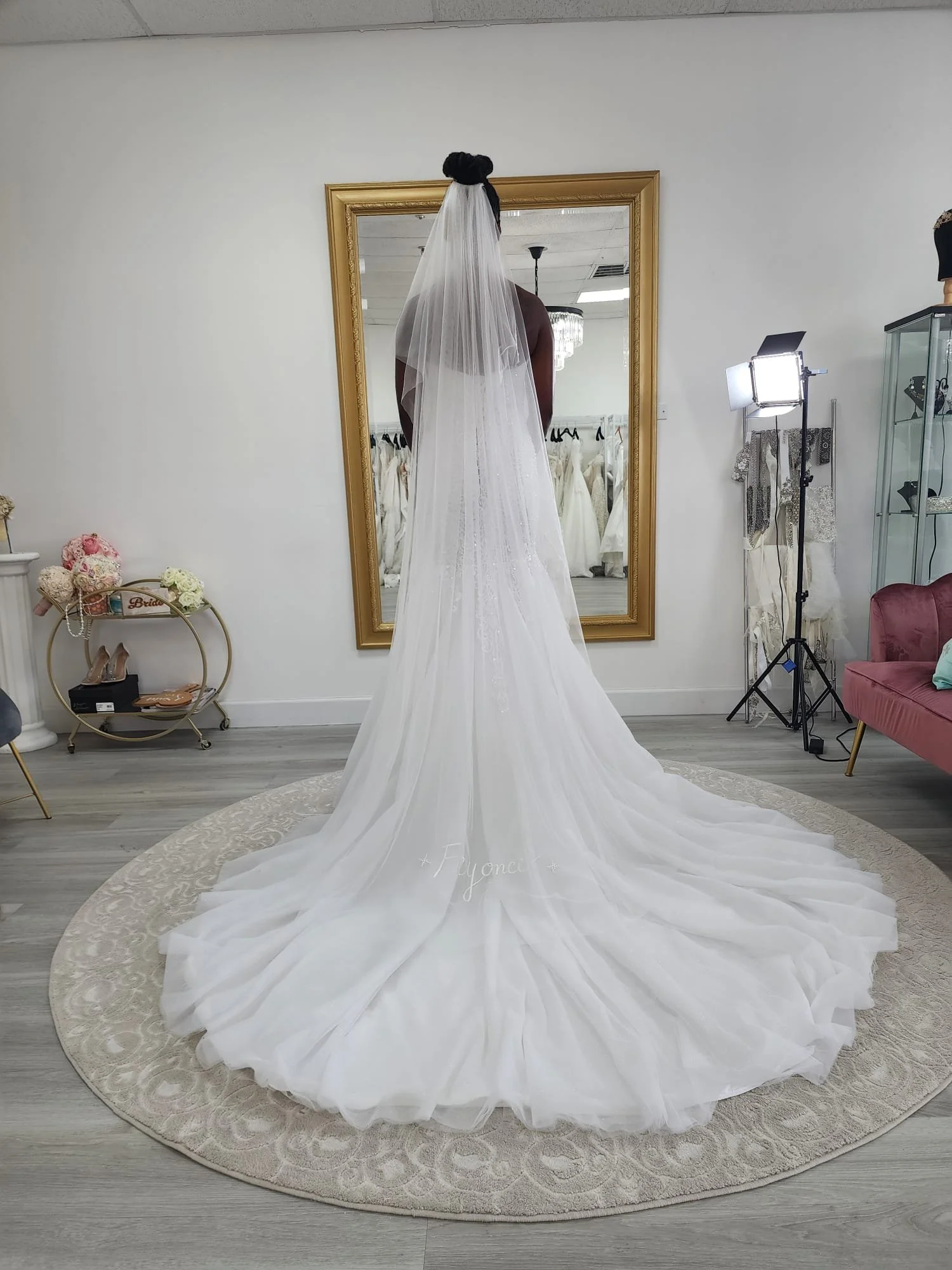
Ready to start? Book your private appointment or call (281) 208-7805. Bring your five line coverage spec and we will work from it.
Modest Wedding Dress FAQs
What makes a wedding dress modest?
A wedding dress is modest when it covers the zones you have decided to keep covered. In practice that usually means some mix of sleeves, a neckline at or above the collarbone, a closed back and opaque fabric. There is no industry standard, so the only definition that matters is the one you write down.
Does illusion lace count as modest?
Not always. Illusion lace is a sheer mesh with lace applied on top, so skin shows through the gaps between the motifs. It reads as covered in photographs and often does not in daylight. If your rule is opaque coverage, ask for the panel to be lined, or choose a solid fabric instead.
Can you add sleeves to any wedding dress?
Most gowns can take sleeves, but it is a rebuild of the bodice rather than a quick addition. The seamstress needs matching fabric, which is hardest to source for plain satin and crepe, and the armhole has to be recut. Decide on sleeves before you order rather than after the gown arrives.
Do modest wedding dresses cost more?
Not because of the coverage itself. Sleeves use a small amount of extra fabric. Cost rises when coverage is added later, because that is skilled labour on a finished gown. Buying a gown that is already covered, or having one made that way, is usually the cheaper path.
How early should you shop for a modest wedding dress?
Start ten to twelve months out. Designer gowns take four to six months to produce, a custom gown at Estelle Bridal takes six to eight months depending on complexity, and fittings run across the eight to twelve weeks before the wedding. Covered gowns are a smaller slice of most showrooms, so the search itself takes longer.
More Questions About Fit, Cost and Timing
Will you overheat in a covered wedding dress?
Lining does more to trap heat than sleeves do. A single layer of light lining under a lace sleeve wears far cooler than a heavy double lined bodice. Ask what each layer is for, and remove the ones that are only there for structure you do not need.
Can a modest wedding dress still look modern?
Yes. What dates a gown is the shape and the finish, not the amount of skin showing. A clean high neckline in crepe, a fitted sleeve with no gathering and a narrow silhouette all read as current. Heavy shoulder padding, stiff stand up collars and busy all over appliqué are what read as dated.
What should you ask a bridal shop before booking a modest appointment?
Ask how many gowns with sleeves they have in the showroom, what sample sizes those come in, whether the coverage is lined or sheer, and whether they can add coverage in house. Four questions on the phone will tell you whether the appointment is worth the trip.
Does Estelle Bridal make modest wedding dresses?
Yes. Estelle Bridal designs custom gowns in Houston, so neckline height, sleeve length, back coverage and lining are all set at the design stage rather than added later. Alterations are included in every gown price, both custom and ready to wear.
How do you keep two coverage levels for one wedding day?
Build the gown at your ceremony coverage and make the extra layer removable. Detachable sleeves, a removable modesty panel and an overskirt all let you change the look after the ceremony. Plan this at the design stage, because retrofitting a removable layer onto a finished gown rarely sits well.
About the Author
Florence Adeboye is the founder and lead designer of Estelle Bridal in Houston, Texas. Since 2016 she has designed and fitted gowns for hundreds of Houston brides, with particular experience in custom coverage, lace and embellished construction, and design solutions for brides whose proportions make standard ordering difficult.
To talk through your own coverage spec, book a private appointment at 2428 S Hwy 6, Houston, TX 77077, or call (281) 208-7805.