
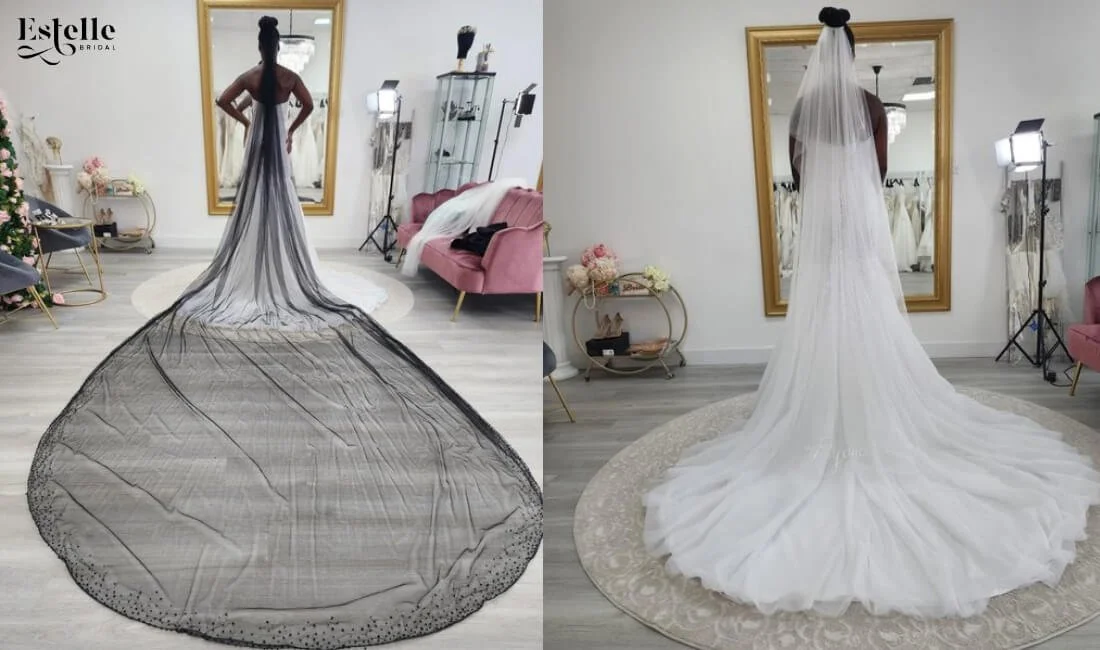
In the grand tapestry of wedding traditions, few elements carry the same weight of symbolism and grace as the bridal wedding veil. This delicate accessory, draped over the bride's head, has been a fixture in weddings across cultures and centuries, evolving from its origins in ancient rituals to become a symbol of purity, modesty, and the transition into a new phase of life.
This guide explains the wedding veil meaning across history, faiths and cultures, then covers the practical questions: who lifts the veil, what each length says and whether you need one at all.
Key Observations
- The earliest well-documented bridal veil is the Roman flammeum, a flame-colored veil linked with faithfulness and fertility, not a white veil.
- In Christian weddings the veil came to stand for modesty, reverence and, when white, chastity. In Jewish weddings the bedeken (veiling) recalls Jacob, Leah and Rachel.
- The white lace veil many brides picture today owes much to Queen Victoria's 1840 wedding, after which veil length and lace quality signaled status.
- No major church or tradition today requires a face veil. Many brides wear one pinned back, choose a blusher only for the processional, or skip it.
- Who lifts the veil depends on the ceremony: the father, the groom or no one at all. Agree on it with your officiant and photographer before the day.
- Some popular "origin stories", such as veils hiding brides from evil spirits, are folklore rather than documented history.
Quick answer: A wedding veil traditionally symbolizes modesty, purity and the bride's passage into married life. In ancient Rome it signaled faithfulness, in Christian ceremonies it expresses reverence, and in Jewish weddings the bedeken veiling recalls the story of Jacob, Leah and Rachel. Today most brides wear a veil because it feels bridal and meaningful to them, not because any tradition requires it.
Here is how the meaning of the veil changes from one tradition to another.
| Tradition | Veil or custom | What it symbolizes |
|---|---|---|
| Ancient Rome | Flammeum, a flame-colored bridal veil | Faithfulness and fertility |
| Christian (Western) | White veil, sometimes with a blusher | Modesty, reverence and, when white, chastity |
| Jewish | Bedeken, the groom lowers the veil before the ceremony | The groom confirms his bride before the ceremony |
| Hindu and Jain | Ghoonghat, the end of the sari or dupatta drawn over the head | Modesty and moving from one family to another |
| Traditional Chinese | Red veil known as the honggaitou | Celebration, with red as the traditional bridal color |
| Victorian era | Long lace veil, as worn by Queen Victoria in 1840 | Status and romance; length and lace showed wealth |
| Modern brides | Any length, worn back, over the face or skipped | Personal style, family heritage or faith |
Sources: Wikipedia, Veil, Flammeum and Ghoonghat; ReformJudaism.org.
In this guide
- What does a wedding veil symbolize?
- Where did the wedding veil come from?
- What does the veil mean in different religions and cultures?
- What does the Bible say about the bridal veil?
- Who lifts the veil, and when?
- Does veil length have a meaning?
- Wedding veil myths vs documented history
- Do you have to wear a veil?
- How to choose a veil that means something to you
- Why choose Estelle Bridal
- Wedding veil meaning FAQs
What Does a Wedding Veil Symbolize?
A wedding veil symbolizes modesty, purity, protection and the bride's transition into married life, although the exact meaning depends on culture and faith. For many modern brides, the veil also stands for heritage, romance and the one moment in life when a veil feels right.
Beyond its aesthetic appeal, the wedding veil is laden with symbolic meaning, representing a variety of cultural and religious beliefs. In many cultures, the veil is seen as a symbol of purity and innocence, with its sheer fabric serving as a metaphorical barrier between the bride and the outside world.
In some traditions, the lifting of the veil by the groom symbolizes the bride's transition from childhood to adulthood, from daughter to wife. It is a moment of great significance, marking the beginning of a new chapter in the couple's lives together.
Read More: Perfect Wedding Veil Guide: Find Your Veiled Elegance
Additionally, the veil is often seen as a symbol of protection, shielding the bride from any harm or misfortune that may come her way. In this sense, it serves as a tangible expression of the groom's commitment to care for and protect his bride throughout their marriage.
What Is a Veil, and What Is the Purpose of a Wedding Veil?
When do you take off your wedding veil?
What is a mantilla veil?
Where Did the Wedding Veil Tradition Come From?
The wedding veil tradition goes back at least to ancient Rome, where brides wore a flame-colored veil called the flammeum. The veil later took on Christian meaning in medieval Europe and became the white lace symbol we know today after Queen Victoria wore one at her 1840 wedding.
Tracing its roots back to ancient times, the wedding veil has a rich history steeped in tradition and symbolism. In ancient Rome, brides would wear a veil to ward off evil spirits and protect themselves from the envious gaze of others. Similarly, in ancient Greece, the veil was seen as a symbol of modesty and obedience to the groom.
Read More: How to Choose the Right Wedding Veil Style for Your Dress
Throughout the Middle Ages, the veil took on religious significance within Christian ceremonies, symbolizing the bride's purity and her submission to God and her husband. It was often worn as a symbol of reverence and respect for the sacred vows of marriage.
As fashion evolved over the centuries, so too did the wedding veil. From intricate lace veils adorned with pearls and jewels in the Victorian era to the sleek, minimalist designs of modern times, the veil has remained a timeless accessory, adapting to reflect the trends and styles of each era.
What Was the Roman Flammeum?
The flammeum was the veil worn by brides at Roman weddings and the most prominent part of the bridal costume. Ancient writers disagree on its exact color, describing it as deep yellow or as reddish, and it was associated with faithfulness and fertility. Roman writers mention it from about the 2nd century BCE to the 4th century CE.
Source: Wikipedia, Flammeum.
How Did Queen Victoria Change the Bridal Veil?
Queen Victoria married Prince Albert on 10 February 1840 wearing a long Honiton lace veil with a wreath of orange blossom instead of a tiara. Her wedding helped return the bridal veil to fashion, and through the Victorian era the weight, length and quality of a bride's veil came to signal her social status.
Sources: Wedding dress of Queen Victoria and Veil, Wikipedia.
How Have Royal Weddings Shaped Veil Length?
Famous royal veils keep long veils in fashion. Princess Diana wore a 25-foot veil in 1981, and Meghan Markle wore a 16-foot veil in 2018, according to a CNN Style report. Brides who love that look today often choose a cathedral-length veil.
Source: CNN Style via KTVZ.
What Does the Veil Mean in Different Religions and Cultures?
The veil means something different in each faith and culture. Christian brides often see it as reverence and modesty, Jewish brides connect it to the bedeken ritual, and Hindu, Muslim and Chinese traditions each have their own head coverings and meanings. Veiling as a practice predates Islam and is also observed by some Christians and Jews.
Source: Encyclopaedia Britannica, Veil.
What Does the Veil Mean in a Christian or Catholic Wedding?
In Western Christian weddings the veil traditionally expresses modesty before God, obedience and, when white, chastity. The Catholic Church does not require a veil or a face-covering blusher. A Baltimore-area parish priest described face veils as roughly "half and half" among the brides he marries.
Sources: Wikipedia, Veil; Catholic Review, Archdiocese of Baltimore.
If you are marrying in a church, our church wedding dress guide covers dress codes, coverage and veil etiquette for ceremonies in a sanctuary.
What Is the Bedeken at a Jewish Wedding?
The bedeken is the Jewish veiling ceremony, held just before the wedding, where the groom lowers the veil over the bride's face. The custom recalls the story of Jacob, who married Leah instead of Rachel because he could not recognize her under a heavy veil. Rabbi Bonnie Koppell notes that brides today may wear a veil over the face, pin it back or skip it altogether.
Source: ReformJudaism.org.
Why Do Hindu Brides Cover Their Heads?
Many Hindu and Jain brides cover their heads with the ghoonghat, the end of a sari or dupatta drawn over the head. A bride may wear veils given by both families, symbolizing her move from the care of one household to another. Customs vary widely by region and family.
Source: Wikipedia, Ghoonghat.
Do Muslim Brides Wear Veils?
Many Muslim brides wear a hijab or a decorative bridal head covering, often layered with a lace or embroidered veil, while others do not. Styles depend on country, culture and personal practice. Our guide to Muslim bridal dresses covers modest gowns that pair well with a hijab and veil.
What Is the Chinese Red Veil?
In traditional Chinese weddings, brides covered their heads with a red veil known as the honggaitou, a custom recorded from the Song dynasty. Red is the celebratory bridal color in Chinese tradition, which is why the veil was red rather than white.
Source: Wikipedia, Veil.
What Does the Bible Say About a Bride Wearing a Veil?
The Bible does not command brides to wear a wedding veil, but it includes veiling stories that shaped the tradition. In Genesis 24, Rebekah covers herself with a veil when she first sees Isaac, and Genesis 29 tells how Jacob was deceived into marrying Leah, a story Jewish tradition links to her veil. Christians also point to 1 Corinthians 11, where Paul writes about head coverings in worship.
Different churches read these passages in different ways, so ask your pastor or priest if your ceremony has a local custom.
Who Lifts the Bride's Veil, and When?
Either the father of the bride or the groom lifts the veil, and the moment depends on the ceremony. In many Christian weddings the father lifts the blusher at the end of the aisle, while some couples save it for the groom before the kiss. In Jewish weddings the groom lowers the veil at the bedeken before the ceremony.
| Ceremony | Who usually handles the veil | When | Photo tip |
|---|---|---|---|
| Christian, father lifts | Father or escort | At the end of the aisle, before the vows | Your face is visible for the whole ceremony |
| Christian, groom lifts | Groom | Just before the first kiss | Fewer clear face shots during the vows |
| Jewish | Groom | Lowers it at the bedeken, before the ceremony | Ask your photographer to cover the bedeken |
| Civil or courthouse | Bride or partner, if worn at all | Whenever feels natural | Short veils photograph well in small rooms |
Brides on wedding forums often mention one regret: keeping the blusher down until the kiss and ending up with no clear photos of their face during the vows. Agree on the plan with your officiant and photographer ahead of time.
What Is a Blusher Veil?
A blusher is a short, sheer layer of veil worn over the face as the bride walks down the aisle, then lifted back over the head. It is the part of the veil most tied to the traditional "lifting of the veil" moment. Many veils have a removable blusher, so you can wear it for the processional and remove it for the reception.
Does the Length of a Wedding Veil Have a Meaning?
Veil length does not carry a fixed religious meaning, but it changes the mood of your look. Longer veils read formal and traditional, echoing Victorian and royal weddings, while short veils feel modern and playful.
| Veil style | The feeling it creates | Works well for |
|---|---|---|
| Birdcage | Vintage and playful | Courthouse, city hall and short dresses |
| Blusher | Traditional, the classic reveal | Religious ceremonies and first-look moments |
| Elbow or fingertip | Classic and easy to wear | Most gowns and long receptions |
| Chapel | Formal and romantic | Church weddings and A-line gowns |
| Cathedral | Grand, royal and dramatic | Large venues, long aisles and ball gowns |
| Heirloom veil | Family history and continuity | Brides honoring a mother or grandmother |
For exact lengths and how each one pairs with your dress, read our wedding veil guide and veil styles for wedding dresses.
Which Wedding Veil Stories Are Myths and Which Are History?
Some veil stories are well documented, and others are folklore passed from one wedding article to the next. Knowing the difference helps you choose the meaning you actually want to carry down the aisle.
| Claim | What the record shows |
|---|---|
| Roman brides wore a bridal veil | Documented: the flammeum appears in Roman writing |
| Veils hid brides from evil spirits | Folklore: repeated in wedding lore, but not well documented |
| Queen Victoria made the white veil fashionable | Documented: her 1840 veil revived the trend |
| The bedeken recalls Jacob and Leah | Documented in Jewish teaching on the custom |
| Brides must wear a veil in church | Not true for most churches; customs vary by parish |
See Snopes on wedding veil lore and the sources linked above.
Do Brides Still Wear Veils, and Do You Have to Wear One?
No, you do not have to wear a veil. Many brides still choose one because it instantly feels bridal, but others prefer a hairpiece, flowers or nothing at all. The decision is about your style, your faith and your venue.
While the traditional white veil remains a popular choice for many brides, modern interpretations of this classic accessory abound. From dramatic cathedral-length veils to chic birdcage veils and everything in between, there is a veil to suit every bride's style and personality.
Some brides opt to forego the veil altogether, choosing instead to accessorize with floral crowns, hairpieces, or statement earrings. Others may incorporate family heirlooms into their veil, adding a personal touch to this timeless accessory.
Why Do Some Brides Not Wear a Veil?
- It is not their style: Some brides prefer a clean, modern look or a statement hairpiece.
- They do not connect with the symbolism: The veil's traditional meanings do not fit every couple.
- Wind and weather: Long veils can be hard to manage at outdoor and waterfront venues on breezy days.
- Comfort: A blusher over the face can feel warm or closed in.
Not sure? Many brides wear the veil for the ceremony and portraits, then remove it for the reception. Our bridal hair accessories guide covers combs, pins and crowns that work with or without a veil.
Can You Wear a Veil If You Have Been Married Before?
Yes. The old idea that only first-time brides wear veils has faded, and a CNN Style report notes the taboo largely waned in the 1980s. Wear one if it feels right to you. See our second wedding dress guide for more styling ideas.
How Do You Choose a Veil That Means Something to You?
Choose a veil by deciding what you want it to say first, then matching length, fabric and placement to your dress and venue. A veil chosen for meaning, whether faith, family or simply joy, feels far more personal than one picked only for trend.
- Decide on the meaning: Faith, family heritage, a nod to a culture, or simply the look you love.
- Plan the ceremony moment: Will you wear a blusher, and who will lift it?
- Match the dress: Lace-edged veils suit lace gowns; plain-edged veils let beading and back details show.
- Think about the venue: Long aisles suit chapel and cathedral lengths; outdoor sites suit shorter or weighted veils.
- Try it with your gown: Color matters. Ivory, white and diamond white veils look different against each gown.
Ultimately, whether elaborate or understated, the custom wedding veil continues to hold a special place in the hearts of brides and grooms around the world. More than just a piece of fabric, it is a symbol of love, tradition, and the promise of a lifetime together.
Why Choose Estelle Bridal for Your Veil and Gown in Houston?
Estelle Bridal is a Houston bridal boutique that has dressed brides since 2016, with gowns, veils and accessories you can try together in one appointment. Our stylists help you choose a veil that fits your meaning, your ceremony traditions and your dress.
- Try the veil with your gown: See veil length, color and edge against your actual dress, not a photo.
- Help with ceremony traditions: We style brides for church, cultural, courthouse and destination weddings, and can talk you through blushers and veil placement.
- Custom gowns and accessories: Our custom wedding gowns can be designed with the veil in mind, so lace, beading and trim work together.
- Alterations included: Alterations are included in every custom gown price for gowns bought from our collection.
- Personal service: Private appointments, plus virtual consultations for brides outside Houston.
- Trusted locally: A Black-owned, woman-owned boutique featured in Black Brides magazine, at 2428 S Hwy 6, Houston TX 77077.
Browse our bridal accessories or read our guide to bridal veils in Houston before your visit.
Find the veil that tells your story. Try veils and gowns together with a stylist at our Houston boutique.
Wedding Veil Meaning FAQs
What is the meaning of the veil in a wedding?
The veil in a wedding traditionally means modesty, purity and the bride's passage into married life. Its exact meaning depends on the tradition, from Roman faithfulness to Christian reverence and the Jewish bedeken.
Why do brides wear veils?
Brides wear veils for tradition, faith, family heritage and style. Today most brides choose a veil because it makes the look feel bridal and connects them to the brides who came before them.
What is the rule of wedding veils?
There is no universal rule. Most traditions and churches do not require a face veil, and modern etiquette leaves the choice of length, style and whether to wear one to the bride.
Does the veil have to cover my face?
No. A face-covering blusher is optional. Many brides wear the veil pinned behind the head for the whole day, while others wear a blusher only for the processional.
When does the groom lift the veil?
If the groom lifts the veil, he usually does it just before the first kiss. In many Christian ceremonies the father lifts it at the end of the aisle instead, and in Jewish weddings the groom lowers it at the bedeken.
Do Catholic brides have to wear a veil?
No. The Catholic Church does not require brides to wear a veil or blusher, although many choose one for tradition. Check with your parish for any local customs.
Is a Jewish bride required to wear a veil?
No. According to Reform rabbinic guidance, brides may wear a veil over the face, pin it back or skip it. The bedeken ritual remains popular with couples who want it.
When should a bride take off her veil?
Most brides remove the veil after formal portraits or before the first dance, so it does not catch while dancing. A long veil can be swapped for a comb or hairpiece for the reception.
Will I regret not wearing a veil?
In bridal forums, most brides who skipped the veil say they did not regret it. If you are unsure, bring one to the wedding, wear it for a few portraits, and decide on the day.