
Toddler Flower Girl Dresses: Sizing, Length and Comfort
Most flower girl advice is written for a seven year old. A two year old is a completely different problem, and almost nothing written about flower girl dresses acknowledges that.
A toddler will not stand still to be measured, will outgrow a dress ordered six months out, may refuse to walk down the aisle on the day, and will tell you immediately if a seam itches. None of that is a reason to leave her out. It is a reason to choose the dress differently.
Quick Summary
Order a toddler flower girl dress by her chest and height measurements rather than by the age on the label, keep the hem clear of her feet, and choose a fastening that can be let out as she grows. Then plan the day around the fact that she is two, not around the photographs you have in mind. A comfortable toddler who walks halfway is a better outcome than a perfect dress on a crying child.
- Age labels are not sizes. Two children of the same age can be two sizes apart, so the measurement is the only number that means anything when you order.
- Floor length is a genuine trip hazard at this age. A toddler who is still finding her balance will step on a long hem on the first stair, which is why knee or tea length is the safer choice.
- Buy room, not a perfect fit. Children grow between the order and the wedding. Length can be shortened in an afternoon, width across the chest and back cannot be added at all.
- The lining decides everything. Stiff net against a toddler's knees and neck is the single most common cause of a child pulling at her dress through the ceremony.
- Plan for her not walking. Plenty of toddlers freeze at the top of the aisle. Walking with a parent, being carried, or skipping the walk entirely are all normal, and worth agreeing in advance.
- Nothing small, loose or removable. Buttons, beads and detachable flowers are a choking risk at this age, so check the trim before you commit.
| Stage | What to prioritise | What to avoid |
|---|---|---|
| Not yet walking | Short length, soft fabric, easy nappy access | Any length that reaches the floor |
| Walking but unsteady | Knee length, flat worn in shoes, light skirt | Heavy skirts, long sashes that trail |
| Confident walker, around 3 | Knee or tea length, tie back for adjustment | Fixed zips, stiff net linings |
| Nearly 4 and steady | Tea length, fuller skirt if she enjoys it | Full floor length with a train |
| Ordering far ahead | Size up, adjustable back, generous hem | Ordering to exact current measurements |
Bring her in and we will measure her properly, even if it takes three attempts. Book a private appointment and we will fit around her nap.
Why is sizing a toddler so different?
Because the label is describing an average child who may not resemble yours at all. A tall two year old and a petite three year old can need the same dress, and the number on the tag will tell you neither of those things.
On top of that, toddlers are shaped differently from older children. They are rounder through the middle, shorter in the torso, and often still in nappies, which adds width exactly where a fitted waist sits. A dress cut for a slim six year old scaled down does not fit a two year old properly.
What should you order by instead?
Chest measurement first, then height. Chest is what decides whether the dress closes at all. Height decides the hem, and the hem is the easy part to change. If her chest measurement sits between two sizes, take the larger one every time.
Does a custom dress solve this?
Largely, yes. A dress made to her measurements avoids the gap between a standard age size and a real child, and it can be drafted with extra seam allowance built in so there is room to let out closer to the day. That is the same principle behind our custom flower girl dresses, scaled to the smallest wearers.
How do you measure a child who will not stand still?
Accept that it will take more than one go, and measure her over the kind of clothing she will actually wear underneath, not over a jumper.
What is the practical method?
Measure while she is distracted rather than while she is being asked to cooperate. Standing at a screen, sitting on a lap, or mid snack all work better than being told to stand up straight. Take the chest at the fullest part, the waist at the natural waist, and the length from the shoulder down to where you want the hem to fall. Our how to measure page sets out the method, and the same principles apply at a smaller scale.
How accurate does it need to be?
Close is good enough on chest and waist, because you are sizing up anyway. Length is the one worth repeating, since a hem that is too long is the main safety problem at this age. Take the length twice on different days and use the longer figure.
What if you cannot measure her at all?
Bring a dress that currently fits her well and we will measure that instead. A garment that already works tells us more than a reluctant toddler standing in a studio.
What length is actually safe for a toddler?
Short enough that she cannot stand on it. That is the whole rule, and it rules out most of the floor length dresses that look so appealing in photographs.
| Length | How it works for a toddler | Verdict |
|---|---|---|
| Knee length | She can walk, climb steps and run without catching it | Safest option under three |
| Tea length | Clears the ankle, still reads as formal | Best balance for most toddlers |
| Ankle length | Workable for a steady walker, risky on stairs | Only if she is confident on her feet |
| Floor length | She will stand on it, usually on the first step | Avoid at this age |
| Any length with a train | Trips her and anyone walking behind her | Avoid entirely |
If you want the longer look for the bridal party overall, put the length on the older children instead. Our guides to flower girl versus junior bridesmaid and junior bridesmaid dresses cover where that line falls.
What about the venue floor?
Worth a thought. Grass catches a hem that stone does not, and a toddler on an uneven lawn in a long skirt is a fall waiting to happen. Shorter is better outdoors, not just indoors.
Which fastenings give you room to grow?
This is the detail that decides whether one dress survives from order to wedding day. A fixed zip gives you nothing. A tie or corset back gives you months.
What should you look for?
A ribbon tie back or a laced back, because both adjust across a range rather than at one setting. A separate sash that can be moved up or down as her waist changes. Shoulder straps that can be shortened. A hem with real allowance folded into it rather than a finished edge with nothing spare.
Are buttons a problem?
Small covered buttons down a back are lovely and genuinely awkward with a toddler, because a child this age will not stand still for twenty of them while everyone is waiting. They are also the trim most likely to work loose. A tie back is faster and safer.
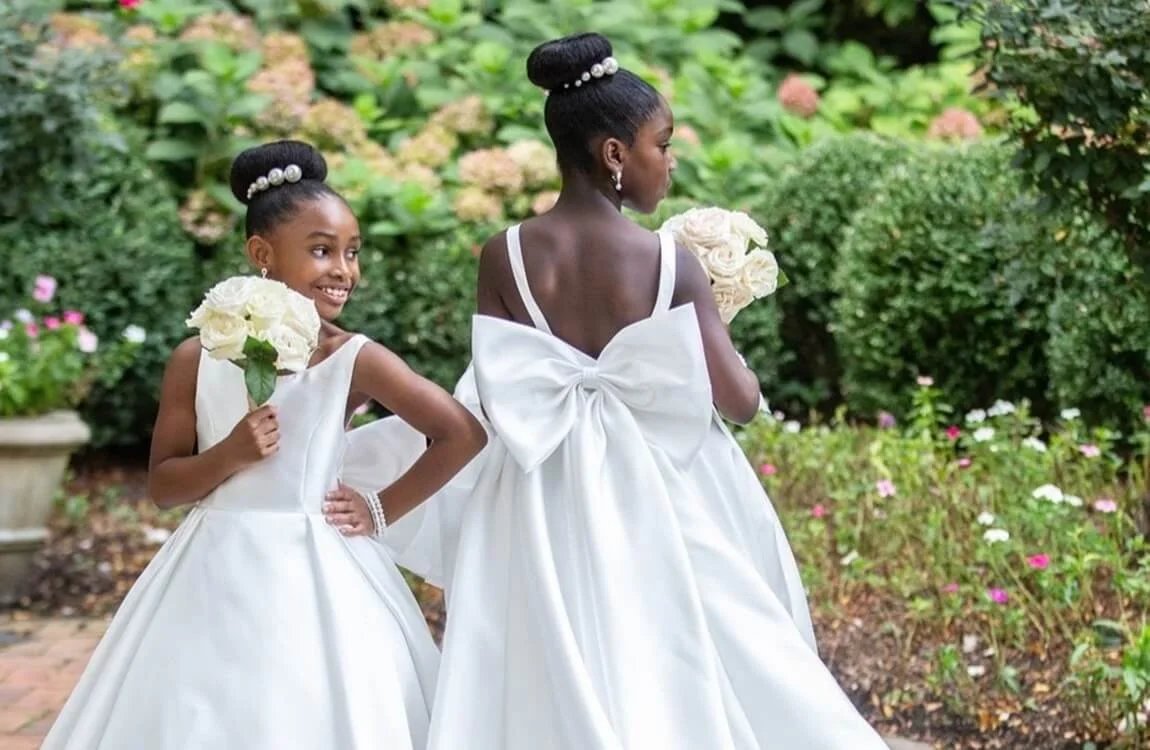
What should you check before you buy?
Turn the dress inside out before you look at the outside. With a toddler, the inside is what decides whether the day goes well.
What are you actually checking?
Run a hand along the inside of the neckline and the armholes. Check that the skirt lining runs the full length rather than stopping above the knee, because a short lining under long tulle is what scratches. Look for flat seams rather than bulky ones at the waist, since that is where she will be picked up and held.
What about safety specifically?
Pull gently on every bead, button and applique flower. Anything that moves is a choking hazard with a child this small, and it is far better to find it in the shop than on the morning. Avoid long loose ribbons that can wrap, and anything with a cord around the neck.
Which fabrics are kindest?
Soft tulle over a full cotton lining, or a cotton blend on its own. Both look right and both stay comfortable. Stiff net is the one to refuse, however good it looks on the hanger, and heavy satin shows every crease the moment she sits down.
Does a toddler flower girl have to wear white?
No, and at this age a colour is often the more practical choice. White shows everything a toddler will do to it before the ceremony has even started.
How do you decide?
If the bride is in ivory, a white dress beside her looks wrong in photographs, which is the whole subject of our guide to white flower girl dresses. Matching the shade properly takes a fabric swatch and daylight. A soft colour sidesteps that entirely and hides a dropped snack rather better.
Which colours work?
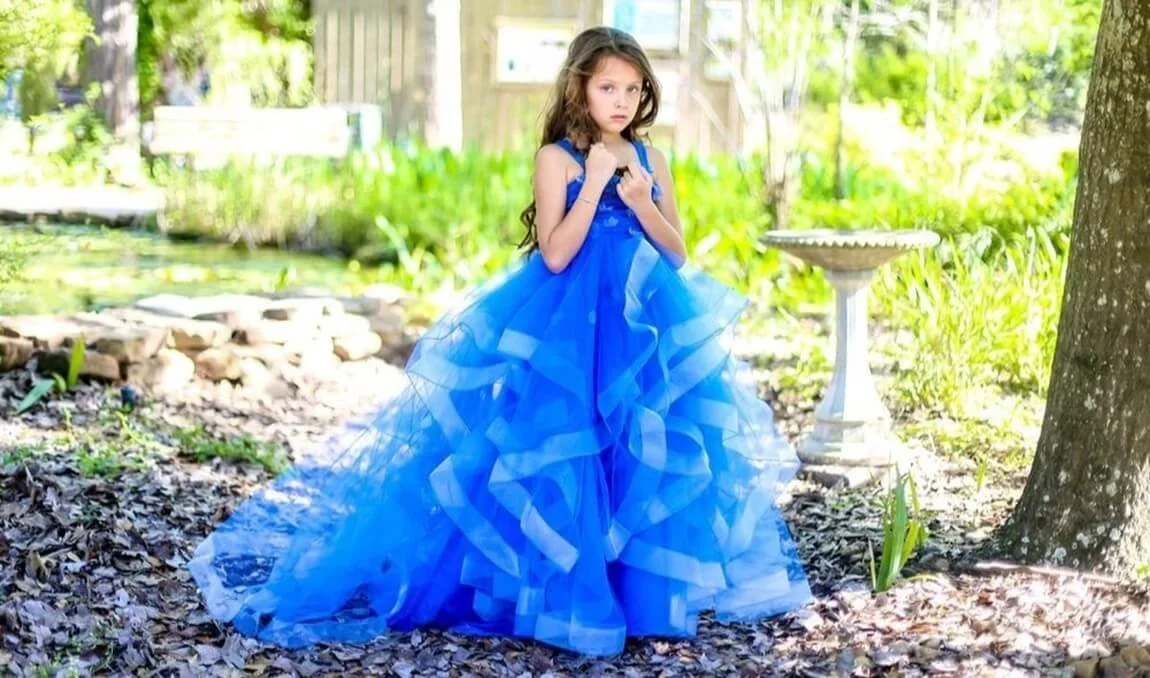
Blush, ivory, pale gold and the bridal party colour all photograph well on small children. A stronger colour reads as a deliberate choice rather than a mismatch, and our guide to the blue flower girl dress covers how a bolder shade sits within a party.
How do you keep a toddler comfortable all day?
You do not. You keep her comfortable for the part that matters and let the rest go.
How long should she be in the dress?
For the ceremony and the photographs, and not much longer. Most families change a toddler into something soft before the reception, and nobody notices. Putting her in the dress at the last sensible moment is better than having her in it from breakfast.
What about the nap?
Plan around it rather than through it. A ceremony that lands in the middle of her usual nap will not go well no matter how good the dress is. If the timing is fixed, a short nap beforehand in comfortable clothes is worth the extra change.
What should she wear on her feet?
Shoes she has already worn, with a sole that grips. New shoes on a toddler at a wedding is the most reliable way to produce tears before the ceremony starts. Soft ballet styles and simple strapped shoes both work, and a spare comfortable pair in a bag is always worth carrying. The same principle applies to adult footwear, which our bridal shoes guide covers in detail.
What should be in the bag?
A change of clothes, a spare pair of shoes, wipes, a snack that does not stain, and something quiet to hold. None of it is glamorous and all of it saves the day.
What if she will not walk down the aisle?
Then she does not walk, and the wedding carries on. This is the single most common toddler outcome and the one families prepare for least.
| What happens | What to plan |
|---|---|
| She freezes | A parent or older child walks with her, agreed beforehand |
| She refuses entirely | She is carried, or seated with family and skips the walk |
| She runs ahead | Someone waits at the front to catch her, not behind to chase |
| She will not drop petals | Give her a small basket to carry instead, with nothing to do |
| She cries partway | A parent steps out and collects her, no fuss, keep going |
Should she be paired with an older child?
It helps a great deal. A junior bridesmaid or an older flower girl holding her hand turns an intimidating walk into following someone she knows. The complete guide to dresses by role covers how the party fits together, and the choosing the perfect flower girl dress guide covers the pairing side.
When should you order?
Later than you would for an adult. Three months ahead is ideal for a toddler, because measurements taken six months out will be wrong by the wedding.
What if you have to order early?
Size up and choose an adjustable back. Then plan a fitting four to six weeks before the day so the hem and straps can be set to the child she actually is by then. The same sequence as adult wedding dress alterations, compressed.
How does this fit the overall schedule?
The whole party runs on the bride's timeline, and our guide to how long it takes to get a wedding dress sets that out. Children are the one group you deliberately leave until later. You can see the ranges on our products page and the wider party on the bridesmaids page.
What should you confirm before ordering?
Chest measurement rather than age. Length that clears her feet. An adjustable back. A full soft lining. Trim that does not come loose. Settle those five and the dress will work. The broader style options are covered in our flower girl dresses guide and in modern flower girl dresses.
Why Houston Brides Choose Estelle Bridal
We measure the child, not the label. Every children's dress is made or altered to real measurements, which removes the gap between a standard age size and an actual toddler.
Room to grow is built in. Adjustable backs, movable sashes and a generous hem allowance mean one dress can carry a child across the months between ordering and the wedding.
Comfort is checked as part of the fit. Linings, armholes, neckline finishes and loose trim are all checked for a child who has to wear the dress all day and put it in her mouth.
The whole party is dressed in one place. Bride, bridesmaids and flower girls are fitted through the same studio at 2428 S Hwy 6 in Houston, so the colours agree with each other. Questions before you book are welcome through our contact page.
Toddler Flower Girl Dress FAQs
What size flower girl dress should I order for a toddler?
Order by her chest measurement rather than by the age on the label, and take the larger size if she falls between two. Children of the same age can be two sizes apart, so the age printed on a tag tells you very little.
How long should a toddler flower girl dress be?
Knee or tea length. Anything that reaches the floor is a trip hazard for a child who is still finding her balance, and the first set of stairs is usually where it goes wrong.
How far in advance should I order a toddler flower girl dress?
About three months. Measurements taken six months ahead will be wrong by the wedding, so ordering later and fitting closer to the day gives a far better result.
What fabric is best for a toddler flower girl dress?
Soft tulle over a full cotton lining, or a cotton blend. Both look formal and stay comfortable. Stiff net is the usual cause of a child pulling at her dress all the way through a ceremony.
What if my toddler will not walk down the aisle?
Agree a plan before the day. Walking with a parent, holding an older child's hand, being carried, or skipping the walk entirely are all perfectly normal and none of them disrupt the ceremony.
More Toddler Flower Girl Questions
Should a toddler flower girl wear white?
She can, but a soft colour is often more practical at this age. White shows everything, and matching the exact shade of white to the bridal gown takes a fabric swatch and daylight to get right.
What back fastening is best for a growing child?
A ribbon tie or a laced back, because both adjust across a range. A fixed zip gives you one setting and no room at all if she grows before the wedding.
Are beads and buttons safe on a toddler dress?
Check every one by pulling gently before you buy. Anything that moves is a choking hazard with a child this small, and loose trim is far better found in the shop than on the morning of the wedding.
What shoes should a toddler flower girl wear?
Shoes she has already worn in, with a sole that grips. New shoes on a toddler at a wedding reliably produce tears, and a spare comfortable pair in a bag is always worth carrying.
Does she have to wear the dress all day?
No, and most families do not keep her in it. The ceremony and the photographs are what matter. Changing her into something soft for the reception keeps her happy and nobody notices.
About the Author
Florence Adeboye is the founder and lead designer of Estelle Bridal in Houston, Texas. Since 2016 she has designed and fitted gowns for hundreds of Houston brides, with particular experience in custom construction, lace and embellished work, and gowns built around fabric that brides bring to her themselves.
To talk through your garment, your cloth and your ceremony plan, book a private appointment at 2428 S Hwy 6, Houston, TX 77077, or call (281) 208-7805.