
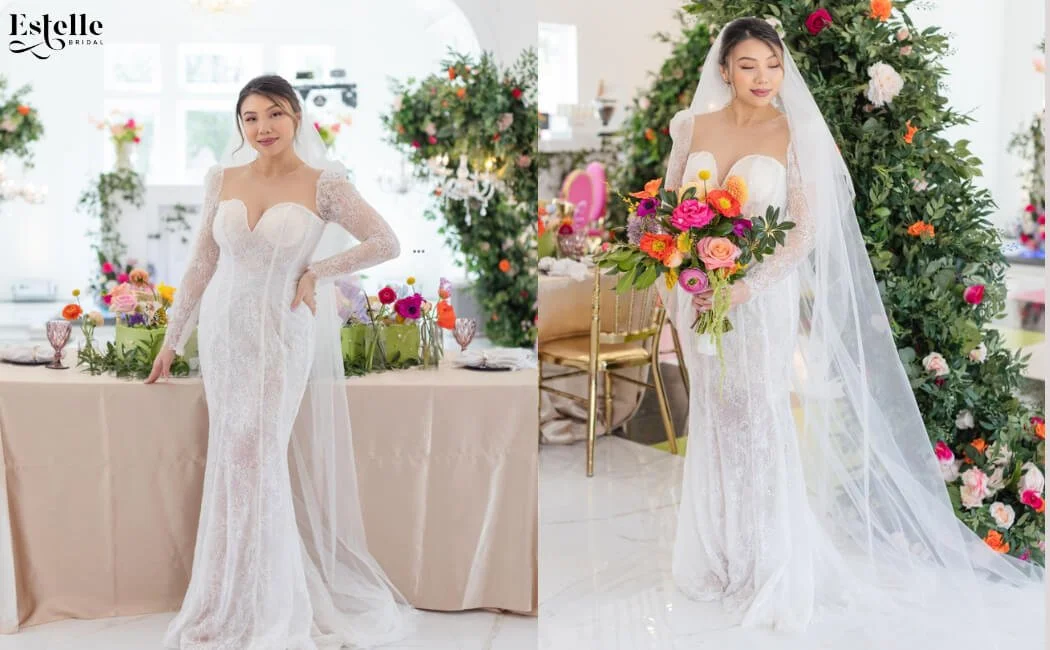
The neckline is one of the most important design decisions in a custom wedding dress because it frames the face in every photograph and sets the visual tone of the entire gown. Sweetheart necklines suit nearly every body type and are the most consistently requested at Estelle Bridal, while V-necks create elongation and plunging options make a bold statement. Scoop and bateau necklines offer understated elegance, off-the-shoulder necklines create romantic femininity, and illusion necklines allow brides to show coverage while maintaining a modern, delicate look. The right neckline depends on your body type, your venue, your coverage requirements, and the silhouette of your gown. At Estelle Bridal in Houston, every custom neckline is designed from your individual measurements with alterations included in every custom gown price.
Choosing the right neckline is one of the most important decisions a bride makes when designing a custom wedding dress. The neckline frames the face in every photograph, sets the visual tone of the entire gown, and directly determines how comfortable and confident the bride feels across a full wedding day. There are many different types of custom wedding dress necklines to choose from, depending on your personal style, body type, coverage requirements, and the overall design of your gown.
At Estelle Bridal in Houston, neckline selection is one of the first conversations in every custom gown consultation. Founder Flo A. has been helping Houston brides find their ideal neckline since 2016, with expertise in how each style photographs across Houston's range of venues, how each interacts with different body types, and how each can be modified for coverage requirements at church ceremonies. This guide covers every major custom wedding dress neckline with practical body type guidance and Houston-specific advice. For the full neckline-to-body-type reference, see our wedding dress necklines guide.
Key Observations
- A strapless bodice is not held up by the bust. It is held by circumference and friction at the ribcage, and the top edge is the last thing holding it rather than the first.
- Every neckline demands a different internal structure. The shape you can see is a consequence of boning, cups and a waist stay you cannot.
- Necklines gape because the edge is too long for the body it crosses, not because the dress is too big. Tightening the zip makes it worse.
- Bust shape decides more than bust size. Wide-set or close-set, full on top or full underneath, and asymmetry all change which neckline sits correctly.
- Fabric can almost always be taken away and almost never put back. A neckline you may want higher later must be bought with the height already there, or with matching fabric reserved.
- Illusion mesh only disappears when it is matched to your skin. It is usually sold in a narrow shade range, which is a real problem the industry does not discuss honestly.
V-Neck Neckline
A V-neck neckline is a classic and versatile option for wedding dresses. It is shaped like a "V," with the point dipping down between the bust. The depth of the V can vary from shallow to plunging, depending on your preference and the style of the dress.
A shallow V-neck is flattering on many body types and is a great option for brides who want to show a little skin without feeling too exposed. It elongates the neck and makes the torso appear longer. A deeper V-neck is a bold and confident choice for brides who want to make a statement, and it is especially flattering for brides with larger busts or hourglass figures.
V-necklines work across many silhouettes, from sleek and modern to romantic and flowing. They pair well with every sleeve length, from strapless to full long sleeves. For Houston brides, a V-neck in lightweight chiffon or crepe is one of the most photographically elegant choices for both outdoor garden ceremonies and indoor ballroom receptions. See our wedding dress silhouettes guide for how V-necks pair with each silhouette.
Best Body Types for V-Neck Necklines
V-necks are particularly flattering for pear-shaped figures because they draw the eye upward and create visual width at the shoulders. They also work beautifully for tall, straight, and athletic figures by adding vertical visual depth. For petite brides, a shallower V is more proportionally balanced than a very deep plunge.
Sweetheart Neckline
A sweetheart neckline is the most consistently requested neckline at Estelle Bridal and one of the most popular across the Houston bridal market. It is named for its heart-shaped curve at the top of the bust, creating a feminine and romantic opening that frames the decolletage beautifully in every photograph.
The sweetheart neckline can be cut in different depths, from a gentle romantic curve to a more dramatic dip. It works across every major silhouette, from ball gown to mermaid to A-line. One of its key advantages is that it creates the visual impression of a fuller, lifted bust regardless of the bride's natural bust size. It also draws the eye upward to the face and away from the midsection, making it a consistently flattering choice for a wide range of body types.
Best Body Types for Sweetheart Necklines
Sweetheart necklines suit nearly every body type. They are particularly strong for hourglass and pear-shaped figures, for full figured and plus size brides where the curved neckline draws the eye upward, and for petite brides where the curve creates the impression of height. For the complete sweetheart neckline guide including fabrics and Houston venue advice, see our sweetheart neckline wedding dress guide.
Scoop Neckline
A scoop neckline is a classic and versatile option for custom wedding dresses. It is a rounded neckline that dips low in the front, creating a gentle curve. The depth of the scoop can vary from a shallow curve that shows just the collarbones to a deeper scoop that showcases more of the chest.
Scoop necklines work across many dress styles, from sheaths to A-lines to ball gowns. They can be paired with every sleeve length. The scoop neckline is one of the most universally flattering options because it creates a clean, elegant visual that works for both outdoor casual ceremonies and formal indoor receptions. It creates the illusion of a longer torso, which is especially flattering for petite brides.
Best Body Types for Scoop Necklines
Scoop necklines suit petite brides exceptionally well due to the torso-lengthening visual effect. They also work beautifully for brides with smaller busts where the gentle open curve adds soft visual interest without overpowering the frame. For brides with broader shoulders, a deeper scoop creates a softened line at the upper body.
Off-the-Shoulder Neckline
An off-the-shoulder neckline sits below the shoulders with fabric or sleeves covering the upper arms. It creates a romantic and feminine silhouette that showcases the collarbones and shoulders while still providing coverage of the upper arms. The horizontal line across the shoulders creates a beautiful visual emphasis that photographs particularly well.
Off-the-shoulder necklines work across many dress styles, from ball gowns to sheaths to mermaids. They pair beautifully with lace fabrics where the lace creates intricate visual interest at the shoulder line. For Houston brides, an off-the-shoulder neckline in chiffon or lightweight lace is one of the most consistently beautiful choices for outdoor spring and autumn ceremonies. For the full off-the-shoulder guide, see our off shoulder wedding dress Houston guide.
Best Body Types for Off-the-Shoulder Necklines
Off-the-shoulder necklines are particularly flattering for athletic and broad-shouldered figures because the draping creates a softened, rounded quality at the shoulder line. They also work beautifully for fuller figures where the horizontal emphasis draws the eye across the shoulders and away from the midsection.
Halter Neckline
A halter neckline loops around the back of the neck with straps that can be thick or thin. It creates an open back and a flattering silhouette that showcases the shoulders and arms. Halter necklines work across many different dress styles, from sheath to A-line to mermaid, and can be paired with different skirt lengths.
One of the key advantages of the halter neckline is that it creates the illusion of a longer neck and a narrower shoulder line. It can also provide extra support for brides with larger busts, as the straps help lift and support the bust throughout a full wedding day. Halter necklines range from modest high-neck versions to more open designs, giving brides a wide range of coverage options.
Best Body Types for Halter Necklines
Halter necklines are particularly flattering for brides with larger busts because the straps provide structured support. They also create a beautiful visual for athletic and straight figures by adding visual curves at the neckline and shoulder area. For pear-shaped figures, the halter creates upper body visual width that balances wider hips below.
Plunging Neckline
A plunging neckline creates a deep V-shape that dips dramatically in the front. It is a confident and elegant choice for brides who want to make a visual statement on their wedding day. Plunging necklines work across many dress styles, from sheaths to ball gowns to mermaids, and create the illusion of a longer torso and a more elongated neckline.
At Estelle Bridal, plunging necklines are constructed with internal boning and modesty panels that ensure the neckline stays in its designed position comfortably throughout the day. For brides who love the visual of a plunging neckline but want to moderate it slightly, a sheer illusion panel at the center creates a beautiful modern alternative.
Best Body Types for Plunging Necklines
Plunging necklines are most flattering for brides with smaller busts where the deep V creates visual depth and interest, and for tall, straight figures where the vertical line of the plunge creates a dramatic elongating effect. For brides with larger busts who love this neckline, a structured boned bodice with internal modesty support is built into the custom gown at Estelle Bridal.
Bateau (Boat Neck) Neckline
The bateau neckline, also called the boat neck, runs horizontally across the collarbone from shoulder to shoulder, following the curve of the collarbone closely. It is a refined, understated neckline that creates an elegant, minimal visual with no plunge or curve. The bateau is one of the most classically sophisticated bridal necklines and suits brides who prefer clean lines over romantic curves.
Bateau necklines pair particularly beautifully with lace fabric, where the fine lace pattern fills the horizontal expanse across the collarbone with intricate visual detail. In a structured crepe or mikado sheath, the bateau creates a very modern and architectural bridal result. For the lace options available at Estelle Bridal, see our Houston lace wedding dresses guide.
Best Body Types for Bateau Necklines
Bateau necklines are exceptionally flattering for brides with narrow shoulders because the wide horizontal line of the neckline creates visual width across the shoulder area. They also suit petite brides because the horizontal emphasis can create the impression of broader, more defined shoulders. For athletic and straight figures, the bateau creates a clean sophisticated visual without added curves.
Illusion Neckline
An illusion neckline uses sheer tulle or lace fabric to create the appearance of a high or covered neckline while actually showing skin through the sheer material. The result is a delicate, modern, and often breathtakingly beautiful neckline that adds intricate detail at the neck and collarbone area without heavy fabric coverage. Illusion necklines are one of the most requested custom design elements at Estelle Bridal.
Illusion necklines are particularly popular for Houston brides with church coverage requirements, because the sheer lace provides the visual coverage needed for the ceremony while feeling light and delicate against the skin. They also add a sophisticated, fashion-forward quality that photographs with particular richness in close-up portrait photography where the lace or tulle pattern is visible in detail. For fabrics best suited to illusion necklines, see our wedding dress fabrics guide.
Best Body Types for Illusion Necklines
Illusion necklines suit every body type because they add visual interest and coverage without adding visual weight. They are especially popular for brides who want a more modest neckline with a contemporary, fashion-forward feel. For brides with longer necks, an illusion yoke that extends from a sweetheart or scoop base to the collarbone frames the neck beautifully.
Square Neckline
A square neckline has a straight horizontal top edge with two perpendicular lines dropping down at the sides, creating a square or rectangular shape at the bust. It is a bold, architectural neckline that creates a strong, defined visual across the chest. In bridal design, square necklines appear in both strapless and strapped configurations.
Square necklines pair beautifully with structured fabrics like mikado and duchess satin, where the clean lines of the neckline are held precisely by the fabric's body. They also photograph very clearly from the front, creating a strong visual in full-length ceremony shots. For Houston brides planning formal ballroom receptions, a square neckline in mikado or structured crepe reads as sophisticated and fashion-forward.
Best Body Types for Square Necklines
Square necklines are particularly flattering for brides with oval or longer face shapes because the horizontal and vertical lines of the neckline create a complementary geometric contrast. They also suit athletic and straight figures by adding visual structure and definition at the bust. For brides with broader shoulders, a moderately wide square (not too wide) creates a very clean and balanced visual.
How to Choose the Right Custom Wedding Dress Neckline
Choosing the right neckline for your custom wedding dress involves four key considerations: your body type and proportions, your face shape, your venue and its coverage requirements, and the overall silhouette of the gown. The neckline must work in harmony with all four to create a result that photographs beautifully and feels comfortable across a full wedding day.
At Estelle Bridal, the neckline conversation happens before any sketch is drawn. Flo A. assesses the bride's proportions with real fabric swatches and discusses the venue, the ceremony setting, and the reception environment before recommending a neckline direction. This is where the difference between a custom gown and an off-the-rack alteration becomes most visible: a neckline built for a bride's specific measurements sits, stays, and photographs in a way no standard-size approximation achieves. For the complete custom design process, see our custom wedding dress design guide.
Neckline and Houston Venue Considerations
For outdoor Houston ceremonies from March through October, necklines that work with chiffon and lightweight crepe are most practical, as heavier structured fabrics trap heat. For indoor formal Houston venues with warm amber chandelier lighting, all neckline types photograph beautifully because the warm light flatters every style. For church ceremonies with coverage requirements, illusion lace extensions, sleeves from the neckline, or high-neck configurations can be built into the custom design from the first pattern piece. See our Houston venue dress guide for venue-specific gown recommendations.
What Actually Holds a Strapless Bodice Up?
Almost no bridal page explains this, and it is the single most useful thing to understand before you choose any neckline. The short version: a strapless bodice is held up by circumference and friction around the ribcage, not by the bust and not by the top edge.
The load path runs like this. The weight of the skirt hangs from the waist. An internal waist stay, a firm band sewn inside the lining at the natural waist and fastened tightly, transfers that weight onto the hips and the skeletal frame rather than letting it pull downward on the bodice. Boning channels running around the ribcage hold the bodice in a fixed shape so it grips rather than collapses. The bust sits into cups that are part of that structure. The top edge simply finishes the shape.
Which means the fit that matters is under the bust and at the waist. If a dress is snug at the top edge and loose beneath it, it will slip, and no amount of tightening at the top will fix it, because the top was never the thing holding it up.
The Two-Finger Rule
The only physical fit standard we have found published anywhere in bridal comes from Colleen Giresei, Creative Design and Alterations Director at Castle Couture, quoted by The Knot in April 2025. Her test: check the gown is sitting correctly by measuring under the arm, two fingers' width on an angle. She calls it the golden rule of a strapless gown.
Two more of her points are worth carrying into your fitting. The gown should sit high enough that the curve of the bust is covered, and it should fall onto the rib cage. And fashion tape is only useful where there is slight gaping and a small area needs to lie flat. It never replaces good bra construction.
Why Two Dresses With the Same Boning Behave Differently
Brides try two strapless gowns, one stays put and one slides, and conclude that strapless does not work for them. Usually the difference is one of these:
- Whether there is a waist stay. Without one, the full weight of the skirt pulls down on the bodice all day. With one, the skirt hangs from your hips and the bodice only has to hold itself.
- The weight of the skirt. A heavy beaded ballgown skirt puts far more downward load on the bodice than a light crepe one. Same bodice, different outcome.
- The fabric of the bodice. Structured fabrics hold a shape and grip. Thin, drapey fabrics slide, which is why they are more likely to need a separate longline bra underneath.
- How much boning, and what kind. One bridal manufacturer states that quality gowns use a minimum of eight to sixteen boning channels mapped around the ribcage, against four to six in low-end gowns, with rigid boning keeping the fabric smooth and spiral steel at the high-stress points so it flexes with the body. Treat that as a manufacturer's stated range rather than an industry standard, but the principle holds: more channels, better placed, grip better.
- Whether the ribcage measurement was taken standing or seated. Your ribcage circumference changes when you sit and when you breathe deeply. A bodice fitted only standing, at a shallow breath, will be uncomfortable seated and may slip when you exhale.
So if a strapless gown slipped on you at an appointment, that is information about that gown, not about you.
What Internal Structure Does Each Neckline Need?
This table does not exist anywhere else we could find, and it is the most practical thing on this page. The shape you choose determines what has to be built underneath it.
| Neckline | Where the load goes | Structure it needs | What fails if it is missing |
|---|---|---|---|
| Strapless, straight across | Entirely on the ribcage | Full boning, built-in cups, a waist stay, gripper elastic at the top edge | It slides down, and the straight edge gapes at the top |
| Sweetheart | Ribcage, with the center dip carrying none | Same as strapless, plus cups shaped so the dip lands cleanly | The dip collapses or stands away from the chest |
| V-neck | Ribcage, plus whatever the straps take | Boning along the V edges so it holds its line, plus cups | The V splays open and the edges roll |
| Plunging | Ribcage and side seams, with nothing spanning the center | Strong side boning, a hidden center stay or tape, and usually no bra at all | It opens when you lean forward. This is the highest-maintenance neckline there is |
| Square | Ribcage, with a long horizontal edge | Boning at the corners, and the edge shortened to the body | The horizontal edge gapes, and it rides up when you sit |
| Halter | Shared between the neck and the ribcage | Enough bodice structure that the neck is not doing the work, plus an adjustable tie | Neck ache after a few hours, and pulling at the nape |
| Off-the-shoulder | Ribcage, with the band anchored on the upper arm | A strapless-grade bodice underneath, because the band is decorative not structural | The band slides, and your arms are tethered to the bodice |
| Bateau or jewel | Shoulders, which is the easiest load path of all | Light structure. Cups optional, boning often unnecessary | Very little. This is the most forgiving group |
| Illusion over a strapless base | Ribcage. The mesh carries nothing | A full strapless structure underneath. The mesh is a cover, not a support | People assume the mesh is holding it up and skip the structure |
| One-shoulder | Asymmetric, split between one shoulder and the ribcage | Boning weighted to the unsupported side, and often a hidden strap | The bare side drops and the bodice twists |
The pattern in that table: every neckline that leaves the shoulders bare is really a strapless bodice with something decorative on top. If you are choosing between an off-the-shoulder and a bateau, you are choosing between a gown that has to grip your ribcage and one that hangs from your shoulders, and that difference will be more noticeable to you than the shape is.
Which Necklines Need a Bra, and Which Cannot Take One?
Nobody publishes this neckline by neckline, and it is one of the most common questions at a fitting.
| Neckline | Can you wear a bra? | What usually works |
|---|---|---|
| Strapless and sweetheart | Yes, a strapless or longline | In a structured fabric, built-in cups plus boning often do the work. In a drapey fabric, a longline strapless bra or bustier is the usual answer |
| V-neck, moderate depth | Yes | A strapless or a plunge style, depending on how deep the V goes |
| Plunging | Usually not | Built-in cups, boning, and breast tape. No commercial bra fits a deep center opening |
| Square and straight across | Yes | A strapless. The edge is high enough that a band does not show |
| Halter | Yes, with a converter | A multi-way bra converted to halter, or built-in cups |
| Off-the-shoulder | Yes, strapless only | A strapless, because straps would sit outside the band |
| Bateau, jewel, high neck | Yes, almost anything | The most bra-friendly group. A regular bra usually works |
| Front illusion panel | Usually not visibly | Cups built into the bodice, plus tape. A band would read through the mesh |
| Low back, any neckline | Only with a low-back converter | A converter strap, or cups built into the gown |
Two points from practitioners worth knowing. A designer interviewed by The Knot advises that with structured fabrics you let the dress, its cups and its boning do the work, while with softer, drapier fabrics a longline strapless bra or bustier is a better solution. And where a corset bodice has a defined under-bust seam, she advises brides with larger chests to choose a bust cup slightly smaller than their true measurement, because a bigger cup emphasizes the area more.
The bigger point: if no commercial bra fits the opening, the answer is not to go without support. It is to have the support built into the gown, which is exactly what a bodice made to your measurements does.
Which Necklines Gape, and Why?
A gaping neckline is the most common complaint in a fitting room and the most commonly misdiagnosed. The instinct is to tighten the dress. That makes it worse.
A gape is excess length on the edge, not excess width in the body. The edge of the neckline is a line that has to cross a curved chest. If that line is longer than the distance it actually needs to travel over your particular curve, the surplus has to go somewhere, and it goes outward as a gape. Pulling the zip tighter shortens the body of the dress and does nothing to the edge, so the gape stays and the ribs hurt.
| Neckline | Gape risk | Why | The fix |
|---|---|---|---|
| Square and straight across | Highest | A long horizontal line crossing a curved chest. Geometry, not fit | Shorten the edge by taking in at the princess seams, not at the side seams |
| Bateau | High | The widest span of any neckline, from shoulder to shoulder | Shoulder darts or shortening at the shoulder seam |
| Scoop | Moderate to high | A wide shallow curve behaves like a straight line on some chests | Take in the princess seams, and check posture first |
| Deep V and plunging | High, but differently | Nothing spans the opening, so it opens when you move rather than gaping at rest | A hidden center stay, tape, or a modesty panel |
| Sweetheart | Moderate | The dip can stand away if the cups do not fill it | Reshape the cups rather than the edge |
| Halter and high neck | Low | The edge is short and anchored at the neck | Rarely needed |
| Off-the-shoulder | Low at the edge | The band is elasticated or fitted to the arm | Usually a band-tension adjustment |
Two things experienced seamstresses check first, in this order. Posture, because a neckline will often gape simply because the bride is not standing straight, and that resolves itself the moment she does. And then the princess seams, because taking those in shortens the neckline edge without changing the body of the dress, which is the correct fix.
Bust Shape, Not Body Shape
Most neckline advice sorts you into a body shape name and gives you a list. That is a blunt instrument, and it misses the variable that actually decides whether a neckline sits correctly on you: the shape of your bust, not its size and not the shape of your whole body. As one couture designer put it to The Knot, it is not all about the size of the chest, because there are many different types of busts, different in shape and different in nature.
Four characteristics, none of which appear on any neckline page we read:
| Characteristic | What it changes | Necklines that work with it | Necklines that fight it |
|---|---|---|---|
| Wide-set | A sweetheart's center dip lands on skin rather than on tissue, so the dip looks empty | Square, straight across, scoop, or a shallower sweetheart | A deep sweetheart dip, a narrow plunge |
| Close-set | The center fills easily, and a deep V can look narrower than intended | Sweetheart, V, plunge | A very wide bateau, which can read as a blank span |
| Full on top | A straight horizontal edge cuts across the fullest part | V, sweetheart, scoop, anything with a curve | Square and straight across, which tend to cut and gape at the top |
| Full underneath | The top of a straight edge gapes because there is less tissue meeting it | Sweetheart with well-shaped cups, halter | Straight across without cup shaping |
| Asymmetric | Extremely common, and never mentioned anywhere. One side sits differently in the same edge | Anything where the cups are shaped individually, which is the point of made to measure | A standard-size bodice with identical cups |
| Shallow projection | A built-in cup can collapse or stand away rather than filling | A higher neckline, or cups cut shallower | Deep pre-formed cups from a standard size run |
Asymmetry deserves a line of its own because it is genuinely widespread and the bridal industry writes as though it does not exist. A standard-size bodice has two identical cups. Most people do not. When a neckline sits beautifully on one side and slightly wrong on the other, this is usually why, and it is entirely fixable at a fitting or designed around from the start.
What Does Each Neckline Do to Your Arm Movement?
The industry openly contradicts itself here. One major bridal brand lists off-the-shoulder among the necklines that allow freer arm movement. Two others say the opposite, that off-the-shoulder restricts how far you can raise your arms and is not ideal if you plan to dance.
The second group is right, and the mechanism settles it: an off-the-shoulder band is anchored on your upper arm, which means your arm and the bodice edge are mechanically connected. Lift your arms and you lift the neckline with them.
| Neckline | Arm freedom | What happens when you raise your arms |
|---|---|---|
| Bateau, jewel, high neck | Best | Nothing. The armhole is entirely free |
| Halter | Very good for arms | Free movement, but load accumulates on the neck over hours |
| V-neck and scoop with straps | Good | Minor lift at the edge |
| Strapless and sweetheart | Good, if it fits | Free arms, but a poorly fitted bodice rides up with the motion |
| One-shoulder | Uneven | The covered side lifts, the bare side does not, so it can twist |
| Off-the-shoulder | Most restricted | The band rides up with the arm and the bodice follows it |
| Fitted long sleeves | Depends entirely on the armhole | A high, small armhole moves well. A low, wide one pulls the whole bodice |
The test at the fitting takes ten seconds: raise both arms above your head, then hug yourself. If the bodice comes with you, it will do that at the reception too.
How Does Each Neckline Behave When You Sit, Lean and Dance?
Not one of the major neckline guides mentions sitting, leaning or dancing. Every one of those things changes the geometry your neckline has to cope with.
- Sitting shortens your torso. A horizontal edge, square or straight across, stays where it is while your body compresses, so it rides up and can feel like it is choking. Check this seated, not standing.
- Leaning forward opens anything unspanned. A deep V or a plunge has nothing crossing the center, so leaning for a first look, to sign a register, or over a table opens it. A hidden center stay solves it and is invisible.
- A strapless bodice falls away from the chest wall when you lean. This is a known issue and matters most for anyone who needs the gown to stay against the chest, including brides wearing a breast form. A snugger fit under the bust is the answer.
- Dancing tests a halter's neck load. Comfortable for an hour, tiring after four. If you have chosen a halter, ask for the tie to be adjustable and let it out a little before the reception.
- Hugging is the test that catches off-the-shoulder. A hundred people will hug you.
- Raising your arms is the test that catches a bad armhole. If the whole bodice lifts, the armhole is too low or too wide, and that is a pattern problem rather than a fit one.
Run all of them at your fitting, in the underwear you will actually wear, and say something if any of them fails. A neckline that is only correct standing still is a neckline you will be managing all day.
Necklines After a Mastectomy, or With a Port, Scar or Prosthetic
Not one of the neckline guides we read mentions any of this. It is the largest gap in the subject, and it is entirely solvable in a workroom.
What changes, and what a bodice can do about it:
- A slightly higher neckline can be the right call. Where there is loss of tissue at the upper chest, a higher edge disguises shallowness without making the gown look conservative. That is a design decision, not a compromise.
- A pocketed bodice holds a breast form securely. An internal pocket sewn into the cup keeps a form in place without relying on separate underwear, and it means you are not limited to the styles that a pocketed bra happens to fit under. Pocketed strapless and halter bras are hard to find precisely because they struggle to hold a form securely, so building the pocket into the gown solves the problem at its source.
- Strapless needs a snugger fit than usual. A strapless bodice falls away from the chest wall when you lean forward, which matters more when a form could shift. A closer fit under the bust and a well-fitted upper edge address it.
- Deep side wings under the arm, and boning routed away from scar tissue. Support can come from a structured internal layer instead of boning that sits across a sensitive line, and it is important to avoid anything digging into scar tissue, particularly where lymph nodes have been removed.
- Wire free. No underwire against the chest wall, with the structure carried by the corselette instead.
- Asymmetry built in rather than corrected for. Cups shaped individually, which a standard bodice cannot do.
- Neckline placed to clear a port or a line. A port sits high on the chest. Where the neckline edge falls relative to it is a decision you get to make, and access can be designed in rather than improvised.
- Soft linings against sensitive skin. Fabric choice matters more after surgery or radiation than most people expect, and it costs nothing to specify.
Every one of those is easier to build in from the start than to add later. Raise it at the first appointment rather than at the first fitting, and raise it with the person who will actually be constructing the bodice.
What Is an Illusion Panel, Really?
The industry cannot agree on what illusion means, which is unhelpful when you are trying to order one. One major retailer says the sheer fabric disappears and gives the illusion of a strapless dress. Another says the mesh is itself the visible neckline. A third says it floats above the base neckline. A fourth files it as a sub-type of V-neck.
The honest resolution: whether the mesh disappears depends entirely on how well it is matched to your skin. That is why the failure mode brides report is always a color mismatch and never a complaint about the shape.
Illusion Panel, Modesty Panel or Modesty Piece?
Three different things, used interchangeably almost everywhere.
| What it is | Permanent? | Usually for | |
|---|---|---|---|
| Illusion panel | Sheer stretch mesh or tulle, part of the design, often carrying lace applique | Yes, built in | The look. Coverage is a by-product |
| Modesty panel | An opaque or sheer insert added to raise coverage, usually at a plunge or a low back | Can be either | Coverage, added to an existing design |
| Modesty piece | A small removable insert, often clipped or tacked in | No, removable | A ceremony that needs coverage and a reception that does not |
That last row is the useful one and almost nobody mentions it. If your ceremony has a coverage requirement and your reception does not, a removable piece gives you both without owning two dresses. Decide it at the order, because it affects how the edge is finished.
Matching Illusion Mesh to Your Skin
Here is the part the industry does not discuss honestly. Illusion tulle is commonly offered in a narrow shade range, sometimes as few as three palettes described as light, medium and dark. Three shades cannot match every skin tone, and when the mesh does not match, it does not read as sheer. It reads as a visible panel of a slightly wrong color, which is the opposite of what illusion is for.
This matters more the further your skin tone sits from the middle of that range, and it is a real and common problem rather than an edge case. What to do about it:
- Test the actual mesh against your actual skin, in person. Not a photograph, not a screen, and not on the inside of your wrist. Against the skin of your upper chest, where it will sit.
- Test two layers stacked. A single layer always looks more transparent than the finished panel will, because illusion panels are frequently doubled.
- Test in daylight and under artificial light. Mesh that matches under warm showroom lighting can read grey or pink outdoors, and your ceremony may be in either.
- Check the edge. A finished hem doubles the thickness of the mesh at the edge and makes the line visible even when the panel matches. A raw or laser-cut edge, or lace laid over the edge, solves it.
- Ask what shade range the maker actually stocks, before you commit. If the honest answer is three, and none of them is yours, choose a different approach rather than hoping.
- Consider the alternatives. Lace laid directly on skin, a matched-to-the-dress panel rather than a matched-to-skin one, or a different neckline entirely. A panel that is clearly a design feature always looks better than one that was trying and failing to disappear.
We say this plainly because brides have ordered illusion gowns, waited months, and received a mesh shade that did not match, with weeks to go. Test it before the order, not after.
What Can and Cannot Be Changed on a Finished Dress?
The most important sentence on this page: fabric can almost always be taken away and almost never put back. A neckline can be lowered far more easily than it can be raised. If there is any chance you will want more coverage later, buy the height already there, or ask the boutique to reserve matching fabric at the time of order.
Four things decide whether a change is possible at all, and you can check them yourself in a fitting room:
- Seam allowance at the edge. Turn the neckline out and look. A generous allowance gives a seamstress somewhere to work. A narrow one or a bound edge does not.
- Whether the lace motif can be cut. Lace has a repeat. Cutting through the middle of a motif breaks the pattern visibly, so a change often has to follow the motif rather than the line you wanted.
- Where the boning channels end. If a channel terminates exactly where the new edge will sit, the bone has to be shortened and re-capped, which is a structural job rather than a trim.
- Whether the fabric holds needle marks. Silk mikado, satin, crepe and charmeuse can permanently show where old stitching was. On those fabrics a change is one-way.
One genuine disagreement worth knowing about. Experienced seamstresses will tell you a sweetheart neckline cannot simply be raised, because the fabric at the center dip is clipped underneath and lifting it exposes the cut. Some boutiques advertise raising a sweetheart as a routine alteration. Both are describing different jobs: the curve can be reshaped or the bodice edge rebuilt, but the existing dip cannot just be lifted. Ask which one you are being quoted for.
| Change | Difficulty | Published US range | Typical time |
|---|---|---|---|
| Minor neckline raise | Moderate | $100 to $250 | 2 to 4 weeks |
| Reducing a plunge, commonly by one to three inches | Moderate to high | $200 to $600 | 3 to 6 weeks |
| Reshaping a sweetheart curve | Moderate | $150 to $450 | 2 to 4 weeks |
| Narrowing or widening a boat neck | Moderate | $150 to $400 | 2 to 4 weeks |
| Reshaping a lace neckline | High | $300 to $800 | 4 to 8 weeks |
| Rebuilding or replacing illusion mesh | Very high | $400 to $1,000 and up | 4 to 8 weeks |
| Rebuilding halter strap support | High | $250 to $700 | 3 to 6 weeks |
| Converting a gown to strapless | Very high | $500 to $1,500 and up | 6 to 10 weeks |
| A full custom neckline redesign | Very high | $700 to $2,000 and up | Case by case |
Those are ranges published by one US boutique, not an industry survey, and they carry no stated geography. Houston pricing sits inside them and we quote our own at consultation. The pattern they show is the useful part: anything that touches structure, lace or mesh costs several times what a simple edge adjustment costs.
And the honest commercial point. If you are already looking at a bodice reconstruction on a gown you have not bought yet, price a made-to-measure bodice against it before you commit. A neckline drafted for your body costs less than rebuilding one that was drafted for someone else, and it carries none of the risk that the fabric will show where the old stitching was.
How Do Necklines Photograph?
Almost nothing is written about this, and a fitting room mirror is a poor preview of a wedding gallery. The mirror gives you one head-on view at a fixed height. Your photographs will mostly be three-quarter, seated, and from slightly below.
- A wide bateau widens the shoulders when you turn. Head on it frames you cleanly. At three-quarters, the horizontal line runs across the frame and reads wider than it does in the mirror.
- A V and a sweetheart both draw the eye up to the face. This is the one thing the industry says about neckline photography and it is true, particularly in a portrait crop.
- A very wide, very low neckline can crop out entirely. In a close portrait, if the garment edge is outside the frame, you look like you are wearing nothing. Photographers work around it, but a slightly higher or narrower edge gives them more to work with.
- A high, heavy collar competes with the jaw. Particularly on a shorter neck, and particularly in a tight crop.
- Illusion mesh behaves differently under flash. Direct flash can make a matched mesh visible when it was invisible in daylight. If your reception is flash-lit, test it under flash.
- A deep V opens when you lean for a first look. That moment is photographed from the front and it is the exact moment a plunge gapes.
Do this at the appointment: ask to be photographed seated, at three-quarters and from slightly below, on a phone. Ninety seconds, and it tells you more than the mirror will.
Veil, Jewelry and Hair: The Mechanical Interactions
Usually covered as styling. These are mechanics, and they are checkable at a fitting.
- A long veil pulls backwards on a strapless bodice. A cathedral veil has real weight, and it is anchored at your head, so it exerts a steady backward pull. On a strapless gown that pull is transmitted to the bodice. Try the gown on with the actual veil before you decide either.
- A halter tie and a veil comb compete for the same space at the nape. If you are wearing both, decide at the fitting where each one sits, because discovering it on the morning is a problem.
- A necklace worn over a front illusion panel sits on mesh, not on skin. It hangs differently, it can catch, and it photographs differently. Often the better answer with an illusion panel is earrings only.
- Hair worn down erases a bateau. The whole point of a wide shoulder-to-shoulder line is the span of skin it frames. Covered by hair, the neckline is doing nothing.
- A high neck and a statement necklace do not coexist. Choose one at the design stage and spend the jewelry budget on earrings or a bracelet instead.
Which Neckline Should You Choose?
Work down the table and stop at the first row that describes a requirement rather than a preference. Requirements outrank taste, because taste can be satisfied several ways and a requirement cannot.
| If this is true | Start with | Runner-up | Why |
|---|---|---|---|
| Your ceremony requires covered shoulders or collarbone | High neck or jewel | Bateau, or illusion with matched mesh | Coverage designed in reads better than a bolero added on |
| You need a breast form held securely, or have scar tissue to protect | A pocketed bodice at a slightly higher neckline | Halter, with wire-free support | Built-in support beats anything worn underneath |
| You want maximum arm freedom for dancing | Bateau or jewel | V-neck with straps | The armhole is free and nothing is anchored to your arms |
| You need real bust support and cannot rely on tape | A strapped neckline, V or square | Halter | A strap is immensely helpful where more support is needed on top |
| You are wide-set through the bust | Square or scoop | A shallow sweetheart | A deep sweetheart dip lands on skin rather than filling |
| You are full on top | V or sweetheart | Scoop | A curved edge works with the shape. A straight one cuts across it |
| You hate anything touching your neck | Strapless or sweetheart | Off-the-shoulder | Rules out halter and high neck entirely |
| You are wearing a cathedral veil | Anything with straps or a shoulder | Strapless with a waist stay and a snug ribcage fit | The veil pulls backwards all day |
| Your gown must work for a ceremony and a reception with different coverage | A removable modesty piece | Detachable sleeves over a strapless base | One gown, two looks, decided at the order |
| You want a plunge and you want to relax | A plunge with a hidden center stay | A deep V rather than a true plunge | Nothing spans a plunge, so it needs something invisible to |
| None of the above, and you like several | Try a V, a sweetheart and a bateau | Three different load paths and three different looks. You will know |
One last thing to take into the appointment. If a neckline you love does not sit correctly on a sample, that is almost always a pattern problem rather than a verdict on the shape. A bodice drafted for you puts the edge where your body actually is.
What Estelle Bridal Brides Say
★★★★★ Shuranda Bastian-Bennett, Google Review, 2 years ago
"My review is definitely overdue, but let me start off by saying Estelle Bridal is the absolute BEST bridal shop in Houston. They were my first bridal shop I tried (thank you TikTok) and I felt so welcomed from the moment I stepped in. They made me feel so happy and comfortable as a bride. I showed them an inspirational photo and they nailed it! My dress was the SECOND dress I tried on. I cried when I put it on and right then and there, I knew I had made the right decision. Kimmie and Blessing are the absolute sweetest ladies and work so incredibly hard. They made my dream dress come to life and will cherish my moment with them forever. Thank you Estelle Bridal for making me the happiest bride on my wedding day."
Why Choose Estelle Bridal for Your Custom Wedding Dress Neckline in Houston
Neckline designed from your measurements. Every custom neckline at Estelle Bridal is built to the bride's specific proportions. The curve depth, width, and height are assessed with real fabric swatches and adjusted until the result is exactly right for her specific body, not adapted from a standard size chart.
Houston venue and coverage expertise. Whether the ceremony requires full coverage at a traditional church or an open decolletage for a garden reception in Katy, the neckline recommendation reflects the actual wedding conditions. This conversation happens at the first consultation before any sketch is drawn.
Illusion and coverage options built in from the first pattern piece. Illusion lace sleeves, convertible straps, high illusion yokes, and detachable coverage pieces are designed into the gown from the beginning as a single cohesive design rather than added afterward as an alteration.
Alterations included in every custom gown price. The complete fitting process from first appointment through final delivery is covered for every gown, custom or ready-to-wear, with no separate alteration bill. See our alterations guide for the full fitting timeline.
Black-owned, woman-owned Houston boutique since 2016. Founded by Flo A. Featured in Black Brides magazine. 4.8 stars, 300+ Google reviews. Private appointments. 2428 S Hwy 6, Houston TX 77077. (281) 208-7805. Tue/Thu/Fri/Sat 10am-5pm, Wed/Sun 1pm-7pm. Browse the wedding gowns collection or book your appointment.
Book Your Custom Wedding Dress Consultation at Estelle Bridal Houston
Custom neckline design from your measurements. Expert body type and venue guidance. Alterations included with custom gowns. Private appointments. Houston's Black-owned boutique since 2016.
Book an AppointmentFrequently Asked Questions
What is the most popular wedding dress neckline?
The sweetheart neckline is the most consistently requested wedding dress neckline at Estelle Bridal and across the Houston bridal market. Its heart-shaped curved opening frames the decolletage romantically and flatters nearly every body type, from petite to plus size, hourglass to athletic. See our sweetheart neckline guide for the complete body type and fabric breakdown.
Which wedding dress neckline is most flattering for plus size brides?
The sweetheart neckline, V-neck, and scoop neckline are the most consistently flattering for full figured and plus size brides. All three draw the eye upward toward the face and decolletage, create visual lift at the bust, and balance the full figure proportionally. At Estelle Bridal, custom necklines for plus size brides are built from individual measurements with boning placed correctly for each bride's specific proportions.
What wedding dress neckline works best for a church ceremony in Houston?
Illusion necklines, high scoop necklines, bateau necklines, and sweetheart necklines with illusion lace extensions to the shoulder all work beautifully for church ceremonies with coverage requirements. At Estelle Bridal, these coverage options are built into the custom gown from the first pattern piece rather than added afterward. See our necklines guide for the full coverage breakdown.
What is an illusion neckline on a wedding dress?
An illusion neckline uses sheer tulle or lace fabric to create the appearance of a high or covered neckline while actually showing skin through the sheer material. The result is a delicate, modern neckline with intricate visual detail at the neck and collarbone. It photographs beautifully in close-up portraits where the lace or tulle pattern is visible, and it is one of the most popular custom design elements at Estelle Bridal for brides with church coverage requirements.
Can Estelle Bridal design any custom neckline I have in mind?
Yes. Custom neckline design from individual measurements is a primary service at Estelle Bridal. Whether you want a specific depth of V-neck, a modified sweetheart with illusion straps, a bateau with lace detail, or any other neckline configuration you have seen or imagined, Flo A. designs it from your measurements. Alterations are included in every custom gown price. Read our custom gown design guide for the full process.
What neckline photographs best at Houston weddings?
Every neckline photographs well when it is correctly fitted and matched to the right fabric and venue. Sweetheart and V-neck necklines are the most consistently beautiful in both close-up portraits and full-length ceremony shots. Illusion lace necklines add rich photographic detail in close-up portraits. At Estelle Bridal, neckline recommendations always include how the neckline will photograph at the specific Houston venue. See our Houston venue dress guide for venue-specific advice.
Where can I try on different wedding dress necklines in Houston?
Estelle Bridal at 2428 S Hwy 6, Houston TX 77077 carries wedding dresses across every major neckline style, with custom neckline design available for brides whose vision requires a specific configuration not available in any ready-to-wear collection. Every appointment is private with a dedicated stylist. Open Tue/Thu/Fri/Sat 10am-5pm, Wed/Sun 1pm-7pm. Browse the wedding gowns collection, book at estellebridal.com/book, or call (281) 208-7805. Read our first bridal appointment guide to prepare for your visit.
What holds a strapless wedding dress up?
Circumference and friction at the ribcage, not the bust and not the top edge. An internal waist stay transfers the weight of the skirt onto the hips, boning channels hold the bodice in a fixed shape so it grips, and cups shape the bust. The fit that matters is under the bust and at the waist, so a dress that is snug at the top and loose beneath it will slip however tight you pull it.
How do I know if a strapless dress fits properly?
One alterations director gives a two-finger test: measure under the arm, two fingers width on an angle. The gown should sit high enough that the curve of the bust is covered and it should fall onto the ribcage. Also check it seated and after a deep breath, since ribcage circumference changes in both.
Why does my wedding dress neckline gape?
Because the edge is longer than the distance it needs to travel across your chest. It is excess length on the edge, not excess width in the body, which is why tightening the zip makes it worse. Check posture first, since standing straight often resolves it, then shorten the edge at the princess seams rather than the side seams.
Which wedding dress necklines gape the most?
Square and straight-across are the highest risk, because a long horizontal line has to cross a curved chest. Bateau is next, since it spans the widest distance. Scoop can behave like a straight line on some chests. A deep V or plunge does not gape at rest but opens when you lean forward, which is a different problem needing a hidden center stay.
Can you change the neckline on a wedding dress?
Lowering is usually straightforward. Raising is often not, because fabric can be taken away and rarely put back. Four things decide it: how much seam allowance is at the edge, whether the lace motif can be cut without breaking the pattern, whether the boning channels end where the new edge will sit, and whether the fabric holds needle marks. Silk mikado, satin, crepe and charmeuse can permanently show old stitching.
Can a sweetheart neckline be raised?
Not simply, and this is where the industry contradicts itself. Experienced seamstresses point out that the fabric at the center dip is clipped underneath, so lifting it exposes the cut. The curve can be reshaped or the bodice edge rebuilt, which are bigger jobs. If a boutique quotes you for raising a sweetheart, ask which of those two you are actually buying.
Which wedding dress neckline is best for a full bust?
A curved edge rather than a straight one, so a V, a sweetheart or a scoop, and a strap helps considerably where more support is needed on top. Avoid very deep plunges and very high closed necklines. Where a corset bodice has a defined under-bust seam, designers often advise a bust cup slightly smaller than the true measurement, because a larger cup emphasizes the area more.
Which necklines let you wear a bra?
Bateau, jewel and high neck take almost any bra. Strapless, sweetheart, square and off-the-shoulder take a strapless or longline. Halter needs a multi-way converter. Plunging and front illusion panels usually cannot take a bra at all, so the support has to be built into the bodice with cups and boning. A low back needs a converter whatever the neckline is.
What is an illusion neckline?
Sheer stretch mesh or tulle above the base neckline, usually carrying lace. The industry defines it three different ways because whether it reads as invisible depends entirely on how well the mesh is matched to your skin. Illusion tulle is often sold in a narrow shade range, sometimes only light, medium and dark, which is a real limitation worth checking before you order.
How do I make sure illusion mesh matches my skin?
Test the actual mesh against the skin of your upper chest, in person, not on a screen and not on your wrist. Test two layers stacked, because panels are often doubled. Test in daylight and under artificial light, and under flash if your reception will be flash-lit. Check the edge too, since a finished hem doubles the thickness and makes the line visible. Ask what shade range the maker actually stocks before you commit.
Which neckline is best for dancing?
Bateau or jewel, because the armhole is completely free and nothing is anchored to your arms. Off-the-shoulder is the most restricted, since the band sits on your upper arm and the bodice lifts when you do. A halter frees the arms but loads the neck over several hours. Test it by raising both arms and hugging yourself at the fitting.
What neckline works after a mastectomy or with a prosthetic?
A slightly higher neckline disguises shallowness at the upper chest, and a pocketed bodice holds a breast form securely without relying on a pocketed bra, which is hard to find in strapless or halter styles. Ask for deep side wings under the arm, boning routed away from scar tissue or left out, wire-free support, and cups shaped individually. All of it is easier built in than added later.
Related Guides
| Read this next | What it covers |
|---|---|
| Neckline types for every body shape | Which necklines suit which proportions, style by style |
| Wedding dress silhouettes guide | Every silhouette explained, and how each pairs with a neckline |
| Wedding dress alterations guide | Every line item with Houston price ranges and what is possible |
| What is a custom wedding dress | Process, cost, timeline and fittings for a made-to-measure gown |
| How the custom design process actually works | Consultation, sketch, pattern, muslin, fittings and handover |
| Where can I find a plus-size wedding dress | Sample stock, bodice engineering, and what to ask before you book |
| Wedding dress body type guide | Which silhouettes suit which proportions, and why |
| Wedding dress train length | Train types measured both ways, bustles, and how a veil interacts with the bodice |
| Your first bridal appointment | How the appointment runs, start to finish |
| Book an appointment | Private appointments at 2428 S Hwy 6, Houston TX 77077 |
About the Author
Flo A. is the founder and lead designer of Estelle Bridal in Houston, TX. Since 2016, she has designed custom wedding dress necklines for Houston brides across every style, body type, coverage requirement, and venue. Estelle Bridal is featured in Black Brides magazine and holds a 4.8-star rating across 300+ Google reviews.
Related guides: Wedding Dress Necklines Guide · Sweetheart Neckline Guide Houston · Off Shoulder Wedding Dress Houston · Wedding Dress Silhouettes Guide · Wedding Dress Fabrics Guide · Lace Wedding Dresses Houston · Custom Gown Design Houston · Houston Venue Dress Guide · Your First Bridal Appointment · Browse Wedding Gowns