
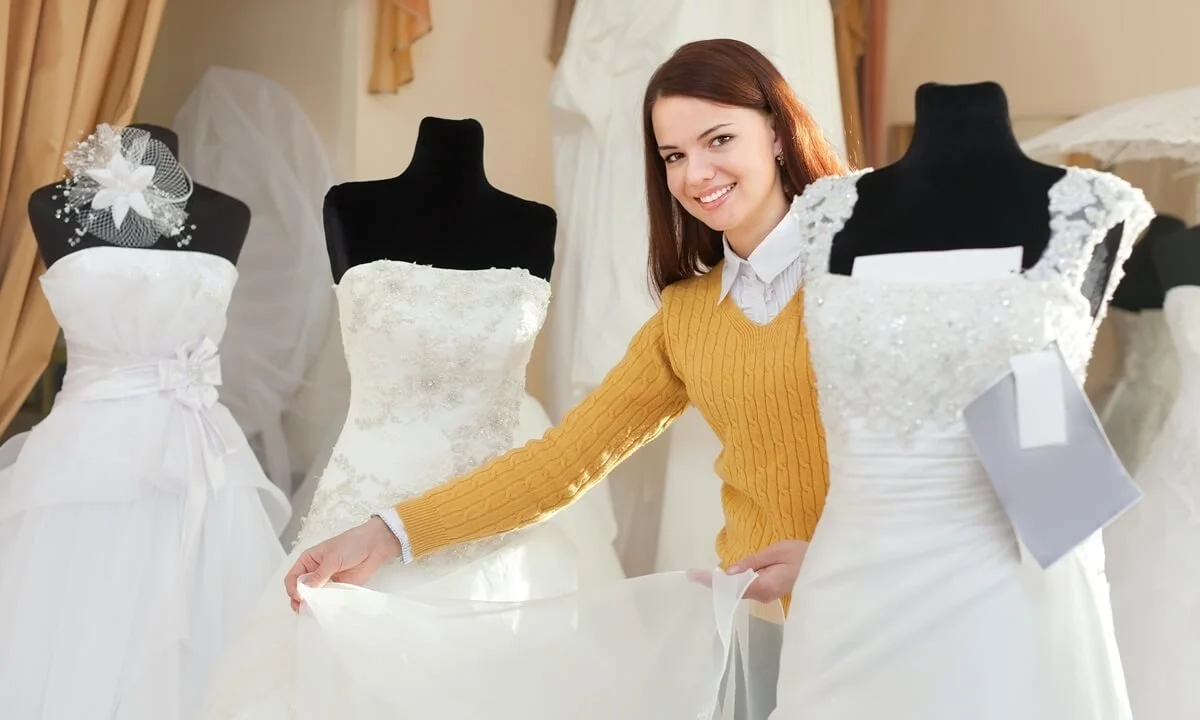
Train length is determined by three things: your venue, your silhouette, and how much you want to move at the reception. Sweep trains suit outdoor and casual venues. Court trains suit semi-formal settings. Chapel trains suit formal church ceremonies. Cathedral trains suit the grandest formal venues with long aisles. Royal trains are reserved for the most formal ceremonial occasions. At Estelle Bridal Houston, every custom gown train is designed for the specific bride's venue, silhouette, and movement needs - with a bustle option for every length.
Choosing the perfect custom wedding dress train length can be a challenging decision. The length of your wedding dress train will depend on several factors, including the style of your dress, the venue of your wedding, and your personal preference. This guide covers every major train type, what each one looks like in photographs, which venues and silhouettes each suits best, and how to make the decision that is right for your specific wedding.
At Estelle Bridal in Houston, the train conversation is one of the first design decisions made in a custom gown consultation - because the train choice shapes everything from fabric quantity to bustle design to alteration timeline. For the complete custom gown process, see our custom wedding dress design guide.
Key Observations
- Published train measurements contradict each other because the industry uses two different measuring conventions and almost nobody says which one they are using. A chapel train is about three to four feet from the waist and about twelve to eighteen inches past the hem. Both numbers are right.
- Measure your aisle before you choose a length. Processional length, and the width at the narrowest point between chair rows, decide more than formality does.
- Whether the train is cut into the skirt or attached at the waist changes what can be done to it later, including where a bustle can be anchored and whether the length can be shortened.
- Bustles are priced by attachment points, commonly around $7 to $50 per point, so a longer train costs more to bustle as well as more to hem.
- Bustles fail. Brides report broken buttons and torn loops regularly, and a wrist loop or a handful of safety pins as a backup is sensible rather than pessimistic.
- Whoever will bustle you on the day should attend your final fitting and practice it. Take a video on your phone while they do.
How to Choose the Right Train Length
1. Consider Your Wedding Venue
The length of your wedding dress train should be suitable for your wedding venue. If you are getting married in a ballroom or cathedral, you may want a longer train that will trail behind you as you walk down the aisle. The smooth floor and wide aisles of formal indoor venues allow longer trains to display correctly and be photographed at their full visual impact. However, if you are getting married on a beach, in a garden, or at an outdoor Houston venue, a shorter train or bustle system is more practical - longer trains collect debris on grass and gravel terrain and become difficult to manage without a designated attendant. For the complete venue guide covering every setting across Houston, see our Houston venue dress guide.
2. Think About the Style of Your Dress
The style of your wedding dress can also help you determine the length of your train. If you are wearing a more traditional, formal gown - a ball gown or a heavily structured mermaid - a longer train adds the visual grandeur that suits the silhouette's formality level. If you are wearing a shorter, more casual dress or a lightweight A-line for an outdoor setting, a shorter train or sweep train is more appropriate and proportionally balanced. For the complete silhouette guide, see our wedding dress silhouettes guide.
3. Consider Your Personal Style
Your personal aesthetic is an important factor when choosing train length. If you prefer a classic, timeless look and want maximum processional drama, a longer train produces the most visually powerful bridal photograph. If you are more modern, minimalist, or comfort-focused, a shorter train or no train gives you a cleaner, more contemporary result while still creating a distinctly bridal look.
4. Consider the Practicality
The length of your wedding dress train should be practical for the full scope of your wedding day - not just the ceremony processional. If you are going to be dancing and moving freely at the reception, a shorter train or a bustle that lifts the train after the ceremony is essential. A bustle allows a longer cathedral or chapel train to be secured up behind the gown for the reception so the bride has full freedom of movement without the train dragging. At Estelle Bridal, every custom gown with a train is fitted with a bustle designed and tested during the alteration process. For the full bustle and alteration process, see our wedding dress alterations guide.
5. Try on Different Lengths
The best way to determine the perfect wedding dress train length is to try on dresses with different train lengths at your bridal appointment. This gives you a direct sense of what each length looks and feels like when you walk, how it photographs, and how comfortable you are managing it. For preparation tips for your first appointment, see our first bridal appointment guide.
The Five Main Train Lengths: What Each One Does
Sweep Train
A sweep train is the shortest train style, extending only a few inches behind the gown and typically falling between the ankle and the floor. It creates a gentle, flowing effect as the bride moves without the management demands of a longer length. Sweep trains are an excellent option for brides who want a touch of elegance without the inconvenience of a longer train. They are ideal for outdoor or beach weddings where a longer train might collect debris, and they suit A-line, sheath, and ball gown styles equally well.
A shorter dress with a sweep train creates a fun, playful look. A longer gown with a sweep train adds a touch of sophistication while remaining practical across the full wedding day. The sweep train is also the most popular choice for Houston outdoor spring and autumn ceremonies where practical comfort is as important as visual elegance.
Court Train
A court train extends approximately one and a half feet behind the gown - longer than a sweep train but shorter than a chapel. It is a classic and elegant option for brides who want a moderate-length train that creates a visible trailing effect without being cumbersome to manage. The court train is a great option for traditional or semi-formal weddings where a long train is appropriate but a full chapel or cathedral length is not required.
Court trains pair naturally with ball gowns and A-line silhouettes and can come in simple, understated versions or more embellished designs. A shorter gown with a court train creates a chic, modern look. A longer gown with a court train adds a touch of regal elegance without the full visual weight of a longer train length.
Chapel Train
A chapel train extends approximately three to four feet behind the gown, creating a more dramatic and formally grand effect. It is one of the most popular formal train lengths because it creates a beautiful processional visual in the church aisle without the extreme management demands of a cathedral or royal train. Chapel trains suit formal or traditional weddings and can be incorporated into ball gowns, sheath dresses, A-line gowns, and mermaid silhouettes.
Chapel trains are typically made from luxurious fabrics - satin, lace, or tulle - and can be embellished with beading, embroidery, or lace applique to add additional visual richness. For Houston church ceremonies with wide central aisles, the chapel train creates a photograph of genuine grandeur at the processional without overwhelming the practical management of the bridal party.
Cathedral Train
A cathedral train extends approximately six to eight feet beyond the edge of the dress, creating the most dramatically grand of the standard bridal train lengths. It is the most photographically powerful train choice - in the processional photograph taken from the rear of a large church, a cathedral train creates a sweeping visual that fills the aisle and reads as truly grand at every distance.
Cathedral trains require a large church or ballroom with sufficient aisle length to display correctly. On a shorter aisle, a cathedral train bunches rather than sweeps. They also require a dedicated attendant - typically the maid of honor - to arrange and manage the train during the ceremony. A bustle is strongly recommended for the reception to lift the train and allow full freedom of movement. The cathedral train suits ball gowns and A-line silhouettes best because the volume of the skirt provides the visual foundation that a very long train needs to look proportional.
Royal Train
A royal train is the longest type of wedding dress train, typically extending six or more feet beyond the gown - sometimes significantly more. It is a dramatic and regal option reserved for the most formal and ceremonial weddings. The royal train is inspired by the long trains worn by royalty and is associated with weddings of exceptional formality and scale.
Because of its extreme length, the royal train is best suited for very large indoor venues with long ceremonial aisles and sufficient floor space. It requires multiple attendants to carry and arrange. For most Houston brides, the cathedral train provides all the visual grandeur of the royal train in a more manageable length. The royal train is a stunning and unforgettable choice for brides whose wedding is designed specifically around maximum visual impact at a very formal scale.
Train Length by Venue Type
Fabrics for Wedding Dress Trains
The fabric choice for a train affects how it falls, how it photographs, and how it moves as the bride walks. Lightweight fabrics - chiffon, soft tulle, and lightweight crepe - create trains that flow and move with the bride. Heavier fabrics - duchess satin, mikado, and heavily embellished lace - create trains that hold their shape more precisely and photograph with more structural grandeur. For the complete fabric guide covering every option by silhouette and venue, see our wedding dress fabrics guide.
Why Do Published Train Measurements Disagree So Much?
If you have read three articles on train lengths and got three different numbers for a chapel train, you are not misremembering. The published figures genuinely contradict each other, and there is a reason for it that nobody explains.
There are two measuring conventions in circulation:
- From the waist. The train is cut from the waist seam, so this is how a maker thinks about it. It includes the vertical drop from your waist to the floor, which is roughly three to four feet before any train begins.
- Past the hem. How far the fabric trails along the floor behind you. This is how it looks in a photograph and how a venue experiences it.
The same train produces very different numbers depending on which is used. A chapel train is around three to four feet measured from the waist, and around twelve to eighteen inches measured past the hem. Both figures appear in print, neither is wrong, and almost no page says which one it means. One well-known bridal brand publishes both figures for the same length on the same page, which is how a bride ends up with a five-fold discrepancy in her notes.
So when a boutique quotes you a train length, ask one question: from the waist, or past the hem? The table below gives both.
Wedding Dress Train Lengths, Measured Both Ways
| Train | From the waist | Past the hem | What it suits | Bustle needed |
|---|---|---|---|---|
| Sweep, also called brush | Just past floor length | 6 to 12 inches | Outdoor, civil, second weddings, anywhere you will walk a lot | Often none. A wrist loop is usually enough |
| Court | Not usually quoted this way | 1 to 2.5 feet | Garden and outdoor ceremonies wanting a little drama | Simple, one to three points |
| Watteau | Attaches at the shoulders or upper back, so it is not measured from the waist at all | Varies from floor length to cathedral | A dramatic back without weight at the waist | Usually detaches rather than bustles |
| Chapel | 3 to 4.5 feet | 12 to 18 inches | The most common choice. Church, ballroom, most formal weddings | Yes, commonly three to six points |
| Semi-cathedral | 4 to 5 feet | Roughly 1.5 to 2 feet | Formal weddings wanting more than chapel without cathedral management | Yes, commonly five to eight points |
| Cathedral | 6 to 8 feet | Roughly 3 to 5 feet | Long aisles, cathedrals, grand ballrooms, formal evening weddings | Yes, often a multi-point under-bustle |
| Royal, also called monarch | 10 feet or more | 6 feet or more, sometimes far more | The most ceremonial occasions only | Yes, and often a detachable option instead |
| Detachable train | Any of the above, then removed | Any of the above, then removed | Brides who want drama for the ceremony and freedom afterwards | No. It comes off instead |
| Overskirt | A separate layer worn over the gown | Usually chapel to cathedral | Two looks from one gown | No. It comes off instead |
For scale, two reference points the whole industry agrees on: Princess Diana's 1981 gown had a twenty-five foot train, and Kate Middleton's in 2011 was about nine feet. Diana's is roughly double a royal train and is not a useful benchmark for anything except perspective.
How Do You Match Train Length to Your Venue?
Formality gets all the attention here and the venue's actual dimensions matter more. A cathedral train in a short garden aisle spends the entire processional dragging across chair legs, and a chapel train in a long nave disappears.
How to Measure Your Aisle in Five Minutes
Every article tells you to consider the aisle. None of them tells you how. Do this at your venue walkthrough.
- Pace the processional length. From where you will enter to where you will stand. A normal adult stride is roughly two and a half feet, so count paces and multiply, or use a tape if you want to be exact. Write the number down.
- Measure the width at the narrowest point. Not the middle of the aisle. The narrowest gap between two chair rows, or between the ends of two pews. This is the number that decides whether a full skirt plus a train will catch on the way past.
- Note the floor surface and any change of surface. Aisle runner to grass, tile to carpet, indoor to outdoor. Transitions are where a train snags.
- Count the steps. Including the single step up to an altar, which is the one everyone forgets and the one a train catches on most often.
- Photograph the whole route. From the entrance, looking forward. Show it to your stylist at the fitting.
Then use the rule of thumb: your train should be no more than about a fifth of your processional length. A hundred foot nave carries a cathedral train beautifully. A twenty foot aisle in an intimate chapel does not, and a chapel or court train will look considered rather than crowded. If the narrowest point is under about four feet, size down a length regardless of what the formality of the wedding suggests.
What a Train Does on Grass, Sand, Gravel, Stone and Stairs
| Surface | What happens | Longest length we would recommend |
|---|---|---|
| Polished wood or carpet indoors | Nothing. Trains are designed for this | Any, up to royal |
| Stone or tile | Dust and grit mark a light hem, and grout lines catch fine lace | Cathedral |
| Manicured lawn, dry | Clippings and dust along the edge. Manageable | Chapel, or semi-cathedral with someone carrying it |
| Damp or dewy grass | Wicks moisture several inches up, and a wet train gets heavy and stays heavy | Court or chapel |
| Gravel or crushed shell | The worst surface for lace and tulle. It snags and pulls threads rather than just dirtying them | Sweep, or a detachable train removed before you walk it |
| Sand | Fills, drags and doubles the effective weight | Sweep, or none |
| Brick or flagstone courtyard | Uneven joints catch a hem, and it is a trip risk for whoever is behind you | Chapel |
| Stairs, and the step up to the altar | The single most common snag point. Going down is riskier than going up | Any length, but someone must lift it. Walk it once at the rehearsal |
If your ceremony and reception are on different surfaces, choose for the ceremony and bustle before you move. And if there is a step up to the altar, decide in advance who lifts the train and practice it at the rehearsal, because it is otherwise improvised in front of everyone.
Does Your Height and Silhouette Change the Right Train Length?
Yes, and the mechanism is simple proportion: a train of a given length reads longer on a shorter bride and shorter on a taller one, because the eye compares it to the rest of you.
| What to know | Where to land | |
|---|---|---|
| Petite | A cathedral train can look like it is wearing you, and the weight is proportionally greater | Chapel is usually the sweet spot. Semi-cathedral works with a lighter fabric |
| Average height | Every length works. The venue decides | Chapel or cathedral, by aisle length |
| Very tall | A short train can look like an accident rather than a choice | Semi-cathedral or cathedral. Skip sweep unless the setting is casual |
| Plus size | Train length is not a size question at all. What matters is the weight hanging from the waist seam and how the bodice is anchored | Any length, with proper internal structure and a well-placed bustle |
| Ball gown | Volume plus length is a lot to manage, and the bustle will need more points | Chapel or cathedral, and budget for the bustle |
| Fitted or mermaid | The train is the only movement in the silhouette, so it carries more of the drama | Chapel or longer, and check you can still take a stair |
| Sheath or slip | A long train fights the simplicity | Sweep or court, or a detachable train for the ceremony |
One practical note for petite brides that nobody mentions: train weight is absolute, not proportional. A cathedral train in heavy satin weighs the same whoever is wearing it, and it hangs from your waist for the whole day. If you love the length, ask for it in a lighter fabric rather than accepting a shorter train.
Is the Train Cut Into the Skirt, or Attached?
This distinction appears on no bridal website we could find, and it decides more about what happens next than the length does. There are two ways a train exists on a gown.
| Cut into the skirt | Attached at the waist | |
|---|---|---|
| What it is | The skirt panels themselves are cut long at the back, so the train is part of the same fabric | A separate piece seamed or fastened at the waist or upper back |
| How it drapes | Continuous. No break in the line, which is why it photographs as one sweep | A visible transition, which can be a design feature or a problem depending on the gown |
| Where the weight hangs | Distributed through the skirt seams | Concentrated at the attachment point, which is why a heavy attached train pulls at the waist |
| Bustle options | More flexible. Points can be anchored into existing seams | More constrained. The anchor has to work with the attachment |
| Can the length be changed? | Shortening is possible but it is not reversible, and it changes the whole skirt line | Often much easier, and sometimes the train can simply be swapped or removed |
| Alterations cost | Higher for length changes, because the skirt is being re-cut | Usually lower for length changes |
Ask which one your gown has at the first fitting, before anything is decided. If you suspect you may want to shorten the train later, or convert it to detachable, that conversation is much easier on an attached train and much more expensive on one cut into the skirt.
What Is a Bustle, and Which Type Do You Need?
A bustle lifts the train off the floor for the reception, using ties, buttons, hooks or loops sewn into the gown. Which type suits you depends on the fabric, the silhouette and how much fabric there is to lift.
| Bustle | How it works | Best for | Points | Typical cost |
|---|---|---|---|---|
| American, also called over-bustle | The train is lifted and fastened on top of the skirt with buttons or hooks | Most gowns. The workhorse | 1 to 5 | About $90 to $150 |
| French, also called under-bustle | The train is tucked underneath and tied from below, so the fastening is invisible | Ball gowns and layered skirts, and anywhere buttons would show | 3 to 15 or more | About $150 to $200, more on many points |
| Ballroom | The train is lifted so the hem sits level all the way round, as if there were no train | Brides who want the train to disappear completely | Many | About $150 to $300 |
| Austrian | A drawstring gathers the fabric vertically up the center back | Soft, unstructured fabrics | Gathered, not pointed | About $150 to $400 |
| Royal | A multi-point under-bustle built for a very long train | Cathedral and royal trains | Many, often 15 or more | About $300 to $400 and up |
| Bow | The gathering is finished with a sash or bow as a feature | Gowns where the bustle should look deliberate | Few | About $150 to $275 |
| Wristlet or wrist loop | A loop you carry the train with, rather than a bustle at all | Light, short trains, and as a backup to a real bustle | 1 | About $50 to $100 |
Those price ranges are drawn from published US bridal alterations pricing, including Moonlight Bridal's bustle guide and BrideAtlas's 2026 alterations breakdown. Houston pricing sits inside them.
How Many Bustle Points Will Your Train Need?
Nobody publishes the relationship between train length and point count, and it is the thing that determines both the cost and how long you will stand there at the reception.
| Train | Typical points | Roughly what that costs | Roughly how long to fasten |
|---|---|---|---|
| Sweep | 0 to 1, often a wrist loop instead | $50 to $100 | Seconds |
| Court | 1 to 3 | $30 to $100 | Under a minute |
| Chapel | 3 to 6 | $100 to $200 | One to two minutes with one person |
| Semi-cathedral | 5 to 8 | $120 to $250 | Two to four minutes |
| Cathedral | 8 to 15 | $200 to $400 | Five to ten minutes, easier with two people |
| Royal | 15 or more | $300 to $400 and up | Eight to fifteen minutes, realistically two or three people |
Those timings are grounded in what brides actually report: around six points takes about a minute for one experienced person, and around fifteen points has taken three people roughly eight minutes. Published bridal-attendant guidance puts the general range at five to fifteen minutes. Budget the time into your schedule rather than discovering it during cocktail hour.
What Does a Bustle Cost?
Bustles are priced by attachment points rather than by the hour, which is why the same bustle costs very different amounts on different gowns. Published US rates run roughly $7 to $50 per point, with a common structure being a base price for the first few points and a per-point rate after that. One documented example: fifty dollars for the first three points and seven dollars per point after, so a five-point bustle comes to sixty-four dollars.
Two things push the price up: hand-sewing, which lace, beading and delicate fabrics require, and layers, because every layer of a full skirt has to be lifted and anchored. Overall published ranges land at roughly $75 to $350 for most gowns, with elaborate multi-layer work reaching $400 or more. Expect the upper end for a cathedral train in a heavily embellished fabric.
Ask for the quote by point count, not as a single figure, so you can see what you are paying for. And decide the bustle style at your first alterations appointment rather than the last, because it affects how the gown is finished.
How Long Does It Take to Fasten, and Who Should Learn It?
Two rules, both widely agreed among bridal professionals and both routinely skipped.
- You will not be able to bustle yourself. Nominate one person, usually the maid of honor or your mother, and make it their job. Not "whoever is around".
- That person should come to your final fitting. Every gown's bustle is different, and reading a diagram on the day does not work. Have them do it twice while the seamstress watches.
- Record a video on your phone while they practice. This costs thirty seconds and it is the single most useful thing on this page.
- Teach a second person too. The first one will be in photographs when you need them.
- Decide when it happens. Most brides bustle straight after the ceremony or at the start of the reception. Pick one, tell your planner, and build ten to fifteen minutes into the schedule for a long train.
What Goes Wrong With Bustles on the Day?
More than the industry admits. Read enough bride discussion and a clear pattern emerges: bustles break, and often. Buttons pop off, loops tear at the seam, and guests step on trains all evening whether they are bustled or not.
Plan for it rather than hoping:
- Ask for a wrist loop as well as a bustle. It costs very little, it is invisible when not in use, and it is what you will be glad of if a button goes at nine in the evening.
- Put safety pins in the emergency kit. A handful of white or clear ones. Brides describe them as the actual fix far more often than anything else.
- Ask your seamstress to reinforce the anchor points. Failures happen at the seam, not in the middle of the fabric, and reinforcement is cheap when it is done at the fitting.
- Know the failure mechanism. Uneven placement pulls unevenly, which makes the train sag on one side and tears delicate fabric at the seam. If it looks lopsided when it is first bustled, say so then rather than living with it.
- Accept that it will be stepped on. A bustled train still sits behind you on a crowded floor. That is normal and it is an argument for a lighter fabric or a detachable train, not for skipping the bustle.
Bustle or Detachable Train? A Costed Comparison
Both options appear on every bridal site and nobody compares them. Here is the comparison.
| Bustle | Detachable train or overskirt | |
|---|---|---|
| Typical cost | About $75 to $400, by point count | About $300 to $600 for the piece, plus roughly $50 to $150 of alterations |
| Time on the day | One to fifteen minutes, depending on points | Seconds. You unhook it and hand it over |
| Can it fail? | Yes. Broken buttons and torn loops are common | Rarely, and a failure just means it comes off |
| Needs a trained helper? | Yes, ideally two | No |
| Reception silhouette | Gathered fabric at the back, which some brides love and some do not | Clean. The gown reads as it was designed underneath |
| Can you put it back on? | Not really, once bustled | Yes, in seconds, for photographs later |
| Best for | Chapel and semi-cathedral trains on most gowns | Cathedral and royal trains, and brides who want two distinct looks |
The honest summary: for a chapel train, a bustle is cheaper and entirely normal. For a cathedral or royal train, run the numbers, because a detachable train often costs about the same all-in, takes seconds instead of ten minutes, and cannot break.
What Does a Train Do to Your Photographs?
Everyone says trains photograph beautifully and nobody says what it actually costs you in the schedule or which shots it makes possible.
- What it buys you. The overhead shot with the train fanned out, the shot from behind on a staircase, the long-lens processional, and a full-length portrait with real depth. None of those exist without a train.
- What it costs you. Time. Published guidance suggests adding roughly ten to fifteen minutes to a portrait block for a chapel or cathedral train, plus around ten minutes for every car transfer, because it has to be arranged each time.
- Somebody has to arrange it. A train does not fall into position on its own. Your photographer will fan it, and every time you move it needs doing again. This is normally your maid of honor's job and it is worth saying so in advance.
- Tell your photographer at the planning call. Train length changes which locations work and how they schedule. A cathedral train in a narrow location is a wasted hour.
- Get your train shots before the reception. Once it is bustled it is bustled, and a dirty hem photographs.
How Does a Train Affect the First Dance and the Reception?
Absent from every train guide we read, and it is the part of the evening where a train is most in the way.
- Bustle before the first dance, not after. A dip or a spin with an unbustled train is how trains get torn, and your partner will step on it.
- Even bustled, there is fabric behind you. On a full dance floor people will still step on it. A French under-bustle sits tighter to the body than an American over-bustle and is the better choice if dancing matters.
- A father-daughter dance involves more turning than you expect. Practice one turn in the bustled gown at your final fitting.
- Check you can sit at the top table. A bustled train gathers at the small of the back, and against a chair back that can be uncomfortable for a two-hour dinner.
- Decide your bustle moment and tell the planner. Straight after the ceremony keeps you free for everything else. At the start of the reception keeps the train for the receiving line and the photographs.
What Does a Train Add to the Alterations Bill?
A train affects three lines on the bill at once, and it is worth seeing them together before you choose a length.
| Line | Typical range | How the train changes it |
|---|---|---|
| Hem, simple single layer | $70 to $150 | A train adds fabric to finish, and a shaped hem takes longer than a straight one |
| Hem, multi-layer with lace, chiffon or tulle | $200 to $450 | Every layer of the train is hemmed separately |
| Bustle | $75 to $400 and up | Priced by point count, so longer trains cost more |
| Shortening a train | Quoted case by case | Possible but not reversible, and more expensive on a train cut into the skirt |
| Whole standard alterations package | $350 to $800 nationally, $300 to $1,200 in Houston | A long embellished train pushes you toward the upper end |
| Rush work | Adds 25 to 50 percent | Bustles are labor-heavy, so rushing one is expensive |
Book your first alterations appointment no later than about three months before the wedding, and raise the bustle at that first appointment rather than the last. Our full wedding dress alterations guide has every line item with Houston ranges.
How Do You Clean and Preserve a Gown With a Train?
No train guide anywhere mentions this, and a train is the part of the gown that gets dirtiest by a wide margin. It has spent the day on floors you did not choose.
- Take it in within three to four weeks. This is the standard professional recommendation and it matters because of the next point.
- The stains you cannot see are the problem. Sugar, sweat and oils are often invisible at first and oxidize into brown marks over months. A hem that looks fine in the car may not look fine in a year.
- Expect to pay for it. Published US figures put cleaning alone at roughly $200 to $300, and cleaning plus preservation commonly at $250 to $700, reaching $1,000 for some gowns. The process typically takes four to six weeks.
- Tell the specialist where it was worn. Grass, sand and gravel each leave different residue, and a cleaner who knows what is on the hem treats it differently.
- Photograph the hem before you hand it over. Useful if anything is disputed later, and useful for your own expectations.
So How Long Should Your Train Be?
Work down this table and stop at the first row that applies to you.
| If this is true | Choose | Why |
|---|---|---|
| Ceremony is on sand, or on gravel or crushed shell | Sweep, or a detachable train | These surfaces damage a train rather than just dirtying it |
| Aisle is under about twenty feet, or narrower than four feet at its tightest | Court or chapel | A long train in a short aisle drags on chair legs the whole way |
| Ceremony is outdoors on grass and you want drama | Chapel, in a lighter fabric | Enough presence, and it will not soak through and turn heavy |
| Church or ballroom, long aisle, formal evening wedding | Cathedral | This is exactly what the length was designed for |
| You want the processional to be the moment, and you have the aisle for it | Cathedral or royal, with a detachable option | Maximum impact, and you are free for the reception in seconds |
| You are petite and unsure | Chapel | The reliable sweet spot. Semi-cathedral in a light fabric if you want more |
| You are very tall | Semi-cathedral or longer | A short train can read as an accident on a tall frame |
| Your gown is a simple sheath or slip | Sweep, or a detachable train | A long train fights the simplicity of the design |
| Dancing all night matters more than the aisle | Chapel with a French bustle, or detachable | Both keep the fabric close and out of the way |
| You are not sure and nothing above applies | Chapel | It is the most common choice for a reason. It works almost everywhere |
And one rule worth carrying into the appointment: choose the length for the ceremony, then solve the reception with a bustle or a detachable train. Brides who do it the other way round end up with a train that photographs as an afterthought.
What Estelle Bridal Brides Say
★★★★★ Katrina Banks, Google Review, 4 months ago
"Blessing and her team were amazing!!! They were attentive, pleasant and professional. I took the picture of a dress to Estelle Bridal and they knocked it out the park. Highly recommend ❤️"
Why Choose Estelle Bridal for Your Custom Wedding Dress Train in Houston
Train length designed for your specific venue and silhouette. Every custom gown consultation at Estelle Bridal includes a specific train length discussion based on the bride's venue, the ceremony aisle length, and the silhouette chosen. The train is not a generic addition - it is a structural design decision that shapes the entire gown.
Bustle engineered for every train length. Every custom gown with a train at Estelle Bridal includes a bustle designed and tested during the fitting process. Every bride is shown exactly how to secure and release the bustle before the wedding day so the transition from ceremony to reception is seamless.
Custom fabric matching for the train. For brides who want the train fabric to match or complement a specific lace, embellishment, or fabric used on the gown itself, Estelle Bridal sources and matches the fabric from the first pattern piece rather than adding a generic fabric extension after the fact.
Alterations included in every custom gown price. The complete fitting and bustle process from first appointment through final delivery is covered. No separate alteration bill. Black-owned, woman-owned Houston boutique since 2016. 4.8 stars, 300+ Google reviews. 2428 S Hwy 6, Houston TX 77077. (281) 208-7805. Browse the wedding gowns collection or book your appointment.
Book Your Custom Wedding Dress Consultation at Estelle Bridal Houston
Train length guidance for every venue. Custom fabric matching. Bustle included. Alterations included with custom gowns. Private appointments. Houston's Black-owned boutique since 2016.
Book an AppointmentFrequently Asked Questions
What is the most popular wedding dress train length?
Chapel train is the most popular formal train length because it creates a beautiful processional visual without the extreme management demands of a cathedral or royal train. For Houston outdoor ceremonies, the sweep train is the most popular practical choice. The right length depends on the venue, silhouette, and the bride's personal preference for visual drama versus practicality.
What is the difference between a chapel train and a cathedral train?
A chapel train extends approximately three to four feet beyond the gown. A cathedral train extends approximately six to eight feet or more. The cathedral train creates a more dramatically grand processional visual and requires a larger venue with longer aisles to display correctly. Both require a bustle for comfortable reception movement.
What train length is best for an outdoor wedding in Houston?
A sweep train or no train is most practical for outdoor Houston weddings. Grass, sand, uneven terrain, and outdoor debris make longer trains difficult to manage and can damage the fabric. If you want a longer look for the ceremony but need freedom at the reception, a bustle system on a court or chapel train is a practical solution. See our Houston venue dress guide for full venue-specific guidance.
Do I need a bustle if I have a train?
For any train longer than a sweep, a bustle is strongly recommended for the reception. A bustle secures the train up behind the gown, giving the bride full freedom of movement for dancing without dragging the train across the reception floor. At Estelle Bridal, every custom gown with a train is fitted with a bustle designed and tested during the alteration process. See our alterations guide for the full bustle process.
Which train length suits a ball gown?
A ball gown has the volume and formality to carry chapel, cathedral, or royal train lengths. Shorter trains can look visually lost against the dramatic volume of a full ball gown skirt. A cathedral train on a ball gown at a large Houston church ceremony creates one of the most powerfully grand bridal processional photographs in any silhouette. See our silhouettes guide for the full breakdown.
Can Estelle Bridal design a custom gown with any train length?
Yes. Every train length from sweep through royal is available as part of Estelle Bridal's custom gown design service. The fabric, embellishment, and bustle system for the train are all designed alongside the gown rather than added as afterthoughts. See our custom gown design guide for the full process.
Where can I try on wedding dresses with different train lengths in Houston?
Estelle Bridal at 2428 S Hwy 6, Houston TX 77077 carries wedding dresses across every major train length with custom design available. Open Tuesday, Thursday, Friday, and Saturday 10am to 5pm, and Wednesday and Sunday 1pm to 7pm. Browse the wedding gowns collection, book at estellebridal.com/book, or call (281) 208-7805. See our first appointment guide to prepare.
How long is a chapel train?
About three to four and a half feet measured from the waist, or about twelve to eighteen inches measured past the hem. Both figures are in common use and they describe the same train. The difference is the measuring convention, and most published guides do not say which one they are using, which is why the numbers online appear to contradict each other.
How long is a cathedral train?
Roughly six to eight feet from the waist, which works out to about three to five feet trailing past the hem. A royal or monarch train starts at about ten feet from the waist and goes up from there. For scale, Kate Middleton wore about nine feet in 2011 and Princess Diana wore twenty-five feet in 1981.
Why do wedding dress train measurements differ between websites?
Because there are two conventions and almost nobody labels which they use. One measures from the waist seam, where the train is cut from, and includes the three to four foot drop to the floor. The other measures how far the fabric trails past the hem. Ask any boutique which one they mean before you compare quotes.
How do I choose a train length for my venue?
Measure the processional length and the aisle width at its narrowest point between chair rows, note the floor surface and any steps including the one up to the altar, and keep the train to no more than about a fifth of the processional length. A hundred foot nave carries a cathedral train. A twenty foot aisle does not.
What does a bustle cost?
Bustles are priced by attachment point rather than by the hour, commonly around $7 to $50 per point, with most gowns landing somewhere between $75 and $400 overall. Hand-sewing on lace or beading and multiple skirt layers both push it up. Ask for the quote by point count so you can see what you are paying for.
How many bustle points does a train need?
Roughly by length: a court train one to three points, a chapel train three to six, a semi-cathedral five to eight, a cathedral eight to fifteen, and a royal train fifteen or more. A sweep train often needs no bustle at all and a wrist loop is enough.
How long does it take to bustle a wedding dress?
Published bridal-attendant guidance puts it at five to fifteen minutes, and brides report about a minute for six points with one experienced person and around eight minutes for fifteen points with three people helping. Build ten to fifteen minutes into your schedule for a long train.
Who should learn how to bustle my dress?
One named person, usually the maid of honor or your mother, plus a backup. They should attend your final fitting and practice it twice with the seamstress watching, and you should record a short video on your phone while they do it. Every bustle is different and a diagram does not work on the day.
Do bustles break?
Frequently enough to plan for. Brides regularly report popped buttons and torn loops, usually at the seam where an anchor point is stitched. Ask for a wrist loop as a backup, put white safety pins in the emergency kit, and ask your seamstress to reinforce the anchor points at the fitting.
Is a detachable train better than a bustle?
For a chapel train, usually not, because a bustle is cheaper and entirely normal. For a cathedral or royal train it is worth pricing, because a detachable train commonly runs about $300 to $600 plus $50 to $150 of alterations, comes off in seconds instead of ten minutes, cannot break, and can be put back on for photographs.
Does a train make alterations more expensive?
Yes, in three places: the hem has more fabric and often more layers, the bustle is priced by point count, and shortening a train is a separate job. Most Houston brides spend $300 to $1,200 on alterations overall and a long embellished train sits toward the top of that.
Can a wedding dress train be shortened?
Usually yes, and it is not reversible. How easy it is depends on whether the train is cut into the skirt or attached separately at the waist. An attached train is often straightforward to shorten or even remove. A train cut into the skirt means re-cutting the skirt, which costs more and changes the whole line. Ask which one your gown has at the first fitting.
Related Guides
| Read this next | What it covers |
|---|---|
| Wedding dress alterations guide | Every line item with Houston price ranges, including hems and bustles |
| Wedding dress silhouettes guide | Every silhouette explained, and which carry a train best |
| Walking, sitting and moving in a fitted gown | Movement technique, stairs, cars and the fitting checklist |
| What is a custom wedding dress | Process, cost, timeline and fittings for a made-to-measure gown |
| How the custom design process actually works | Consultation, sketch, pattern, muslin, fittings and handover |
| How much does a wedding dress cost in Houston | Honest price bands, what drives them, and the hidden extras |
| Wedding dress body type guide | Which silhouettes suit which proportions, and why |
| Your first bridal appointment | How the appointment runs, start to finish |
| What to bring to a bridal appointment | The checklist, including the shoes and underwear that change the fit |
| Book an appointment | Private appointments at 2428 S Hwy 6, Houston TX 77077 |
About the Author
Flo A. is the founder and lead designer of Estelle Bridal in Houston, TX. Since 2016, she has designed and fitted custom wedding dress trains across every length and fabric for Houston brides across every venue type, with particular expertise in matching train length to specific venue conditions, designing bustle systems for reception practicality, and calibrating train fabric weight to the overall gown silhouette and climate. Estelle Bridal is featured in Black Brides magazine and holds a 4.8-star rating across 300+ Google reviews.
Related guides: Wedding Dress Silhouettes Guide · Wedding Dress Fabrics Guide · Houston Venue Dress Guide · Custom Gown Design Houston · Wedding Dress Alterations Guide · Your First Bridal Appointment · Browse Wedding Gowns